

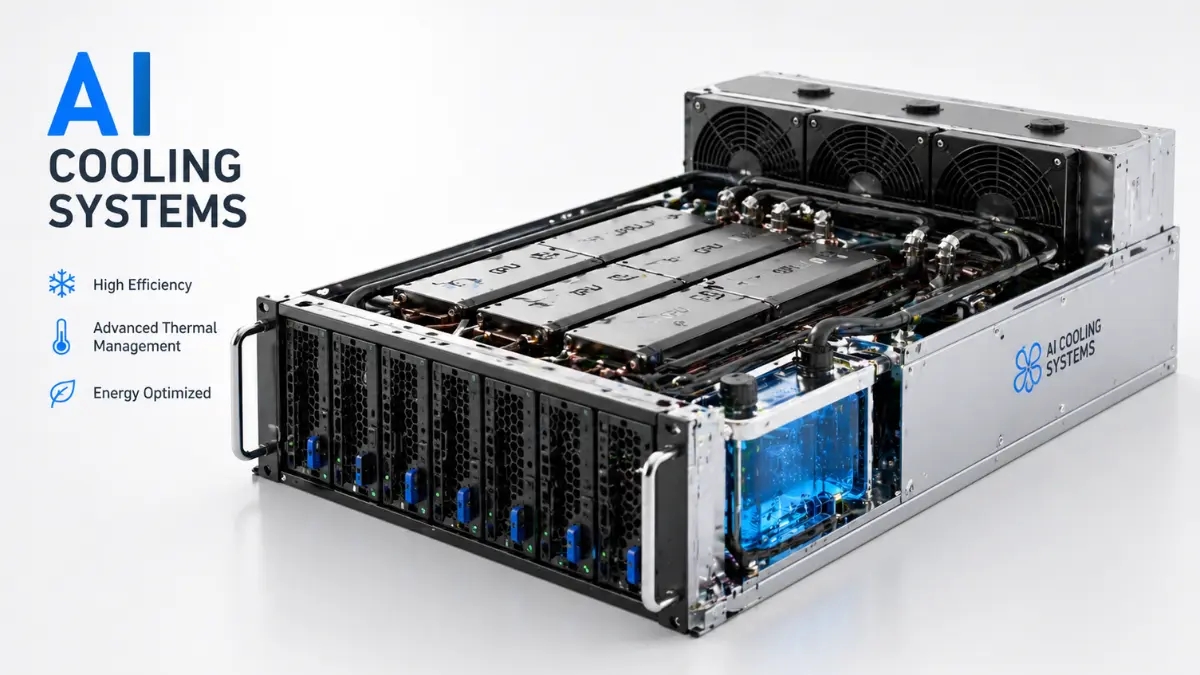
The AI gold rush of the early 2020s was defined by the frantic scramble for H100s and Blackwell GPUs. But as we move into the second quarter of 2026, the smart money has shifted its gaze from the chips themselves to the infrastructure keeping them from melting down. AI cooling systems have emerged as the definitive “pick-and-shovel” investment of the year, transforming from a niche facility expense into a mission-critical component of the $4 trillion AI economy.
The Thermal Wall: Why Air Cooling Failed
The physics of 2026 are unforgiving. Next-generation AI clusters now demand rack densities exceeding 120 kW, a figure that has rendered traditional air-conditioning units nearly obsolete. As a result, the global data center liquid cooling market is projected to skyrocket from $6 billion in 2026 to nearly $30 billion by 2033, representing a staggering 26.4% CAGR.
“We are hitting a thermal wall,” says an infrastructure lead at a major Northern Virginia hyperscaler. “You can no longer cool a 140 kW NVIDIA-powered rack with fans alone. It’s like trying to cool a jet engine with a desk fan. If you don’t have liquid AI cooling systems, you don’t have an AI data center.”
The Market Leaders: Cooling the Giants
While chipmakers face cyclical volatility, cooling providers are seeing record backlogs. Vertiv Group Corp. and Schneider Electric have dominated the headlines this year, with Vertiv’s stock climbing 32% year-to-date following the launch of their modular Coolant Distribution Units (CDUs).
In January 2026, Schneider Electric’s Motivair division unveiled the MCDU-70, a 2.5 MW cooling powerhouse designed specifically for high-density GPU workloads. Investors are increasingly looking at these firms as the true gatekeepers of AI capacity. For real-time performance tracking of the sector’s biggest movers, Bloomberg Markets provides a detailed breakdown of the industrial tech surge.
Why It Matters: Efficiency as a Competitive Moat
For investors and operators, the shift to advanced AI cooling systems isn’t just about hardware—it’s about the bottom line.
- PUE Optimization: Modern liquid systems can bring Power Usage Effectiveness (PUE) down to 1.05, compared to the 1.5 average of air-cooled sites.
- Regulatory Compliance: The European Commission’s new Data Centre Energy Efficiency Package, rolling out this quarter, mandates strict energy reporting. Facilities failing to meet efficiency benchmarks face significant “carbon penalties.” For more on these evolving standards, the European Commission’s Energy portal outlines the upcoming minimum performance requirements.
What Comes Next?
As we look toward the 2026 fiscal year-end, watch for three major trends:
- Immersion Cooling Adoption: The “fully submerged” server is moving from pilot to production in APAC markets.
- Retrofitting Goldmine: Older data centers are spending billions to swap air ducts for liquid manifolds to stay relevant.
- M&A Heat: Expect Tier-1 industrial firms to swallow boutique cooling startups to bolster their patent portfolios.
Strong Conclusion
In the 1849 Gold Rush, it wasn’t the miners who got rich—it was the people selling the shovels. In the AI era, the “shovels” are the systems that manage the heat. As power densities continue to climb, AI cooling systems are no longer a luxury; they are the baseline for the future of computing.
Read More: Agentic AI & The Robotics Convergence: Why 2026 is the Year the “Brain” Met the “Body”