


AI Arms Race: Why Cybersecurity is the New Frontline for OpenAI and Anthropic
The honeymoon phase with “general” AI is over. For three years, we marveled at bots that could write sonnets or generate vibrant art; today, that fascination has been replaced by a cold, high-stakes reality: code is the new battlefield. We have entered a high-stakes AI Arms Race where the prize isn’t creativity, but the very survival of the digital economy.
The launch of OpenAI’s GPT-5.4-Cyber on April 15, immediately followed by the release of Anthropic’s “Mythos,” marks the official end of the “chatbot era” and the dawn of the “agent era.” These are no longer mere assistants; they are specialized defensive systems designed to secure the digital bedrock of global commerce. This trend is exploding because the “dual-use” dilemma has finally come home to roost: the same intelligence that powers your productivity can, in the wrong hands, dismantle a Fortune 500 company’s infrastructure in minutes.
OpenAI’s Digital Bunker: The TAC Initiative
OpenAI isn’t just releasing a new tool; it’s building a fortress. The “Trusted Access for Cyber” (TAC) program is the blueprint for that transition. For years, the C-suite and security community viewed Large Language Models (LLMs) as a “black box”—capable of being leaked into the public training set or, worse, tricked into generating malicious exploits.
TAC is the industry’s response: a gated ecosystem designed specifically for verified security professionals and red teaming experts. Unlike the public-facing ChatGPT, GPT-5.4-Cyber under the TAC program operates with a higher degree of privilege and a much lower threshold for “false refusals” when analyzing malware. It allows defenders to feed the model live, zero-day threat data without fear of exposure. By creating this secure “digital bunker,” OpenAI is proving that AI can be the most reliable shield in a company’s arsenal.
Anthropic vs. OpenAI: A Clash of Security Philosophies
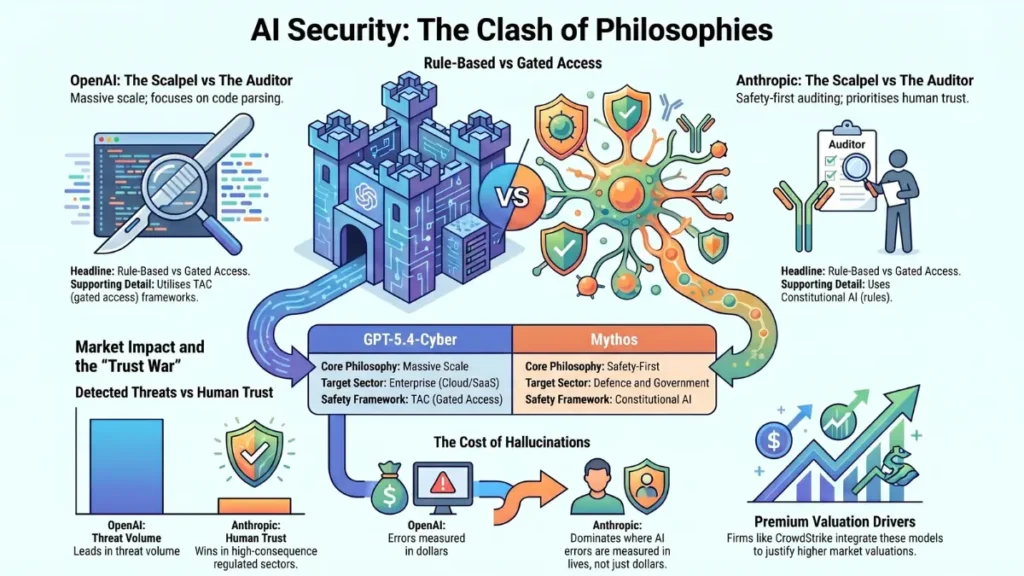
While OpenAI is building the bunker, Anthropic is focused on building the “Intelligent Immune System.” The rivalry between Anthropic Mythos and GPT-5.4-Cyber represents the two dominant philosophies in the current AI Arms Race.
| Feature | OpenAI GPT-5.4-Cyber | Anthropic Mythos |
| Core Philosophy | The Scalpel (Massive Scale) | The Auditor (Safety-First) |
| Primary Strength | Parsing billions of lines of legacy code | Resistance to social engineering |
| Target Sector | Large-scale Enterprise (Cloud/SaaS) | Highly Regulated (Defense/Gov) |
| Safety Framework | TAC (Gated Access) | Constitutional AI (Rule-based) |
Market analysts suggest that while OpenAI may win on the sheer volume of detected threats, Anthropic is winning the “trust war” in sectors where the cost of an AI hallucination is measured in lives, not just dollars. This has created a surge in cybersecurity stock performance, with firms like CrowdStrike and Palo Alto Networks increasingly integrating these models to justify their premium valuations.
Agentic Capabilities: Finding 3,000+ Vulnerabilities in Real-Time
The most impressive aspect of this new generation is their “agentic” nature. Previous models were passive; you asked a question, and it gave an answer. These new models are proactive. Last month, a mid-sized Silicon Valley fintech pitted an AI agent against its best human auditors. The result? The bot found a dormant SQL injection path in twenty minutes that three senior engineers had missed for two years.
Recent benchmarks show that specialized AI agents are now capable of identifying over 3,000 vulnerabilities in enterprise-grade software in real-time. This isn’t just scanning; it is autonomous penetration testing. These bots can identify and categorize critical risks, including:
- XSS (Cross-Site Scripting): Injecting malicious scripts into trusted websites.
- Buffer Overflows: Overloading memory to crash systems.
- SSRF (Server-Side Request Forgery): Forcing servers to perform unintended actions.
The Double-Edged Sword
This speed is a strategic necessity. As noted in the OpenAI Cybersecurity Grant Program updates, the integration of AI into defensive operations must outpace the creative use of AI by threat actors to maintain systemic stability.
The Hidden Threat: Adversarial Prompt Injection
Despite sophisticated firewalls, a new frontline has emerged: Adversarial Prompt Injection. As companies like Salesforce and Tesla integrate AI into their core operations, they open a new door for hackers. Injection occurs when an attacker “tricks” the AI by hiding commands inside seemingly innocent data. While simple “ignore previous instructions” traps have been patched, “indirect injections”—where the command is hidden on a website that the AI reads while browsing—remain a critical risk for 2026.
Strategic Takeaways for Business Leaders
- Agentic Integrity Score: Before deploying, audit your AI’s resilience against prompt injection.
- Human-in-the-Loop: AI finds the “needle in the haystack,” but humans must decide which haystacks are worth burning.
- CISA Compliance: Ensure your AI deployment matches the latest federal guidelines for secure software development.
FAQs
Q: Can GPT-5.4-Cyber be used for hacking?
While optimized for defense, the “dual-use” nature of AI means the same logic could find vulnerabilities for exploitation. This is why access is strictly gated through the TAC program.
Q: How does Mythos differ from standard Claude models?
Mythos is fine-tuned specifically for security audits and resilience against social engineering, rather than general conversation or creative writing.
Q: Will AI replace human security analysts?
Not entirely. It will replace the “drudge work” of scanning code, allowing human experts to focus on high-level strategy and incident response.
Conclusion
The AI Arms Race is no longer a futuristic concept; it is the current reality of the U.S. business landscape. For founders and investors, the takeaway is clear: cybersecurity is no longer a cost center—it is a competitive advantage. Washington’s attempt to “secure the core” has triggered an ironic backlash: by building a wall around the dollar, we’ve effectively locked the rest of the world out. The winners won’t be the companies with the smartest AI, but those with the most secure AI. In this new frontline, the goal isn’t just to be fast—it’s to be bulletproof.
Read More: The $852 Billion Bet: How Anthropic is Rewriting the Venture Capital Playbook