

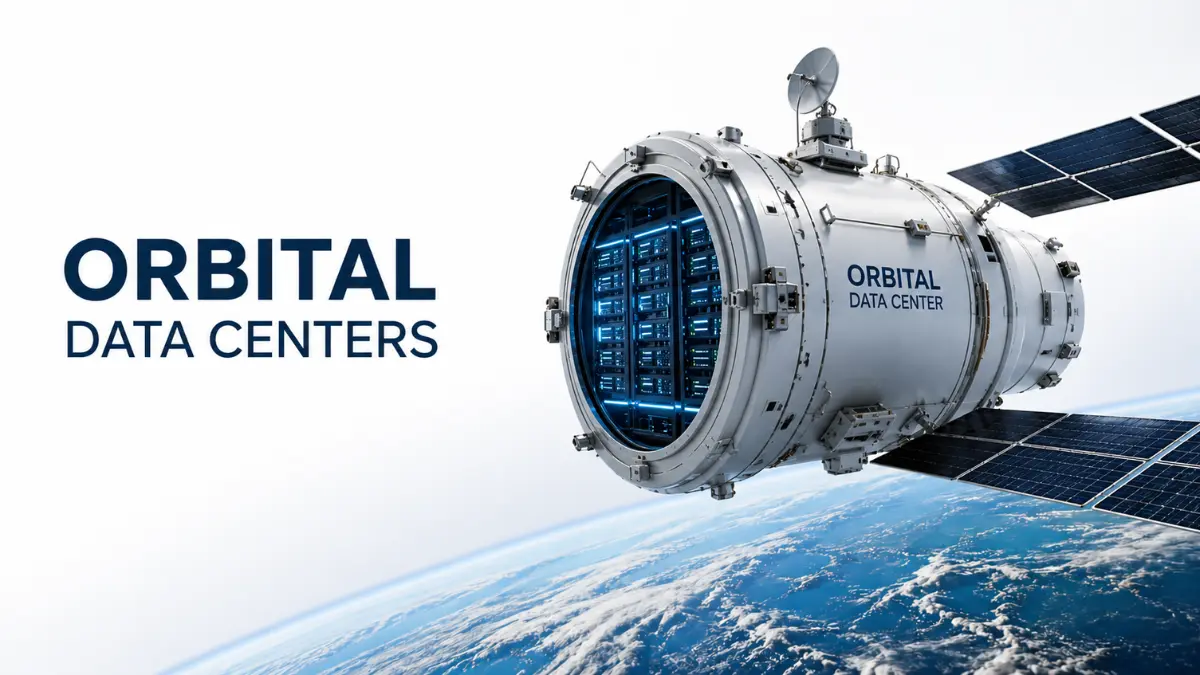
Orbital Data Centers: The New Multi-Billion Dollar Frontier for AI Infrastructure Investors
As terrestrial power grids buckle under the weight of generative AI, the tech industry is looking up—literally. Orbital data centers have officially transitioned from science fiction to a strategic asset class. Driven by the relentless compute demands of models like GPT-6 and Llama 5, investors are pouring capital into “off-world” infrastructure to bypass Earth’s mounting energy and permitting bottlenecks.
The $200 Million “Starcloud” Signal
The most definitive proof of this shift came this quarter when Starcloud, a leader in space-based compute, closed a $170 million Series A round at a $1.1 billion valuation. This landmark funding—the largest of its kind for the sector—highlights a growing consensus: the next generation of AI training and inference may not happen on the ground.
While a terrestrial 40-megawatt cluster can consume over 1 million tons of water annually for cooling, orbital data centers leverage the vacuum of space for passive radiative cooling. “We aren’t just moving servers; we’re moving the environmental and regulatory burden,” says Trevor Smith, CEO of Atomic-6, which recently launched ODC.space, a marketplace for orbital capacity.
Why Investors are Pivoting to LEO
The investment thesis for orbital data centers rests on three pillars of the “Space-AI Convergence”:
- Uncapped Solar Energy: In Low Earth Orbit (LEO), solar arrays achieve a capacity factor of over 95%, compared to just 24% for U.S. terrestrial farms. Starcloud estimates energy costs could be 15 times lower than wholesale Earth prices.
- Regulatory Speed: Building a gigawatt-scale data center in Virginia or Ireland can take a decade due to zoning and “Not In My Backyard” (NIMBY) opposition. Atomic-6 claims orbital nodes can be spec’d and deployed in 24–36 months.
- The “Vera Rubin” Effect: Nvidia CEO Jensen Huang recently confirmed the Space-1 Vera Rubin Module will be available for flight qualification by late 2027, providing the first GPU architecture specifically hardened for the radiation environments of space.
Market Players to Watch
The ecosystem is rapidly bifurcating into specialized tiers:
- Hyperscale Nodes: Axiom Space launched two free-flying orbital data center nodes in January 2026, aiming to provide “Compute-as-a-Service” tied to its future commercial space station.
- Edge & Relay: Kepler Communications currently operates the largest compute cluster in orbit—10 satellites equipped with Nvidia Orin processors linked via high-speed optical lasers.
- Sovereign Storage: Lonestar Data Holdings is targeting the “Data Sovereignty” market, with plans to launch its StarVault service in October 2026. Lonestar focuses on lunar data centers, offering air-gapped disaster recovery at the Moon’s South Pole.
According to data from Fortune Business Insights, the space-based data center market is projected to grow from $1.44 billion in 2026 to nearly $4 billion by 2034. However, more bullish analysts at Bloomberg Intelligence suggest that if AI inference migration accelerates, the market could hit $30 billion by 2035.
The Bottom Line for 2026
The “Green AI” movement is finding its greatest ally in the stars. By decoupling high-density compute from the terrestrial grid, orbital data centers offer a pressure valve for the $1.2 trillion AI infrastructure market. For investors, the risk has shifted from “Will it work?” to “Who will own the most bandwidth?”
As Nvidia prepares its space-rated silicon and SpaceX’s Starship continues to slash launch costs per kilogram, the orbital cloud is no longer a fringe bet—it is the inevitable destination for the AI revolution.
FAQ: Investing in the Orbital Cloud
What are the main risks?
Radiation-induced hardware failure (bit-flipping) and orbital debris remain the primary technical hurdles. However, Red Hat’s MicroShift and other containerized software are making “self-healing” orbital nodes more resilient.
Will this replace terrestrial data centers?
Unlikely. Expect a hybrid model where massive training runs remain on Earth (for now), while latency-sensitive “Space Edge” processing and high-security sovereign storage move to orbit.
Read More: Why Agentic Workflows Are Replacing RPA: The 2026 Office Revolution