


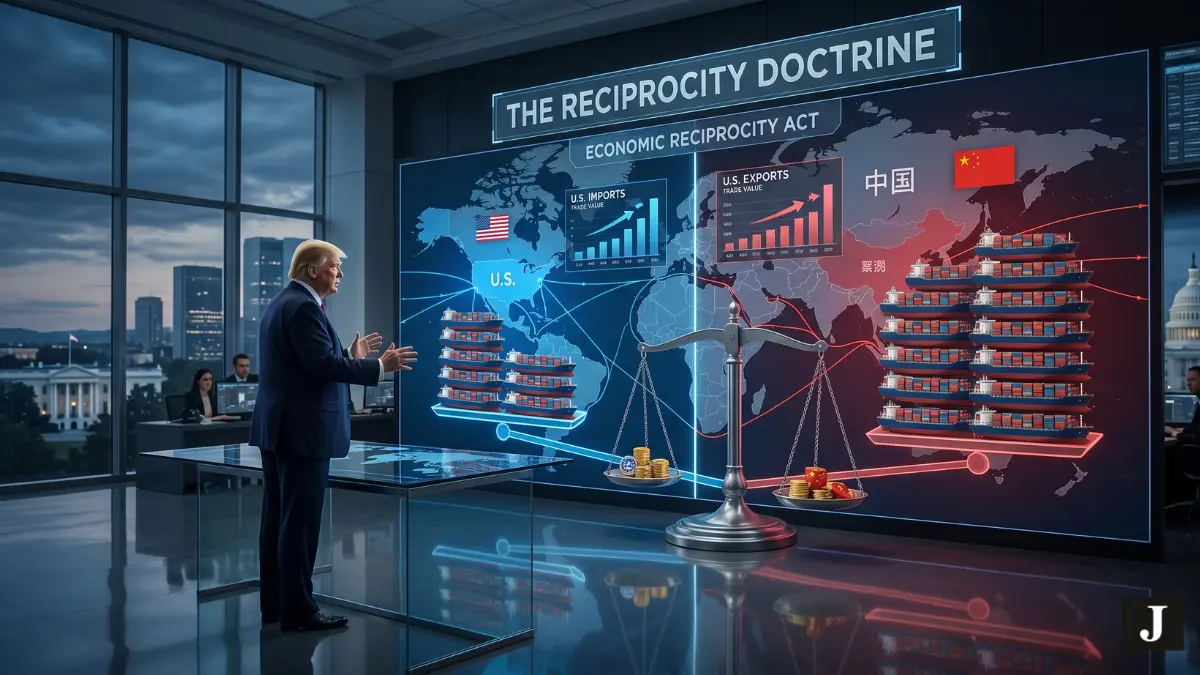
In a move that has sent shockwaves through global capital markets, Donald Trump has unveiled the Economic Reciprocity Act, a sweeping legislative proposal designed to fundamentally reset the terms of engagement between the United States and China. The act hinges on a simple, high-stakes premise: if a foreign nation imposes a tariff or barrier on U.S. goods, the United States will automatically respond with an identical measure. This “mirror-image” trade policy represents the most aggressive shift in American commercial diplomacy in nearly a century, targeting the long-standing $279 billion trade deficit with Beijing.
The Mechanics of Mirroring
The Economic Reciprocity Act operates on an algorithmic trade-defense mechanism. Under the proposed framework, the Department of Commerce would be mandated to maintain a real-time database of global trade barriers. For every percentage point of duty China levies on American agriculture or machinery, a reciprocal levy would be triggered against Chinese electronics or textiles entering U.S. ports. Unlike previous discretionary measures under Section 301 of the Trade Act of 1974, this new legislation aims to remove executive hesitation, making retaliation a matter of statutory law rather than political will.
2026 vs. 2018: A Harder Line
While the 2018 trade war was characterized by tactical skirmishes and “Phase One” agreements, the 2026 landscape is vastly different. Eight years ago, the focus was on forcing China to the negotiating table; today, the goal is structural decoupling. The 2018 tariffs averaged roughly 19% on targeted goods; the Economic Reciprocity Act could effectively see baseline tariffs on Chinese imports climb above 60% if reciprocal logic is applied to non-tariff barriers and subsidies. Investors are already pricing in this “new normal,” with the CBOE Volatility Index (VIX) spiking 12% following the announcement.
Winners and Losers: The Industrial Divide
The domestic impact of the Act is bifurcated. US Steel and other domestic industrial titans saw shares climb nearly 7% in pre-market trading, as the act promises a protected environment for high-cost American smelting and manufacturing. Conversely, retail and tech behemoths are bracing for a margin squeeze. Walmart, which relies on a vast network of overseas suppliers to maintain its “Everyday Low Price” promise, faces an estimated 4-6% increase in COGS (Cost of Goods Sold). Apple is similarly exposed; despite its ongoing efforts to move assembly lines, the vast majority of its hardware ecosystem remains geographically tethered to the Pearl River Delta.
The Near-Shoring Gold Rush
Perhaps the most significant byproduct of the Act is the accelerated “near-shoring” boom. With the Chinese route becoming prohibitively expensive, capital is flowing into Mexico and Vietnam at a record pace. Foreign Direct Investment (FDI) into Mexico’s manufacturing sector hit a record $42 billion in the last fiscal year, as firms scramble to qualify for USMCA tariff exemptions. Vietnam has similarly seen a 15% CAGR in electronics exports, positioning itself as the primary alternative for “China Plus One” strategies.
What Comes Next
The proposal now moves to a divided Congress, where the debate will center on inflationary risks versus national security. Market analysts at Goldman Sachs warn that a full implementation could add 0.8% to headline CPI by 2027. Investors should watch the upcoming Q2 earnings calls for major retailers, where management is expected to provide revised guidance based on “Reciprocity” scenarios. For the global supply chain, the era of frictionless trade is officially over; the era of mirrored barriers has begun.