


The 2026 Energy Crisis: Why the U.S. is Forced to Balance Sanctions with Survival
On the morning of April 18, 2026, the global energy landscape shifted from a simmer to a boil. With Iran threatening the immediate closure of the Strait of Hormuz—the world’s most vital oil artery—the White House made a move that few saw coming but many feared necessary. President Trump issued an emergency 30-day waiver allowing maritime purchases of sanctioned Russian oil.
The ink on the waiver hadn’t even dried before the markets signaled their verdict: the dream of a “clean” energy supply chain is dead, replaced by the grim necessity of keeping American lights on. This decision marks a definitive turning point in the 2026 Energy Crisis, a moment where geopolitical idealism has officially collided with the cold, hard reality of domestic survival.
Why This Topic is Trending Now
The “Hormuz Hedge” is the talk of Wall Street and Washington. With oil prices flirting with $120 per barrel and domestic logistics costs spiraling, the U.S. government had to choose: maintain the moral high ground of total sanctions or prevent a catastrophic domestic price shock. The waiver is a pragmatic, albeit controversial, attempt to stabilize a market on the brink of a heart attack. Investor attention is now laser-focused on the spread between Brent and WTI, as the “war premium” threatens to erase year-to-date gains in the S&P 500.
The Chokepoint: Why the Strait of Hormuz Matters in 2026
The Strait of Hormuz remains the ultimate geographic trump card. Roughly one-fifth of the world’s total oil consumption passes through this narrow stretch of water. In 2026, despite the rise of EVs and renewable grids, the global economy still runs on the reliable flow of hydrocarbons.
When Iran signals a blockade, it doesn’t just affect tankers; it hits the algorithmic trading floors of Manhattan and the shipping rates for giants like Amazon and FedEx. The mere threat has forced the U.S. to look for supply in the very places it once sought to economically isolate.
Read more on Johny Millionaire: The Strait of Hormuz Standoff: Why a Fragile Ceasefire is the Only Thing Standing Between $150 Oil and a Global Recession
The “Plan B” Trade Strategy: Shifting to Energy Realism
For years, U.S. policy was defined by “friend-shoring” and strict adherence to sanctions. However, the 2026 Energy Crisis has birthed “Plan B.” This strategy prioritizes price stability and domestic industrial health over long-term diplomatic pressure.
By allowing Russian oil back into the mix, the administration is acknowledging that a $7.00 gallon of gas at home is a greater threat to national security than a boost to Moscow’s coffers. This is a masterclass in realpolitik, reminiscent of Richard Nixon’s 1973 pivot during the OPEC embargo. Just as Nixon had to navigate the collapse of the Bretton Woods system while managing a domestic fuel shortage, the current administration is sacrificing diplomatic leverage to prevent an industrial blackout.
[Source: McKinsey on Energy Transitions and Global Security]
Case Study: The Logistics Breaking Point
Consider Mid-State Freight, a regional trucking firm in Ohio. In early 2026, their fuel surcharges spiked by 40% in a single week. “We aren’t just losing profit; we’re losing the ability to fulfill contracts,” says their CEO. When diesel prices hit the roof, the “everything gets more expensive” rule applies. This isn’t just a macro trend; it’s a micro-economic strangulation that forces companies to choose between layoffs or passing 100% of the costs to a frustrated consumer base.
Inflationary Impacts: The Psychological Toll of $120 Oil
When oil prices skyrocket, the American psyche shifts. We are seeing a “Luxury Flight” where consumers cancel vacations and pull back on discretionary spending at Apple or Tesla stores to cover the cost of a commute.
- Last-Mile Delivery: Shipping giants face surging surcharges that kill the “Free Shipping” era.
- Manufacturing: The cost of petroleum-derived resins and chemicals spikes, affecting everything from medical supplies to iPhone components.
- Food Security: Diesel costs for farming contribute to “agriflation,” making the grocery bill the front line of the crisis.
Has U.S. Energy Independence Held Up?
“Independence” is a dangerous word in a globalized market. While U.S. shale production is at record highs, the 2026 Energy Crisis has exposed a critical flaw: we don’t refine everything we need, and we cannot decouple our prices from the global Brent crude benchmark. War pressure has shown that in a hyper-connected world, you are only as independent as your neighbor’s ability to stay peaceful.
To navigate this, smart investors are using the Millionaire Resilience Matrix:
- Hedge Producers: Focus on firms with sovereign refining capabilities.
- Adaptive Tech: Watch startups specializing in localized micro-grids that bypass the national grid’s fragility.
- Commodity Cash: Keeping liquid reserves to capitalize on the “crude spreads” during high-volatility windows.
Read more on Johny Millionaire: The Tariff Doctrine: How Trump’s “Greenland Escalation” and EU Threats are Redefining 2026 Trade Alliances
Strategic Takeaways for the Business Leader
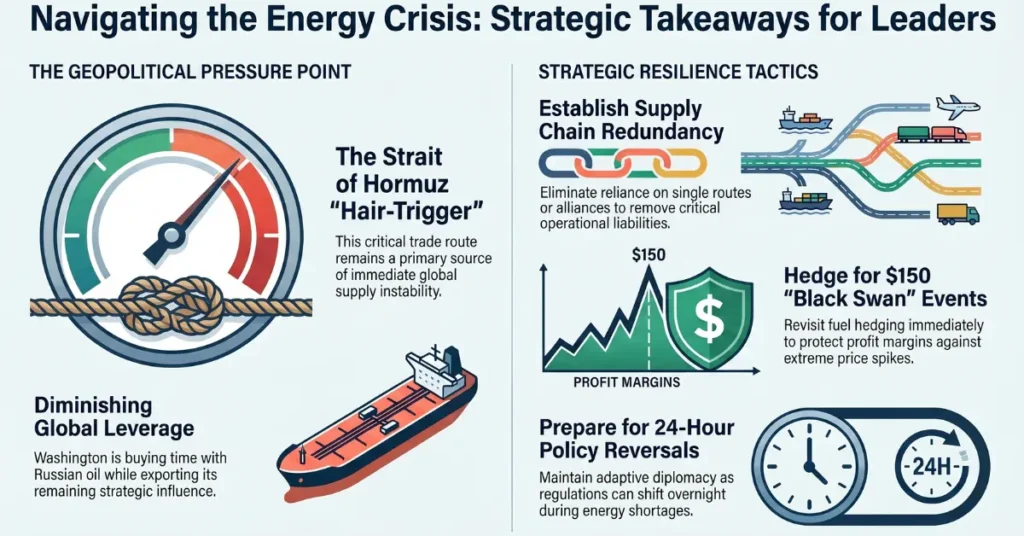
The Millionaire Insight: Washington is buying time with Russian barrels, but as the Strait of Hormuz remains a hair-trigger, the U.S. isn’t just importing oil—it’s exporting its remaining leverage.
- Supply Chain Redundancy: Relying on a single route or alliance is a liability.
- Energy Hedging: Revisit fuel hedging to protect margins against $150 “black swan” scenarios.
- Adaptive Diplomacy: Be prepared for sudden regulatory reversals. Policies can change in 24 hours when the lights are at risk of going out.
[Source: Harvard Business Review on Navigating Geopolitical Risk]
Conclusion: Survival Over Sentiment
The 2026 Energy Crisis has forced the United States to make a choice that contradicts years of foreign policy. By prioritizing survival over sanctions, the U.S. is signaling a new era where economic stability is the ultimate north star. Whether this “energy realism” pays off or simply emboldens adversaries remains to be seen, but for now, the goal is clear: keep the wheels of the American economy turning at any cost. In the game of global power, the most expensive resource isn’t oil—it’s time.
Key Takeaways
- The Strait of Hormuz remains the world’s most sensitive economic trigger.
- The 30-day Russian oil waiver is a strategic move to prevent a U.S. recession.
- Energy realism is replacing idealism in 2026 trade policy.
- True energy independence is a myth in an interconnected global market.
FAQs
Q: Why did the U.S. waive sanctions on Russian oil?
To increase global supply and offset the price spike caused by the Iranian threat to the Strait of Hormuz.
Q: How will this affect gas prices?
It is intended to cap the “war premium,” keeping domestic prices from hitting the feared $7.00 mark.
Q: Is this a permanent policy change?
No, it is currently a 30-day emergency waiver, subject to the volatility of Middle Eastern tensions.