


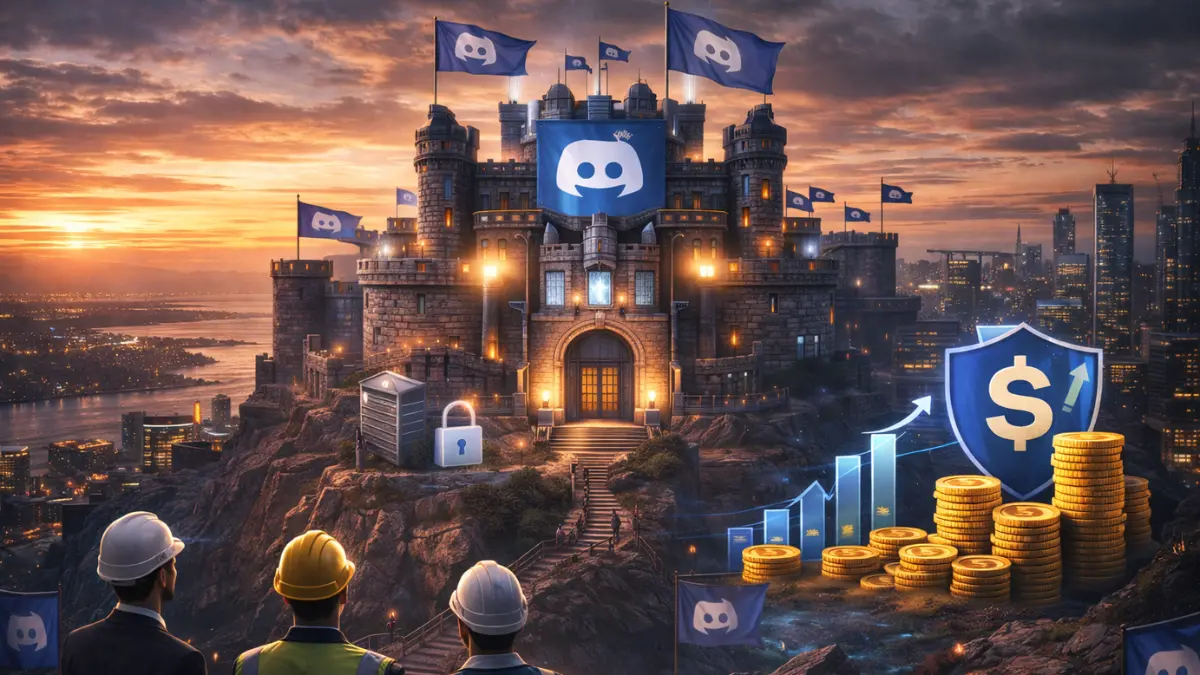
The 2026 IPO Roadmap: How Discord Built a $25B Fortress Without Selling Its Soul
The tech world is holding its collective breath. After a two-year drought that saw venture-backed unicorns hibernating through record interest rates and a painful “growth at all costs” hangover, the floodgates have finally creaked open. At the center of this storm is Discord.
Once the private enclave of niche gaming guilds, Discord is now entering the public spotlight with a rumored $25 billion valuation. It isn’t just another tech listing; it is the definitive 2026 IPO Roadmap. As the bellwether for the “community-as-a-service” era, Discord’s debut will determine whether Wall Street is ready to value “digital intimacy” at the same premium as enterprise SaaS utility.
Discord’s Intimacy-at-Scale Framework: Beyond the Gamer Label
Discord’s journey to the public markets is a masterclass in identity evolution. For years, the platform’s biggest strength—its lack of intrusive ads and algorithmic feeds—was also viewed as its greatest financial liability by the old guard. Investors questioned how a “free” chat app could justify a ten-figure price tag without auctioning off user data to the highest bidder.
The breakthrough came when Discord staged a coup against its own gamer-only reputation. They didn’t just add features; they colonized the “Third Place” digital market—a sociological concept referring to social surroundings separate from the home and the office. By expanding its infrastructure to support AI research hubs, student study groups, and neighborhood gardening clubs, Discord effectively became the internet’s living room.
This “Intimacy-at-Scale Framework” allowed for a monetization model driven by Nitro subscriptions and “Social Commerce.” Instead of selling the user, Discord began selling the experience. Their recent integrations, allowing game developers to sell in-game items directly within servers, proved that a social layer can drive commerce without destroying the community’s soul. This pivot is the first major milestone on the 2026 IPO Roadmap, proving that stickiness and privacy can coexist with a $25 billion valuation.
The “Quiet” Winner: Why Strava’s $2.2B Valuation is the 2026 Sleeper
While Discord captures the headlines with its massive scale, Strava is quietly executing the most disciplined IPO preparation in the fitness-tech sector. At a targeted $2.2 billion valuation, Strava represents a different kind of “sticky” success.
Unlike the pandemic-era hardware darlings that crashed when gym doors reopened, Strava’s value is locked in its data and its community. With nearly 90% of its revenue tied to premium subscriptions and a clear path to $500 million in annual recurring revenue (ARR), Strava is the “Goldilocks” IPO of the year. It isn’t overvalued, it isn’t over-leveraged, and it has successfully converted a massive user base into a high-margin revenue engine. The takeaway for the 2026 founder is sobering: billion-dollar caps are vanity; predictable, high-margin moats are sanity.
Read more on Johny Millionaire: The SpaceX IPO Fever: Why Musk is Finally Preparing to Unbundle His Starlink Empire
Equity Liquidity: The Rise of the Secondary Market Exit
One of the most distinct features of the 2026 IPO Roadmap is the redefinition of “liquidity.” In the 2021 frenzy, employees waited for the “big bang” of the opening bell to see their first dime. Today, the secondary market has become an essential pressure-relief valve.
As tech listings were delayed throughout 2024 and 2025, companies like Discord and Stripe utilized tender offers and secondary share sales. Institutional heavyweights—think Lexington Partners or Goldman Sachs’ secondary arm—have stepped in to provide equity liquidity long before the Nasdaq IPO Center ever registers a ticker symbol.
This move is a strategic play to prevent “IPO Fatigue.” When a company finally hits the public market, its staff isn’t just looking for the exit; they are already financially settled. However, there is a contrarian risk: this early price discovery can sometimes dilute the traditional “IPO pop,” as much of the value has already been traded in private rooms.
Valuation Traps: Why 2026 is the Era of Data and Discipline
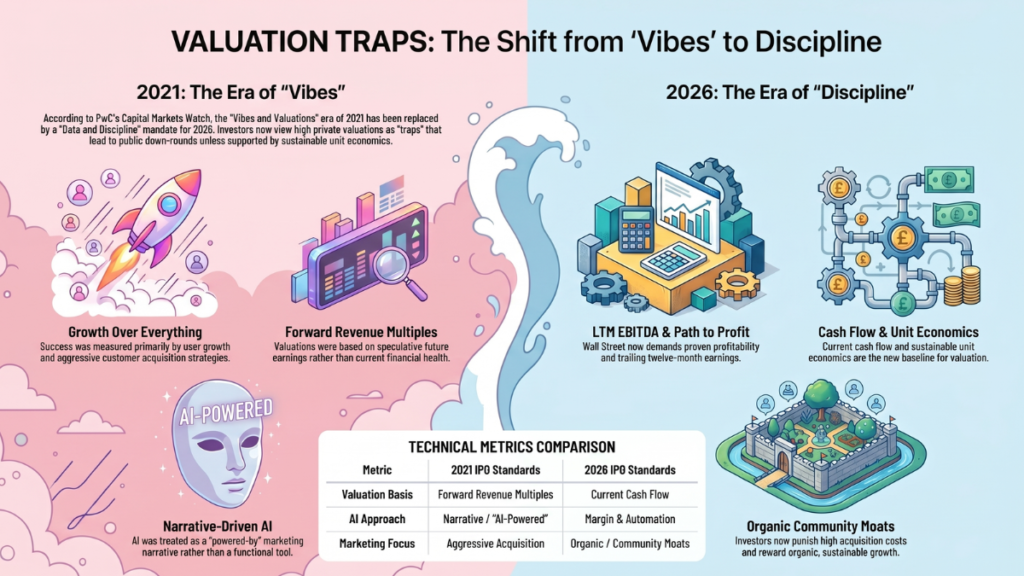
If 2021 was the year of “Vibes and Valuations,” 2026 is the year of “Data and Discipline.” Investors have learned the hard way that a high private valuation is often a “trap” that leads to a disastrous public down-round.
| Metric | 2021 IPO Standards | 2026 IPO Standards |
| Primary Driver | User Growth / “Vibes” | LTM EBITDA / Path to Profit |
| Valuation Basis | Forward Revenue Multiples | Current Cash Flow & Unit Economics |
| AI Approach | Narrative / “AI-Powered” | Margin Improvement & Automation |
| Marketing Focus | Aggressive Customer Acquisition | Organic / Community-Driven Moats |
According to data from PwC’s Capital Markets Watch, 2026 IPOs are pricing with significantly more conservative multiples. Growth is no longer the sole metric; Wall Street now punishes high customer acquisition costs (CAC) while rewarding organic, community-driven growth that proves a listing environment is sustainable for the long haul.
Read more on Johny Millionaire: The Rise of the “One-Person Unicorn”: How AI Founders are Scaling to $1B with Minimal Staff
Key Takeaways for the Strategic Investor
- Community is the Moat: Discord and Strava prove that “sticky” users are infinitely more valuable than “acquired” users.
- Monetization Must Feel Native: Avoid the “ad trap.” Native commerce that enhances the user experience is the 2026 gold standard.
- The Down-Round Avoidance: It is better to IPO at a sustainable $10 billion than a shaky $25 billion. A branding nightmare in the public markets takes years to repair.
Conclusion
The 2026 IPO Roadmap is a testament to the resilience of community-driven business models. Companies like Discord and Strava have shown that by building “fortresses” of engaged users and pivoting toward native monetization, it is possible to achieve massive scale without sacrificing brand integrity. As the tech window stays open, the winners will be those who prioritize the “soul” of their community as much as the strength of their balance sheet. Public markets are finally rewarding durable cash flows again—and the “fortress” is ready for its close-up.
FAQs
1. How does the 2026 IPO Roadmap differ from previous tech cycles?
The 2026 cycle prioritizes equity liquidity through secondary markets and demands rigorous unit economics, moving away from the “growth at all costs” mentality of 2021.
2. Is Discord still considered a gaming-only platform for investors?
No. Discord’s transition into a “Third Place” for AI research, education, and social commerce has successfully repositioned it as a broad-market social infrastructure.
3. Why are secondary market exits becoming so common?
They provide early liquidity for employees and allow companies to stay private longer while ensuring the public debut isn’t marred by immediate mass sell-offs.