

Jensen Huang’s Vision: Why Nvidia Ising Making Traditional GPUs Obsolete
In the high-stakes theater of Silicon Valley, where “disruption” is often a marketing buzzword rather than a reality, Jensen Huang has just dropped a bombshell that might actually earn the title. For decades, the Graphics Processing Unit (GPU) has been the undisputed king of the hill—the silicon engine powering everything from high-end gaming to the massive Large Language Models (LLMs) that have defined the early 2020s. But as we cross the threshold into 2026, the pioneer of the GPU is signaling its sunset.
Enter Nvidia Ising.
Named after the landmark mathematical model used to understand phase transitions in physics, Nvidia Ising isn’t just a new chip or a clever software update; it is a declaration of war on the status quo of traditional computing. By bridging the gap between classical “brute force” processing and the ethereal, probabilistic world of quantum mechanics, Huang is signaling that the era of the standalone, deterministic GPU as we know it is coming to a close.
Why This Topic is Trending: The “Quantum Squeeze”
We are currently witnessing what industry insiders call the “Quantum Squeeze.” Global titans like Google, IBM, and Microsoft have spent billions racing to build a stable quantum computer. However, they have hit a formidable wall: Noise.
Quantum bits (qubits) are notoriously fragile. A slight change in temperature or a stray electromagnetic wave causes “decoherence,” leading to calculation errors faster than the machine can solve them. For years, the industry thought we were decades away from a solution.
Nvidia Ising has arrived as the “AI Control Plane” for this chaos. By using advanced AI to predict and correct quantum errors in real-time, Nvidia is positioning itself as the indispensable operating system for the next century of computing. This isn’t just a trend; it’s a fundamental shift in the global power structure of technology.
From Parallelism to Probability: The Ising Shift
To understand why Nvidia Ising makes traditional GPUs look like pocket calculators, we must look at the underlying architecture. Traditional GPUs excel at parallel processing—performing thousands of small, linear tasks simultaneously. They are “deterministic,” meaning if you give them a math problem, they follow a rigid, set path to a single answer.
However, the world’s most complex problems—optimizing global supply chains for Amazon, simulating fusion energy, or discovering new molecular structures for Pfizer—are “probabilistic.” They are what scientists call NP-hard problems. In these scenarios, the number of possible variables is so vast that even the most powerful GPU cluster would take centuries to find the perfect solution.
The Hybrid Leap: How It Works
Nvidia Ising utilizes a classical-quantum hybrid approach. It does not attempt to replace the quantum computer; instead, it acts as the “brain” that makes quantum systems actually functional. Through the Nvidia cuQuantum SDK, Nvidia is allowing developers to simulate quantum circuits on classical hardware with unprecedented speed.
The results are staggering:
- Computational Speed: Ising Decoding is up to 2.5x faster than traditional industry standards for error mitigation.
- Precision Accuracy: It offers a 3x improvement in error detection, turning “noisy” quantum experiments into reliable, actionable data.
- Resource Efficiency: By offloading error correction to specialized AI cores, the actual quantum processor is free to focus entirely on the core calculation.
Is Your Data Center Already a Relic?
In the halls of McKinsey and Gartner, analysts are already debating the “useful quantum” timeline. Historically, the consensus was that we wouldn’t see commercial quantum value until the 2030s. But with Nvidia Ising, Jensen Huang has effectively “hacked” the timeline.
By using AI to handle the “dirty work” of quantum calibration, Nvidia is allowing enterprises to run quantum-like algorithms on the hardware they already own—like the Blackwell GPU architecture—while preparing them for the day they plug into a real Quantum Processing Unit (QPU).
“AI is essential to making quantum computing practical,” Huang recently noted during a keynote. “With Ising, AI becomes the control plane—the operating system of quantum machines.”
This shift is strikingly reminiscent of how Apple moved from Intel to M-series chips. It wasn’t just a speed upgrade; it was a fundamental change in how the machine “thinks.” For a business, staying on traditional GPU-only architectures is beginning to look like investing in horse-drawn carriages at the dawn of the Model T.
Read more on Johny Millionaire: Nvidia AI earnings 2026: Is the Artificial Intelligence Bubble Finally Bursting?
Real-World Impact: Beyond the Research Lab
This isn’t just theoretical physics discussed in ivory towers; the implications for the U.S. and global markets are massive. We are looking at a total reconfiguration of industrial capability.
1. Financial Modeling and High-Frequency Trading
Imagine a Wall Street firm using Nvidia Ising to simulate millions of market variables simultaneously. Traditional Monte Carlo simulations are limited by compute time. Ising-based models can find the “lowest energy state” for a portfolio—the point of maximum profit with minimum risk—in seconds rather than hours.
2. Logistics and the “Traveling Salesman” Problem
Companies like Tesla, UPS, and FedEx deal with the “Traveling Salesman” problem every day: finding the most efficient route for thousands of stops. At a certain scale, traditional GPUs fail because the complexity grows exponentially. Nvidia Ising handles these optimization problems by treating them as physical systems, finding the solution through probabilistic “annealing” rather than brute-force counting.
3. National Security and Post-Quantum Cryptography
The ability to decode complex systems faster than any adversary is a cornerstone of modern defense strategy. As quantum computers threaten current encryption methods, Nvidia Ising provides the bridge to “Quantum-Safe” protocols, ensuring that data remains secure in a post-RSA world.
The Architecture of Tomorrow: GPU vs. QPU vs. Ising
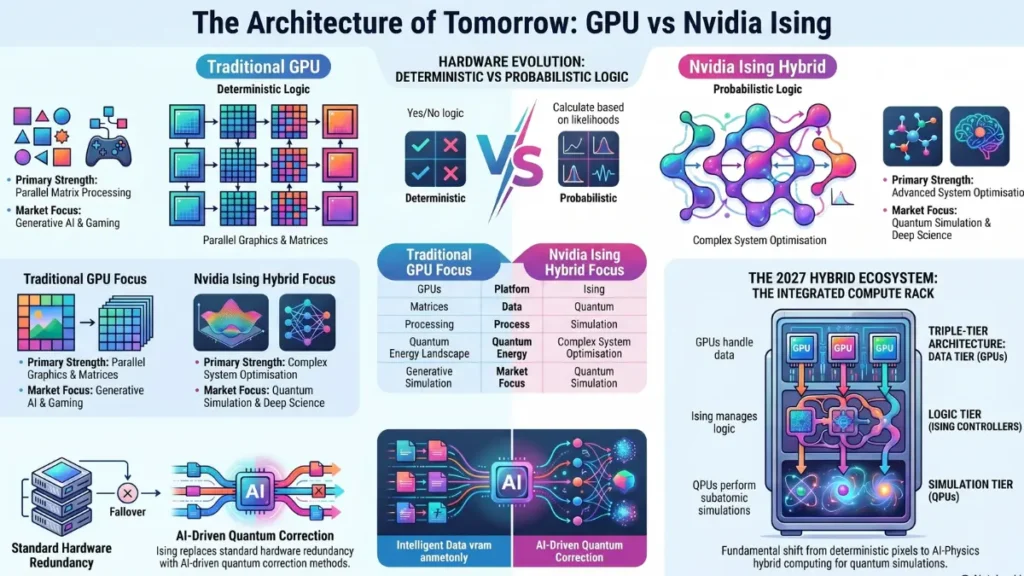
To grasp the magnitude of this change, we must look at the hardware evolution. The GPU was designed to render pixels. We “tricked” it into doing AI work. But Nvidia Ising is designed from the ground up to handle the intersection of AI and Physics.
| Feature | Traditional GPU | Nvidia Ising Hybrid |
| Logic Type | Deterministic (Yes/No) | Probabilistic (Likelihoods) |
| Primary Strength | Parallel Graphics/Matrices | Complex System Optimization |
| Error Handling | Hardware Redundancy | AI-Driven Quantum Correction |
| Market Focus | Generative AI & Gaming | Quantum Simulation & Deep Science |
As we see in official technical reports from NVIDIA, the integration of these systems means the “Computer” of 2027 will likely be a rack containing a GPU for data handling, an Ising-controller for logic, and a QPU for the heavy lifting of subatomic simulation.
The Strategy Guide: How to Pivot
For the strategic leader, the “Wait and See” approach is no longer viable. The “first-mover advantage” in the Ising era will be measured in trillions of dollars.
Step 1: Audit Your Current Compute Stack
If your enterprise is still purely focused on raw TFLOPS (Teraflops), you are measuring the wrong metric. Start looking at your capacity for “Accelerated Computing.” Are your developers utilizing libraries like cuQuantum? If not, you are building on a foundation that is becoming obsolete.
Step 2: Invest in Hybrid Talent
The most valuable engineers of the next five years won’t just know Python or C++; they will understand “Quantum-Classical Integration.” They will be the ones who can write code that runs on a GPU but thinks like an Ising model.
Step 3: Shift from “Data-First” to “Model-First”
Traditional AI requires massive amounts of data to learn. Ising-influenced AI can “reason” through physical models, requiring less data to reach more accurate conclusions. This “Leptonic” approach to AI will be the hallmark of the next generation of startups.
Read more on Johny Millionaire: AI Arms Race: Why Cybersecurity is the New Frontline for OpenAI and Anthropic
Common Mistakes: Don’t Fall for the “Quantum Hype”
While Nvidia Ising is revolutionary, it is important to avoid the common pitfalls:
- Expecting Instant Magic: It is a bridge, not a teleporter. You still need high-quality data and strong classical infrastructure.
- Ignoring the Software Layer: The hardware is impressive, but the real power of Ising lies in the software stack (CUDA, cuQuantum, Aerial).
- Underestimating Energy Costs: While more efficient in the long run, the initial setup for hybrid-quantum simulation requires significant power and specialized cooling.
The Competitive Landscape: Nvidia vs. The World
While Intel and AMD are still perfecting their next-gen GPUs, Nvidia has effectively changed the rules of the game. They aren’t just competing on chip speed anymore; they are competing on the very nature of computation. By open-sourcing the Ising-Calibration-1 VLM, they have created an ecosystem where every quantum startup in the world is now dependent on Nvidia’s AI to keep their qubits stable.
This is the ultimate “moat.” It makes Nvidia not just a hardware provider, but the “Central Bank” of computational trust.
Key Takeaways for the Strategic Leader
- The Standalone GPU is Evolving: It isn’t dying; it is being subsumed into a larger “Quantum-GPU” supercomputer ecosystem where it no longer acts alone.
- Error Correction is the New Gold: In 2026, the highest value isn’t found in raw compute power, but in “computational reliability” and error mitigation.
- Hybrid is the Only Path Forward: Don’t wait for a “pure” quantum computer to arrive in a decade. The winners are those adopting the Nvidia Ising workflow today to simulate those results now.
- Topical Authority: Companies that master probabilistic computing will dominate fields ranging from pharmaceuticals to autonomous logistics.
FAQs
1. Does Nvidia Ising replace my current Blackwell GPUs?
No, it enhances them. Think of Ising as a specialized “pre-processor” and “error-corrector” that allows your current Blackwell or Hopper hardware to perform calculations that were previously impossible.
2. Why is it called “Ising”?
It refers to the Ising Model, a mathematical abstraction used to describe how individual bits (like magnets or neurons) interact to create a collective state. It is the perfect mathematical framework for quantum-AI interaction.
3. Is Nvidia Ising available for small-scale startups?
Yes. Through Nvidia’s cloud partnerships and the open-release of several Ising model weights, even smaller firms can begin experimenting with probabilistic computing without owning a multi-million dollar quantum rig.
4. How does this impact AI inference?
It makes inference significantly more “reasoning-heavy.” Instead of just predicting the next word in a sentence, an Ising-enhanced AI can evaluate the physical or logical validity of its output in real-time.
Conclusion: The Architecture of the Infinite
Jensen Huang has once again proven that he isn’t just building chips; he is building the future. Nvidia Ising represents the exact moment when artificial intelligence stops being a “task-runner” and starts being the “architect” of reality itself. By solving the noise problem that has plagued quantum computing for decades, Nvidia has ensured that traditional, standalone GPUs are no longer the ceiling of human achievement—they are now the floor.
The message to the business world is clear: adapt to the hybrid era now, or find yourself managed by a competitor who did. The future of computing isn’t just faster; it’s smarter, it’s probabilistic, and it’s powered by the Ising shift.