

The “Ghost” in the Silicon: How Figure AI’s Newest Brain Just Ended the Humanoid Debate
What if the most important person on the factory floor tomorrow isn’t a person at all? What if the “soul” of the next industrial revolution isn’t found in a boardroom, but in a series of neural networks housed within a matte-black magnesium exoskeleton?
For decades, we’ve been promised a future where robots handle the “dull, dirty, and dangerous” tasks. But usually, those promises came with a catch: the robots were bolted to the floor, encased in safety cages, or required a team of specialized engineers to program a single, repetitive movement. We looked at the sleek machines in sci-fi movies and then looked at the clunky, stuttering reality of modern automation, asking the same question: Why is the future taking so long to get here?
The answer arrived with a quiet mechanical hum, and it didn’t just walk into the room—it spoke, it reasoned, and it understood.
Could one breakthrough in embodied AI destroy the concept of manual labor as we know it? Why are the world’s most aggressive investors—from Jeff Bezos to NVIDIA—pouring billions into a startup that didn’t even exist three years ago? We are witnessing the birth of a trillion-dollar wave, and if you aren’t paying attention to what Figure AI just achieved with the Figure 02 humanoid robot, you are missing the single most disruptive moment in the history of advanced manufacturing.
This isn’t just a better robot. This is the moment the machine learned to reason. It’s time to look at the silicon brain behind the metal face and realize: the gap between “science fiction” and “shipping product” just closed. We are no longer watching a demo; we are watching the new workforce clock in.
The Unveiling: Why Figure 02 Changes Everything
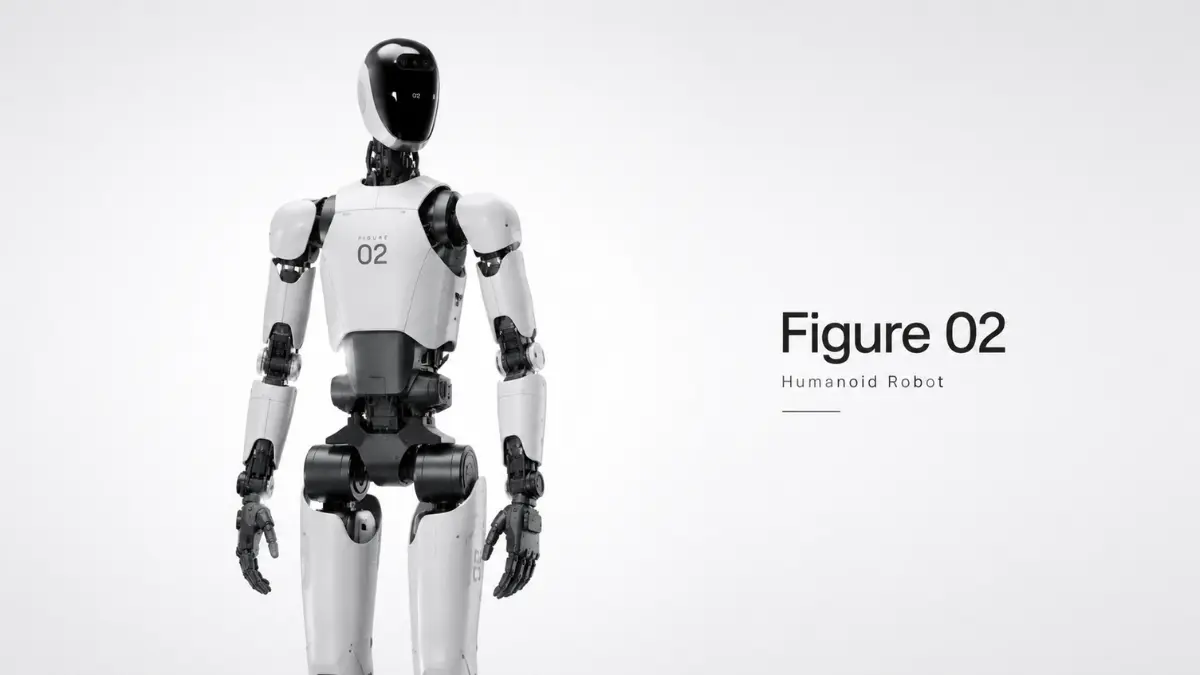
In the high-stakes world of Silicon Valley, “disruption” is a word thrown around until it loses all meaning. But when Figure AI released the specifications and footage of their second-generation humanoid, the industry went silent. The Figure 02 humanoid robot isn’t a prototype or a laboratory experiment designed to do backflips for YouTube views. It is a highly refined, aesthetically intimidating, and functionally superior machine designed for one thing: to replace human effort in the world’s most grueling environments.
Unlike its predecessor, Figure 01, which looked like a collection of exposed wires and hopeful engineering, the 02 is a “clean sheet” redesign. It features integrated cabling (no more exposed “veins”), a custom matte-black finish, and—most importantly—the highest-performing compute and sensing suite ever put into a bipedal frame. It represents the transition from “robotics research” to “product design.”
The Architect: Brett Adcock’s Audacious Bet
To understand the Figure 02 humanoid robot, you have to understand its creator, Brett Adcock. Adcock isn’t a traditional robotics professor; he’s a serial entrepreneur with a track record of building and exiting billion-dollar companies like Archer Aviation and Vettery.
Adcock realized something that the giants like Boston Dynamics seemingly missed for years: the hardware is only 20% of the battle. The other 80% is the “brain.” Adcock’s philosophy was simple: build the most capable hardware in the world as fast as possible, then give it the best AI “soul” available. By partnering directly with OpenAI, Figure leapfrogged a decade of traditional robotics research in a mere eighteen months. This partnership allowed Figure to bypass the slow, traditional “coding for every movement” approach and move straight into end-to-end neural networks.
The Problem: The Global Labor Collapse
Why do we need this technology right now? We are facing a global demographic time bomb. In the USA alone, there are over 600,000 unfilled manufacturing jobs. As the workforce ages out, there simply aren’t enough humans willing or able to perform repetitive, high-precision assembly tasks.
Previous solutions—traditional industrial arms—failed because they were “dumb.” They couldn’t adapt. If a part was two inches to the left of where it was supposed to be, the robot would just keep hitting the empty air. The Figure 02 humanoid robot solves this through Vision-Language-Action (VLA) models. It sees the world, understands the language of the task, and acts autonomously. It doesn’t need a cage; it needs a job description.
The Breakthrough: Speech-to-Speech Reasoning
The most shocking feature of the Figure 02 is its onboard integration with OpenAI. This allows the robot to engage in real-time speech-to-speech conversations. This isn’t Siri or Alexa; this is a machine that uses a Vision Language Model (VLM) to interpret its physical surroundings and explain its actions.
Imagine a supervisor walking up to a robot and saying, “Hey, we’re low on those silver bolts, use the black ones instead and tell me if they don’t fit.” In the past, that would require weeks of recoding and safety testing. The Figure 02 humanoid robot hears the command, reasons through the visual difference between the bolts, and adjusts its grip and torque in real-time. It has “onboard intelligence” that allows it to navigate a messy, unpredictable warehouse just as well as a human—perhaps better, because it never gets tired and never loses focus.
The Hardware: Precision Meets Power
Beneath the sleek exterior, the Figure 02 is a masterclass in engineering. To achieve human-level utility, Figure AI had to push the limits of power density and mechanical precision:
- The Hands: These are the “holy grail” of robotics. The 02 features 16-degree-of-freedom (DoF) hands that can carry up to 25kg. They aren’t just claws; they have human-equivalent strength and tactile sensing, allowing them to pick up a strawberry without crushing it or a power tool without dropping it.
- The Battery: A custom 2.25 kWh battery pack integrated into the torso increases energy density by 50%. This allows the robot to work a full shift, addressing the “uptime” problem that has plagued previous humanoid designs.
- The Sensors: Six onboard cameras feed into the VLM, providing a 360-degree field of view. This allows the robot to perceive the world in 3D, identifying obstacles and objects with sub-millimeter precision.
- Compute Power: With 3x the CPU/GPU power of the previous generation, the Figure 02 humanoid robot can perform complex “inference” (thinking) locally, meaning it doesn’t need to be tethered to a cloud server to figure out how to walk over a pallet.
The BMW Pilot: Out of the Lab, Into the Plant
This isn’t just a YouTube demo designed to pump a stock price. Figure 02 has already been deployed at BMW’s Spartanburg plant. This is one of the most sophisticated manufacturing hubs on Earth. While competitors are still trying to get their robots to walk across a flat stage without falling, Figure is already testing its machines in “sheet metal” applications—tasks that require immense precision and the ability to work alongside humans without causing a safety shutdown.
The BMW Group has stated that they are exploring the use of humanoid robots to handle tasks that are ergonomically difficult or dangerous for human workers. By placing the Figure 02 humanoid robot in a real-world production environment, Figure is gathering the most valuable currency in the AI era: real-world data.
The Market Impact: Figure AI vs. Tesla Optimus
The humanoid race is officially the new “Space Race,” and the stakes are the global labor market. On one side, you have Elon Musk’s Tesla Optimus, which benefits from Tesla’s massive scale, proprietary actuators, and the AI training data harvested from millions of cars. On the other, you have Boston Dynamics with the new electric Atlas, which boasts unmatched athletic mobility.
However, Figure has carved out a unique “middle ground.” It moves with the fluidity of Atlas but possesses the commercial pragmatism of Tesla. By choosing to be a “platform” for OpenAI’s intelligence, Figure doesn’t have to spend all its time building a Large Language Model (LLM) from scratch; it can focus on making the best body in the world for the best brain in the world. This “embodied AI” approach is what separates the winners from the science projects.
Read More: Why Agentic Workflows Are Replacing Traditional Automation in the Modern Office
The Hidden Psychology: Why the World is Watching
There is a specific kind of “Future Anxiety” surrounding the Figure 02 humanoid robot. It triggers our primal fear of being replaced—the Luddite’s nightmare realized in matte black. But it also offers a glimmer of “Post-Scarcity Hope.” Investors are betting on Figure because they realize that the first company to perfect a general-purpose humanoid robot will effectively own the “Operating System of Labor.”
If you can rent a Figure 02 for $10 an hour to do a job that costs $35 an hour in human wages (including benefits, insurance, and HR overhead), the economic math becomes undeniable. This is why NVIDIA, Microsoft, and Amazon are all involved. They aren’t just buying a robot; they are buying a stake in the future of work itself. We are moving toward a world where “labor” is a commodity that can be scaled like a cloud server.
Risks and the “Uncanny Valley”
It’s not all smooth sailing. The Figure 02 humanoid robot still faces massive hurdles:
- Durability: Can it survive 24/7 operation in a dusty, vibrating factory for five years? Most consumer electronics fail within three; industrial machines must be built differently.
- Safety: What happens if a neural network “hallucinates” while the robot is holding a heavy piece of equipment near a human coworker? The “black box” nature of AI makes safety certification a nightmare.
- Public Perception: The “Terminator” stigma is real. Figure has worked hard to make the 02 look “friendly” yet “professional,” avoiding the creepy human-skin look in favor of a high-tech tool aesthetic.
Global Implications: The End of Offshoring?
If the Figure 02 humanoid robot succeeds, the concept of “cheap overseas labor” vanishes overnight. Why build a factory in a country with lower wages if a fleet of Figure robots can produce the same goods in Ohio or Munich for less? This innovation could lead to a massive “reshoring” of manufacturing, bringing production back to domestic soil while simultaneously disrupting the blue-collar economies of developing nations. It is a geopolitical shift disguised as a mechanical one.
What Businesses Can Learn from Figure AI
The lesson from Figure AI is clear: Speed is the only moat. In less than two years, they went from a drawing board to a robot working at BMW. They did this by:
- Aggressively hiring talent: They didn’t hire generalists; they poached the best from Tesla, Apple, and IHMC.
- Strategic Partnerships: They didn’t reinvent the wheel; they partnered with OpenAI for the “brain” and utilized existing supply chains for components.
- Iterating in Public: They didn’t hide in stealth mode for a decade. They showed their progress, failures and all, to build market momentum.
CONCLUSION
The Figure 02 humanoid robot represents more than just a leap in robotics; it represents the moment the “Ghost in the Machine” became a reality. We are no longer talking about “if” humanoid robots will enter the workforce, but “how many” will be there by the end of the decade.
The lesson here is profound: Intelligence is no longer confined to a screen. It has grown legs. It has grown hands. It is now capable of reaching out and reshaping the physical world. For the first time in human history, the bottleneck of economic growth—human labor—is about to be removed.
We are standing at the edge of a world where “work” is optional for humans and mandatory for silicon. While the media focuses on AI writing poems and drawing pictures, the real revolution is happening on the factory floors of South Carolina, where the Figure 02 is quietly learning how to build our future.
The trillion-dollar question remains: When the machines can do everything we can do, what is left for us to define as “human”? Are we underestimating how fast the future is moving, or are we ready for a world where your next coworker is a Figure 02 humanoid robot?
Read More: NVIDIA Project GR00T: The Dawn of General Purpose Humanoid Robots
Key Takeaways
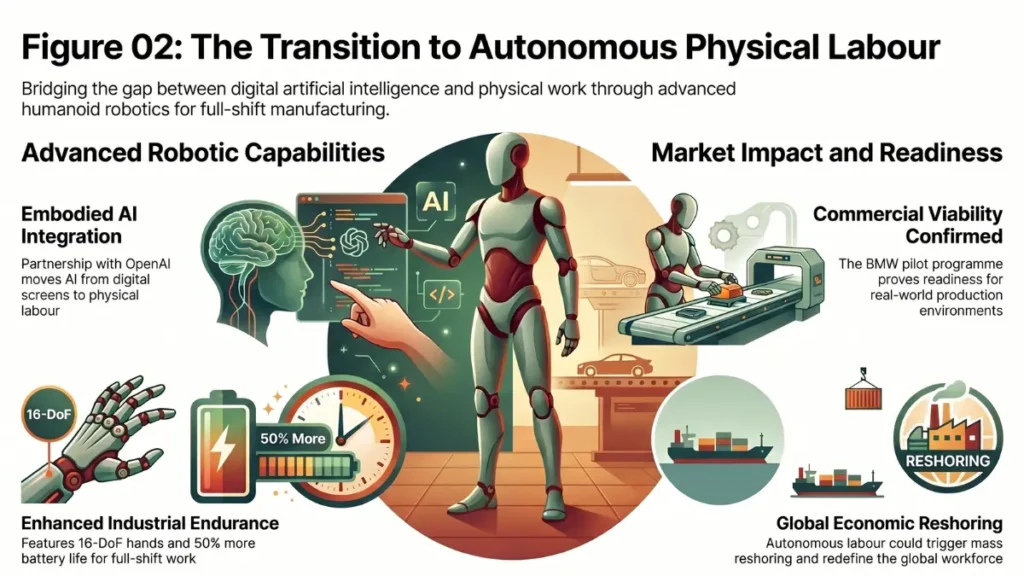
- Embodied AI is Here: The partnership between Figure AI and OpenAI has moved AI from digital screens to physical labor.
- Commercial Viability: The BMW pilot program proves that humanoid robots are moving out of the lab and into real-world production.
- Superior Hardware: With 16-DoF hands and a 50% increase in battery life, Figure 02 is built for full-shift industrial work.
- Economic Shift: The rise of autonomous labor could lead to mass reshoring of manufacturing and a total redefinition of the global workforce.
FAQ (Search Engine Optimized)
1. What is the Figure 02 humanoid robot?
The Figure 02 humanoid robot is the second-generation general-purpose robot developed by Figure AI. It features integrated OpenAI intelligence, allowing it to communicate and reason while performing complex manual tasks in manufacturing and logistics.
2. How is Figure 02 different from Tesla’s Optimus?
While both are bipedal humanoids, Figure 02 currently holds an edge in integrated speech-to-speech reasoning through its partnership with OpenAI. It also features a unique 16-DoF hand design and has already been tested in active BMW production lines, whereas Optimus is primarily tested within Tesla’s own facilities.
3. Will Figure 02 replace human workers?
The goal of Figure AI is to address labor shortages in “dull, dirty, and dangerous” jobs. While it will automate many tasks currently done by humans, the company argues it will allow humans to move into more creative, supervisory, and high-level roles within the automated ecosystem.
4. Who is funding Figure AI?
Figure AI has raised over $675 million from high-profile investors including Jeff Bezos, NVIDIA, Microsoft, OpenAI Startup Fund, and Intel Capital, reaching a multi-billion dollar valuation.
5. Can Figure 02 talk and understand commands?Yes. Thanks to its custom AI models developed with OpenAI, the Figure 02 humanoid robot can engage in full, real-time conversations, understanding context, and answering questions about the specific tasks it is performing on the factory floor.