


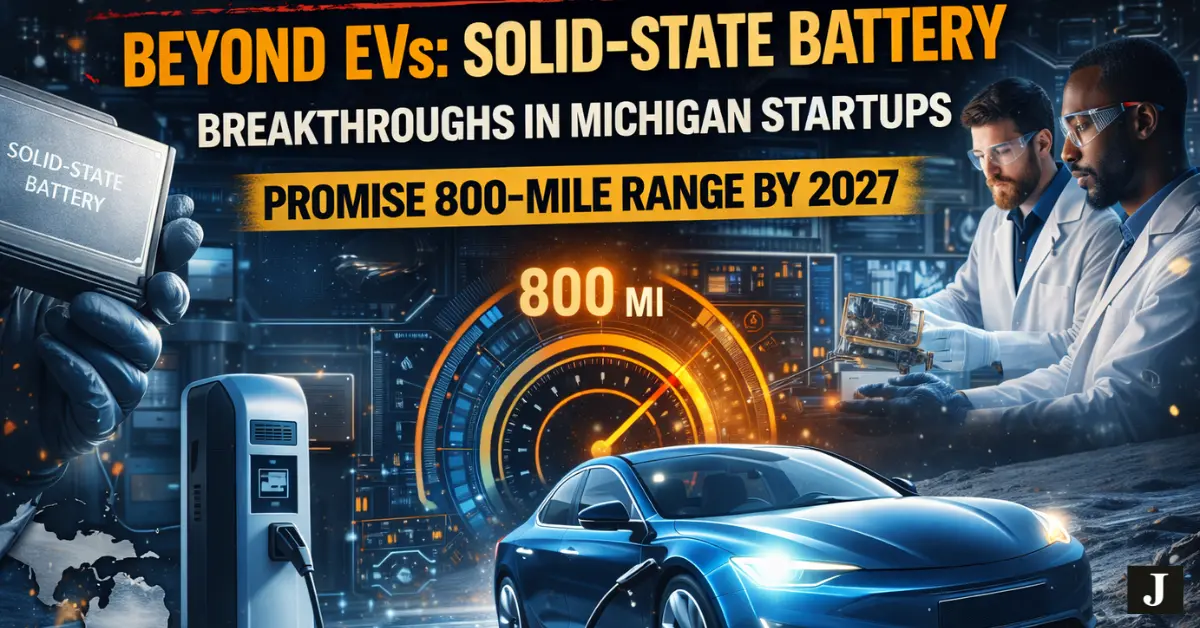
While the automotive world has spent years debating the limitations of lithium-ion technology, a quiet revolution in the American Rust Belt is nearing its crescendo. A cluster of high-tech Michigan startups, fueled by a surge in private equity and federal grants, has announced a series of solid-state battery breakthroughs that could effectively end “range anxiety” for good. These emerging ventures are now promising a staggering 800-mile range by 2027, a milestone that would nearly double the capability of today’s top-tier electric vehicles.
The shift from liquid electrolytes to solid-state architecture is often described as the “Holy Grail” of energy storage. By replacing the flammable liquid components with solid ceramic or polymer materials, these batteries offer higher energy density, faster charging times, and enhanced safety. According to recent technical briefings from the U.S. Department of Energy, solid-state cells could potentially reduce the weight of EV battery packs by 30%, further boosting vehicle efficiency and lowering long-term manufacturing costs.
For investors, this newsroom-ready development signals a massive valuation pivot. While legacy automakers have struggled with softening EV demand in 2025, the promise of an 800-mile range provides a fresh catalyst for consumer adoption. The ripple effects extend well beyond passenger cars; an 800-mile battery would revolutionize long-haul trucking and regional aviation, sectors where traditional lithium-ion batteries have proven too heavy and inefficient to be viable.
The strategic importance of this being “Made in Michigan” cannot be overstated. By centering these solid-state battery breakthroughs in the United States, startups are bypassing the geopolitical complexities of the traditional battery supply chain. This domestic focus aligns with recent initiatives from the International Energy Agency (IEA) to diversify energy tech sourcing away from single-country dependencies.
As we look toward 2027, the focus for the industry now shifts from laboratory success to mass-market scalability. If these Michigan-based firms can bridge the “valley of death” between prototype and commercial production, the internal combustion engine may finally lose its last remaining advantage over the electric powertrain. The 800-mile mark is no longer a distant dream—it is the new baseline for the next generation of American mobility.
Read More: The Biotech Boom: Why 2026 is the Year of the Healthcare Unicorn