

The $1.75 Billion Quibi Failure: A Masterclass in Executive Hubris and Strategic Blindness
How does a company manage to burn through $1.75 billion in capital and vanish in just six months? The Quibi failure is not just a footnote in the history of the “Streaming Wars”; it is a towering monument to the dangers of top-down disruption and the folly of ignoring user behavior. In the high-stakes world of Silicon Valley and Hollywood, Quibi stands as perhaps the most expensive “speedrun” to bankruptcy ever recorded.
Imagine possessing the most powerful Rolodex in Hollywood, the deepest pockets in venture capital, and a roster of talent that included Steven Spielberg, Guillermo del Toro, Kevin Hart, and Jennifer Lopez. Now, imagine watching that entire empire evaporate before you’ve even finished your first fiscal year. This was the reality for Jeffrey Katzenberg and Meg Whitman. Their venture was designed to redefine how we consume media, but instead, it became a cautionary tale for every entrepreneur who believes that a massive bank account can substitute for product-market fit.
The Genesis of a “Quick Bite”
The story begins in 2018. The media landscape was undergoing a seismic shift. Netflix was no longer just a DVD-by-mail service; it was a global juggernaut. Disney+ was preparing for a world-dominating launch. In the background, an algorithmic titan named TikTok was beginning its silent takeover of the global attention economy.
Jeffrey Katzenberg, the legendary former chairman of Disney and co-founder of DreamWorks, spotted what he believed was a “white space” in the market. He observed people in line for coffee, riding subways, and waiting in doctors’ offices, all staring at their phones. His thesis was simple: people want high-production, “Hollywood-grade” content delivered in chapters of ten minutes or less. He called it “Quibi”—short for “Quick Bites.”
To execute this vision, he recruited Meg Whitman, the former CEO of eBay and Hewlett-Packard. On paper, it was a “dream team” pairing: Hollywood’s creative intuition met Silicon Valley’s operational discipline. They weren’t just building an app; they were attempting to birth a third category of filmed entertainment—somewhere between the polished prestige of HBO and the raw, user-generated energy of YouTube.
The $1.75 Billion War Chest
Before a single frame of video was shot, Quibi raised a staggering $1 billion from every major Hollywood studio, including Disney, NBCUniversal, and Warner Bros. They later added another $750 million. The industry wasn’t necessarily convinced the idea would work, but they were terrified of being left behind if it did.
Katzenberg’s pitch was intoxicating. He convinced A-list creators that Quibi was the next frontier of storytelling. He paid top dollar for content—often upwards of $100,000 per minute of footage. This ensured that Quibi looked like a blockbuster on a five-inch screen, but it also created a burn rate that was unsustainable without immediate, massive adoption.
The “Turnstyle” Trap: Innovation for Innovation’s Sake
At the heart of the Quibi experience was a proprietary technology called “Turnstyle.” It allowed users to flip their phones from portrait to landscape seamlessly. The video wouldn’t just rotate; the framing would actually change in real-time to optimize the viewing experience for both orientations.
From a technical standpoint, Turnstyle was an engineering marvel. From a business standpoint, it was a solution in search of a problem. Quibi spent millions of dollars and countless development hours perfecting a feature that most users found gimmicky. More importantly, the focus on Turnstyle led to a fatal strategic error: to protect the intellectual property of the rotating video, Quibi disabled the ability to take screenshots or screen recordings.
In 2020, social media “virality” was the primary engine of growth for any new app. By preventing users from sharing memes or clips of their shows, Quibi built a digital fortress. They effectively siloed their content in an era where the “share” button is the most powerful tool in marketing. While TikTok was exploding because users could remix and share content, Quibi remained a closed loop, invisible to the very cultural conversations it sought to dominate.
Read More: The IP Graveyard: Lessons from the $100B Collapse of “First-Wave” AI Startups
A Launch into a Ghost Town
Quibi launched on April 6, 2020. The timing was nothing short of catastrophic.
The world had just entered the first wave of global COVID-19 lockdowns. Quibi was built for the “on-the-go” lifestyle—the commute, the gym, the coffee shop. Suddenly, the “in-between moments” of life had vanished. People were no longer on the go; they were stuck on their couches.
When users are trapped at home, they don’t want to watch a $100 million thriller on a five-inch screen; they want to watch it on their 65-inch 4K televisions. Yet, in another baffling move, Quibi launched as a mobile-only service. There was no TV app, and for the first several months, you couldn’t even “cast” the content from your phone to your television. According to a retrospective analysis by The Wall Street Journal, this lack of flexibility was one of the primary drivers of early user churn.
Analyzing the Quibi Failure: The Three Fatal Disconnects
To understand why Quibi collapsed, we must look beyond the pandemic. COVID-19 was a headwind, but the foundation of the house was already made of sand. The failure was rooted in three fundamental disconnects between the founders and the modern consumer.
1. The Content Mismatch
Katzenberg and Whitman applied a 1990s “Appointment Viewing” mindset to a 2020 mobile audience. They believed that by cutting a movie into ten-minute slices, they could create “snackable” prestige. However, they ignored the psychology of mobile usage. Mobile users don’t necessarily want “mini-movies”; they want authenticity, community, and creators they feel a connection with.
While Quibi was airing The Most Dangerous Game starring Liam Hemsworth, TikTok was showing us the real world through the eyes of millions of creators. One was a lecture; the other was a conversation. Quibi felt like “Big Media” trying to colonize the phone, and the audience sensed the lack of soul immediately.
2. The Paywall Problem
In the attention economy, you are competing for time. Quibi asked users to pay $4.99 (with ads) or $7.99 (without ads) for content they didn’t yet know or care about. Meanwhile, YouTube and TikTok offered an infinite stream of personalized entertainment for free.
Even Netflix, with its massive library, struggled to justify price hikes during this period. Quibi was asking for a “Netflix-lite” price for a fraction of the content. As noted in the Los Angeles Times, the value proposition simply didn’t hold up when compared to the vast, free ecosystems of social media and the established libraries of Hulu or Disney+.
3. The Generational Culture Gap
Perhaps the most damning aspect of the Quibi saga was the lack of “Founder-Market Fit.” Jeffrey Katzenberg famously admitted in interviews that he wasn’t a “social media person.” He was a titan of the old guard trying to dictate taste to a “bottom-up” generation.
The leadership team treated the audience like passive consumers. They didn’t understand that for Gen Z and Millennials, media consumption is a participatory act. If you can’t comment, share, or engage with a community around the content, it effectively doesn’t exist in the modern zeitgeist.
The Collapse Timeline: From Hype to Fire Sale
By June 2020, just two months after the grand debut, Quibi was already plummeting in the App Store rankings. Internal reports were grim: only 8% of users who signed up for the initial 90-day free trial converted into paying subscribers.
The “pivot” phase was frantic but ultimately futile. They finally allowed screenshots. They scrambled to develop a TV app. They tried to market the shows as standalone films. But the brand had already become a punchline—a symbol of Silicon Valley excess and Hollywood arrogance.
On October 21, 2020—just 199 days after launch—Quibi announced it was shutting down. They returned approximately $350 million to investors, but the remaining $1.4 billion had been incinerated in less than a year. It was the fastest, most expensive fire sale in the history of the media industry.
The Aftermath: Where Are They Now?
In early 2021, the Roku Channel bought the rights to Quibi’s entire content library for a sum reported to be less than $100 million. It was pennies on the dollar. Interestingly, when these “Quibi Originals” were rebranded as “Roku Originals” and made available on traditional TV interfaces, they found a modest, respectable audience. This suggests that the content itself wasn’t necessarily the problem—the delivery system and the business model were the true culprits.
Jeffrey Katzenberg remains an influential figure in media, though his reputation as a digital visionary was severely tarnished. He has since focused on traditional investment through WndrCo. Meg Whitman, meanwhile, transitioned into public service, eventually being confirmed as the U.S. Ambassador to Kenya in 2022.
The Hidden Psychology of Failure: The “A-List Delusion”
Why didn’t the leadership team see the writing on the wall? The Quibi failure can be attributed to a psychological phenomenon we might call the “A-List Delusion.” Because they had the biggest names in Hollywood, they assumed they were immune to market forces. They mistook “expensive” for “valuable.”
In venture capital, there is a concept known as the “Sunk Cost Fallacy,” but there is also the danger of “Over-Capitalization.” Having too much money allowed Quibi to ignore the market’s feedback for far too long. If Quibi had started with a lean $10 million instead of $1.7 billion, they would have been forced to iterate, listen to their users, and change their model within weeks. Their massive bank account gave them the luxury of driving a gold-plated bus off a cliff without ever checking the brakes.
Critical Lessons for Today’s Entrepreneurs
The smoking ruins of Quibi provide several vital lessons for anyone looking to build a tech or media company in the current era:
- Don’t Build in a Silo: Quibi ignored basic user behaviors like sharing and TV casting. If your product ignores how people actually use technology, it will fail, regardless of the budget.
- Capital is a Tool, Not a Strategy: Raising a billion dollars is not a business model; it is a massive liability that demands immediate, exponential growth.
- Know Your True Competition: Quibi thought they were competing with HBO. They were actually competing with the “Close Friends” list on Instagram, the “For You” page on TikTok, and even Fortnite.
- Listen to the “Bottom-Up” Signal: You cannot manufacture “cool” from a boardroom in Beverly Hills. Cultural relevance is earned through resonance and community, not through Super Bowl ads.
Comparison of Streaming Strategies
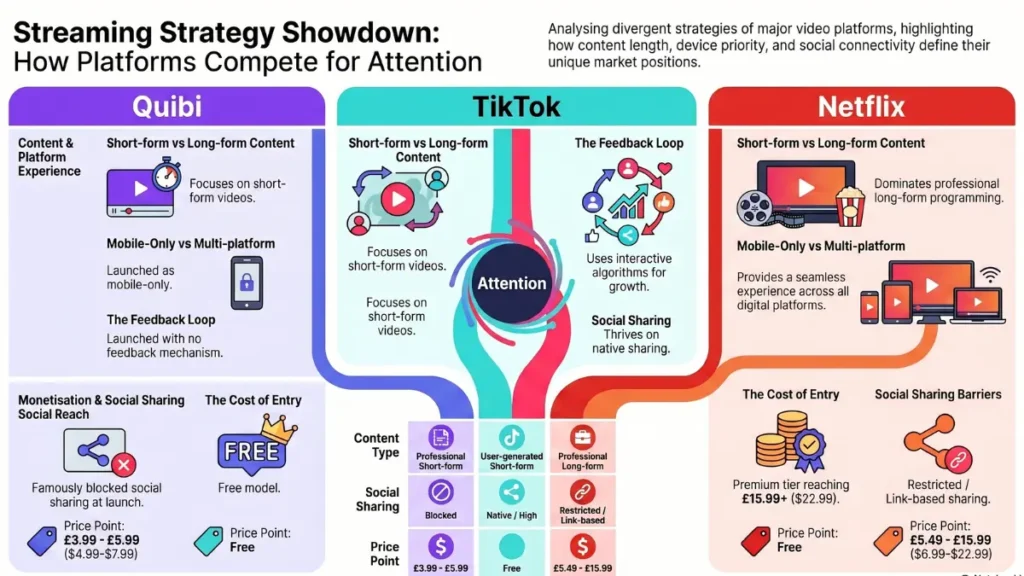
| Feature | Quibi | TikTok | Netflix |
| Content Type | Professional Short-form | User-generated Short-form | Professional Long-form |
| Primary Device | Mobile Only (at launch) | Mobile First | Multi-platform |
| Social Sharing | Blocked (at launch) | Native / High | Restricted / Link-based |
| Price Point | $4.99 – $7.99 | Free | $6.99 – $22.99 |
| Feedback Loop | None | Algorithmic / Interactive | Viewership Data |
Conclusion: The Ghost in the Machine
The ghost of Quibi still haunts the halls of Silicon Valley. It stands as the ultimate monument to the “Big Media” era’s failed attempt to colonize the digital frontier through sheer force of will. Quibi failed because it tried to force the old world into a new shape, rather than learning the language of the new world itself.
The most staggering lesson of the Quibi failure is that money cannot buy attention. In the 21st century, attention is the only currency that matters, and it is earned through relevance, not through $100,000-per-minute production budgets. Quibi had the best of everything—the best stars, the best tech, the best PR—but it lacked the one thing a startup needs to survive: a soul that resonated with its users.
As we look at the next wave of “revolutionary” technology, from Generative AI to the Metaverse, we must ask ourselves if we are falling for the same “Turnstyle” trap. Are we building expensive solutions for problems that don’t exist, or are we truly listening to the heartbeat of the consumer?
FAQ
1. Why did Quibi fail so quickly?
The Quibi failure was caused by a “perfect storm” of a flawed mobile-only business model, the lack of social sharing features, a high subscription price compared to free alternatives like TikTok, and a launch during COVID-19 lockdowns when mobile-on-the-go usage plummeted.
2. Was the Turnstyle technology actually good?
Technically, yes. It was a sophisticated engineering feat that allowed seamless rotation between portrait and landscape modes. However, it was strategically flawed because it led to the blocking of screenshots and sharing, which killed the app’s virality.
3. What happened to the Quibi content after it shut down?
The library was acquired by Roku for less than $100 million. Many of the shows were rebranded as “Roku Originals” and are now available for free (with ads) on The Roku Channel, where they have performed significantly better than they did on the Quibi app.
4. Could Quibi have survived if it launched at a different time?
While the pandemic hurt its “on-the-go” premise, most analysts believe the structural flaws—the paywall, the lack of social features, and the lack of a TV app—would have eventually led to its demise regardless of the global health crisis.
5. How much money did investors actually lose?
Of the $1.75 billion raised, approximately $350 million was returned to investors. This means the venture resulted in a net loss of roughly $1.4 billion in just over six months of operation.


[…] Read More: The $1.75 Billion Quibi Failure: A Post-Mortem on Hubris […]