



Introduction: Where the Next Unicorns Startup Are Really Coming From
In a quiet office in San Francisco, a small team of 18 engineers is building a product most people have never heard of. No viral launch. No flashy marketing. No headlines.
Yet within three years, that company crosses $100 million in annual revenue—and investors line up, not because of hype, but because of something far more powerful: predictable, scalable value.
This is what the new era of startups looks like.
Between 2022 and 2025, the U.S. startup ecosystem didn’t collapse—it recalibrated. Capital became expensive. Investors became cautious. And founders were forced to confront a hard truth: growth without substance doesn’t last.
What emerged from this shift is a sharper, more disciplined model for building billion-dollar companies. A model where efficiency beats excess, depth beats speed, and execution beats storytelling.
This is the Unicorn Startup Blueprint for 2025—and it looks very different from what Silicon Valley once celebrated.
The Modern Unicorn Startup Blueprint in 2025
The old playbook rewarded visibility. The new one rewards durability.
Instead of chasing rapid expansion fueled by endless funding, today’s unicorns are being built with a different mindset:
- Smaller teams, higher output
- Real revenue early
- Products deeply embedded into customer workflows
- Strategic—not excessive—capital use
According to recent insights from McKinsey, startups that focused on capital efficiency during downturn cycles consistently outperformed high-burn companies.
The shift is subtle—but powerful.
Founders are no longer asking, “How fast can we grow?”
They are asking, “How strong can we build?”
The Collapse of “Growth at Any Cost”
For years, startup success was measured in speed—user growth, funding rounds, valuation spikes. Profitability was often treated as something to figure out later.
That model broke.
As interest rates climbed and public markets corrected, the ripple effects hit private startups hard:
- Venture funding dropped significantly across 2023–2024
- Down rounds became common
- Layoffs forced companies to rethink scale
- Investors shifted focus from storytelling to sustainability
But here’s what’s interesting:
Investors didn’t disappear—they became sharper. More skeptical. And far more disciplined.
That skepticism is now filtering out weak business models faster than ever before.
What Investors Actually Look for Now
Beyond Growth: The Rise of Precision Metrics
Today’s investors don’t just care about growth—they care about how that growth is achieved.
Here are the metrics that define modern unicorn potential:
1. Revenue Efficiency
How much revenue is generated per employee? Lean teams are now a competitive advantage.
2. LTV to CAC Ratio
A sustainable business typically maintains a ratio of at least 3:1. Anything lower raises concerns about scalability.
3. Net Revenue Retention (NRR)
The strongest SaaS companies expand revenue from existing customers—often exceeding 120%.
4. Burn Multiple
How much capital is used to generate each dollar of new revenue? Lower is better.
5. Gross Margins
High-margin models—especially in SaaS and AI—are heavily favored.
Real-World Insight
Companies like Stripe and Databricks didn’t just scale—they built ecosystems. Their strength lies not only in revenue, but in how deeply they are integrated into their users’ operations.
Product-Market Fit in 2025: Depth Over Width
There was a time when startups aimed to capture large markets quickly. Today, the strategy has flipped.
Winning companies start small—but go deep.
They focus on:
- Highly specific customer segments
- Critical, high-cost problems
- Products that become difficult to replace
The “Mission-Critical” Advantage
In 2025, successful startups are not “nice to have”—they are essential.
They:
- Reduce operational costs
- Automate time-consuming processes
- Directly impact revenue
This creates something powerful: dependency.
Once a product becomes embedded into daily operations, switching becomes painful—and retention becomes natural.
The Role of AI in the Unicorn Startup Blueprint
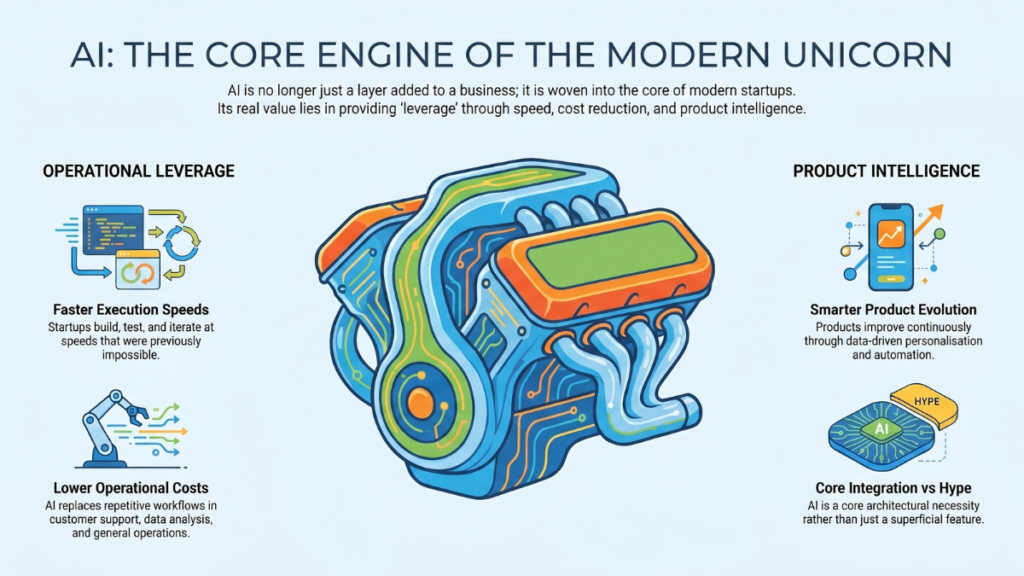
AI is no longer a layer added on top—it’s woven into the core of modern startups.
But the real advantage of AI isn’t hype—it’s leverage.
How AI Is Changing the Game
1. Faster Execution
Startups can now build, test, and iterate at speeds that were impossible just a few years ago.
2. Lower Operational Costs
AI replaces repetitive workflows in customer support, data analysis, and operations.
3. Smarter Products
Products improve continuously through data, personalization, and automation.
Industry-Level Impact
AI-driven startups are dominating sectors like:
- SaaS automation
- Fintech risk analysis
- Healthcare diagnostics
- Logistics optimization
And many of them are building on top of existing AI infrastructure rather than starting from scratch—dramatically reducing time to market.
Funding in 2025: Strategy Over Scale
The funding landscape hasn’t dried up—it has matured.
Founders are no longer chasing the biggest round. They’re optimizing for the smartest one.
New Funding Approaches
Instead of relying solely on venture capital, many startups are now:
- Using revenue-based financing
- Partnering with strategic investors
- Prioritizing early profitability
- Raising smaller, more efficient rounds
A Shift in Founder Thinking
Founders used to measure success by how much capital they raised.
Today, the real signal is different:
How efficiently can that capital be converted into sustainable revenue?
Founder Mindset: The Real Differentiator
Behind every modern unicorn is a founder who thinks differently.
Not louder. Not more aggressive. Just sharper.
What Defines Today’s Founders
- They make decisions based on data—not ego
- They are comfortable operating with constraints
- They prioritize long-term value over short-term validation
The Operator Era
The era of the “vision-only founder” is fading.
Today’s successful founders are operators—people who understand systems, execution, and discipline.
They don’t just imagine outcomes.
They build them, step by step.
Mini Case Study: The Rise of Quiet Unicorns
Some of the fastest-growing startups today are almost invisible to the public.
No viral buzz. No media hype.
Just:
- Strong recurring revenue
- Deep customer integration
- Consistent product improvement
Take the example of emerging AI SaaS companies serving niche industries like legal automation or supply chain intelligence. Many of them reach massive valuations without ever becoming household names.
Why?
Because they solve problems so critical that customers don’t just use them—they depend on them.
This is the new path:
Build something indispensable—and growth follows naturally.
Quick Insight Box
- U.S. startup funding declined significantly post-2022, but high-quality startups still secured capital
- AI startups continue to attract a major share of investment
- SaaS models with strong retention outperform high-growth, low-margin businesses
Founder Reality Check
Not every startup should aim to become a unicorn.
In fact, chasing valuation without fundamentals is one of the fastest ways to fail.
The smarter approach:
Build a strong, profitable business first.
Let valuation become a byproduct—not the goal.
The Unicorn Startup Blueprint Framework (2025 Edition)
1. Start Narrow, Then Expand
Own a niche before scaling outward.
2. Prioritize Retention
Acquisition gets attention. Retention builds empires.
3. Use AI as Leverage
Scale faster without scaling costs.
4. Focus on Unit Economics
Every dollar should work harder than the last.
5. Raise Capital Intentionally
Capital is a tool—not validation.
6. Execute Relentlessly
Ideas are common. Execution is rare.
Key Takeaways
- The Unicorn Startup Blueprint has shifted toward efficiency and sustainability
- Product-market fit must be deep, not broad
- AI is a powerful enabler—but not a shortcut
- Investors reward discipline, not hype
- Founder mindset is often the deciding factor
FAQs
What is a unicorn startup?
A privately held startup valued at over $1 billion.
Is building a unicorn harder today?
Yes—but the businesses being built are stronger and more sustainable.
Do startups still need venture capital?
Not always. Many are achieving growth through alternative funding and early profitability.
How important is AI in modern startups?
AI plays a critical role in scaling efficiently and building competitive products.
What is the biggest mistake founders make?
Focusing on growth without strong fundamentals or real product-market fit.
Internal Links
External References
- McKinsey & Company – Startup and venture insights
- Harvard Business Review – Innovation and leadership research
- Forbes – U.S. startup and funding trends
Conclusion: The New Definition of a Unicorn
The idea of a unicorn startup hasn’t disappeared—it has evolved.
The companies reaching billion-dollar valuations today aren’t built on noise. They’re built on clarity, discipline, and deep value creation.
They don’t chase attention.
They earn trust.
And in a world where capital is no longer easy and competition is sharper than ever, the real advantage isn’t speed—it’s precision.
If you’re building something today, remember this:
The next unicorn won’t be the one that grows the fastest.
It will be the one that builds the strongest foundation—and compounds it over time.


[…] [Read more on Johny Millionaire: What It Takes to Build a $1B Company in America Today] […]
[…] [Read more on Johny Millionaire: What It Takes to Build a $1B Company in America Today] […]