

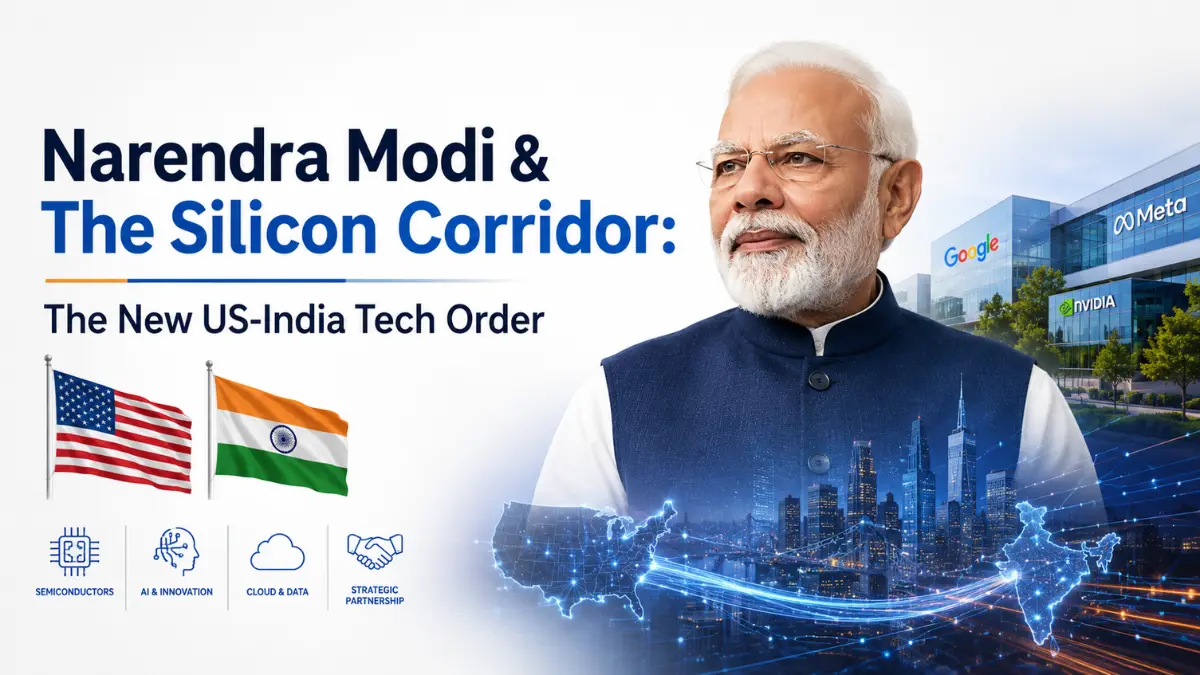
Narendra Modi and the New “Silicon Corridor” Between US and India: The Dawn of a Tech Super-Alliance
What if the world’s most critical technology was no longer held hostage by a single geographic bottleneck? What if the “Designed in California” label on your next iPhone was permanently paired with “Manufactured in India”?
For decades, the global technology supply chain was a one-way street leading to East Asia. But in 2026, we are witnessing a tectonic shift—a geopolitical and economic rewiring so profound that it is being dubbed the “Silicon Corridor.” At the center of this transformation stands one man: Narendra Modi.
Why are the world’s most powerful CEOs—from Tim Cook to Elon Musk—suddenly treating New Delhi like a second Silicon Valley? Is it just about cheaper labor, or is there a deeper strategic play involving national security, AI dominance, and the race for the next billion consumers?
As India joins the elite Pax Silica alliance and domestic semiconductor fabs begin shipping their first “Made in India” chips, the stakes have never been higher. We are no longer talking about “outsourcing.” We are talking about a total integration of the world’s largest democracy and its oldest democracy. If you aren’t paying attention to the Silicon Corridor, you aren’t paying attention to where the next trillion dollars of value will be created.
The Architect of a New Digital Reality
The vision of Narendra Modi for a “Digital India” has evolved into something far more ambitious: a global manufacturing powerhouse. For years, skeptics argued that India could never match the sheer industrial scale of China. However, the events of early 2026 have effectively silenced that narrative.
In February 2026, during the India AI Impact Summit at Bharat Mandapam, Narendra Modi signaled that India is moving from being a consumer of technology to a primary architect. The summit wasn’t just a talk shop; it witnessed investment commitments exceeding $250 billion across the AI value chain. This is the “Silicon Corridor” in action—a seamless flow of capital, talent, and hardware between the US and India.
Pax Silica: The Alliance That Changed Everything
The most significant development of 2026 was India’s official entry into Pax Silica. This US-led coalition, focused on securing the global silicon supply chain, represents a new economic security paradigm. By joining this alliance, Narendra Modi has positioned India as the “Trusted Partner” for the West.
The US State Department describes Pax Silica as an effort to reduce “coercive dependencies.” In simpler terms: the US needs a fallback if the Taiwan Strait or the South China Sea becomes inaccessible. India is that fallback. This partnership ensures that the materials foundational to AI—from critical minerals to high-end semiconductors—remain within a “free society” ecosystem.
The Apple Renaissance: 25% and Counting
If you want to see the “Modi Effect” in hard numbers, look no further than Cupertino. By March 2026, Apple reached a historic milestone: 25% of all iPhones are now manufactured in India.
This wasn’t a gradual shift; it was a sprint. According to recent reports from India Today, India assembled approximately 55 million iPhones in 2025 alone. The entire iPhone 17 lineup, including the Pro and Pro Max models, was manufactured in Indian facilities from day one.
This shift was accelerated by the Production-Linked Incentive (PLI) scheme, a flagship policy of Narendra Modi that offers financial incentives for domestic manufacturing. Apple’s supply chain in India has now created over 350,000 direct and indirect jobs, proving that the Silicon Corridor is a massive engine for social mobility.
Tesla’s Indian Debut: Beyond the Hype
After years of “will-they-won’t-they” headlines, Elon Musk’s Tesla officially landed on Indian soil in late 2025, with its full-scale commercial impact hitting in 2026.
On April 22, 2026, Tesla launched its three-row SUV, the Model Y L, in India with a starting price of ₹61.99 lakh. But the real story isn’t just about car sales. Tesla has established Global Capability Centers (GCCs) in Bengaluru and Ahmedabad, which are now integral to the company’s global R&D. These centers aren’t just for software “bug fixing”; they are designing the autonomous driving algorithms that will be used in Tesla vehicles worldwide.
The Semiconductor Hub: Sanand and Beyond
For the Silicon Corridor to be sustainable, India needed a “heart”—a place where actual silicon is processed. That heart is now beating in Sanand, Gujarat.
In February 2026, Micron Technology celebrated the grand opening of its $2.75 billion semiconductor assembly and test facility in Sanand. Prime Minister Narendra Modi attended the inauguration, marking the first time a commercial semiconductor chip was produced on Indian soil.
- Production Goals: Micron expects to assemble tens of millions of chips in 2026, scaling to hundreds of millions by 2027.
- The Ecosystem: The presence of Micron has acted as a magnet, bringing in chemical suppliers, specialized logistics firms, and high-tech equipment manufacturers.
According to a 2026 report by Deloitte, India’s semiconductor market is projected to triple to $120 billion by 2030 and reach a staggering $300 billion by 2035.
GCCs: The Enterprise Nerve Centers
The evolution of Global Capability Centers (GCCs) is the unsung hero of the Silicon Corridor. Traditionally seen as back-office cost-cutting measures, GCCs in India have transformed into “Enterprise Nerve Centers.”
By May 2026, India’s GCC revenue is projected to hit $98.4 billion. There are now over 2,117 GCCs in the country, supporting 2.36 million professionals. What’s changed?
- AI-First Design: Nearly 50% of GCCs established since 2021 have been AI-focused from day one.
- Leadership Maturity: 64% of site leaders in these centers now hold dual global mandates, managing cybersecurity and AI governance for the entire global organization.
This maturity shift means that American companies like Microsoft, Google, and Amazon are no longer just hiring “labor” in India; they are hiring “leaders” who dictate global strategy.
Challenges: The Roadblocks to the Corridor
While the trajectory is upward, Narendra Modi faces significant challenges to maintain this momentum:
- The Talent Gap: While India has a massive workforce, the demand for high-end AI and VLSI (Very Large Scale Integration) engineers is currently outstripping supply. The sector needs to train 400,000 to 500,000 specialized professionals annually.
- Infrastructure Continuity: While “Sanand” is a success, the rest of India needs similar plug-and-play industrial parks. High-speed logistics and 24/7 “clean power” remain a bottleneck for advanced fab units.
- Regulatory Harmonization: For the Silicon Corridor to function as one unit, US and Indian data privacy and trade laws need better alignment to allow for the seamless transfer of sensitive tech IP.
Strategic Roadmap for Investors
For the readers of Johny Millionaire, the Silicon Corridor represents the most significant investment opportunity of the decade.
- Real Estate: Hubs like Sanand, GIFT City, and North Bengaluru are seeing unprecedented commercial appreciation.
- Ancillary Stocks: Look beyond the big names. The companies providing high-purity chemicals, industrial gases, and specialized logistics for the semiconductor industry are the “pick and shovel” plays of this gold rush.
- AI Startups: India’s “Bharat Innovates 2026” program is nurturing a new breed of deep-tech startups that are ripe for early-stage investment.
Read more on Johny Millionaire: The De-Dollarization Update: How 2026 Trade Policies are Strengthening BRICS
CONCLUSION
The Silicon Corridor is more than just a series of trade deals; it is a fundamental reset of the global power structure. By aligning India’s massive scale with American innovation, Narendra Modi has created a defensive and offensive tech shield that will define the next fifty years.
As the first made-in-India memory modules from the Micron plant make their way into Dell laptops, we are seeing the physical manifestation of this new world order. The “China Plus One” strategy was just the beginning. Today, we are witnessing the birth of a unified, democratic tech ecosystem that spans from the Bay Area to the Bay of Bengal.
The bridge is built. The capital is flowing. The chips are being minted.
So the real question is—if the center of gravity for global tech has shifted to the Silicon Corridor, is your portfolio still stuck in the past?
Key Takeaways
- 25% Production: Apple now manufactures 1 in 4 iPhones in India, fulfilling the majority of US demand.
- Pax Silica: India’s entry into this US-led alliance secures its place in the global AI and chip supply chain.
- $120B Market: India’s semiconductor market is on track to hit $120 billion by 2030.
- GCC Maturity: Indian capability centers have evolved from support hubs to global R&D leaders.
FAQs
1. What exactly is the “Silicon Corridor”?
It is the strategic tech-industrial partnership between the US and India, encompassing semiconductors, AI, and green energy manufacturing, supported by policies like iCET and Pax Silica.
2. How has Narendra Modi accelerated this?
Through the India Semiconductor Mission (ISM) and the PLI schemes, which provide multibillion-dollar subsidies to global tech giants to set up manufacturing in India.
3. Which companies are leading the Silicon Corridor?
Apple, Tesla, Micron, Microsoft, and Google are currently the primary drivers, with massive investments in both manufacturing and R&D centers.
4. Is India a threat to Silicon Valley?
No, it is a collaborator. The corridor is designed so that US companies can scale their innovations using India’s talent and manufacturing base, creating a more resilient global supply chain.
5. How can I invest in this trend?
Investors can look into US tech stocks with high India exposure, Indian semiconductor and infrastructure ETFs, and the emerging deep-tech startup ecosystem in Bengaluru and Hyderabad.