

How Glean Became the $12B Backbone of Modern Enterprise AI: The Ultimate Glean AI Success Story
Have you ever spent thirty minutes frantically scouring Slack channels, Google Drive folders, and buried Jira tickets for a single PDF that you know exists but has seemingly vanished into the digital ether? You aren’t alone. This “digital scavenger hunt” is the silent killer of modern corporate efficiency. Most founders look for “blue ocean” opportunities—untapped markets with zero competition. But Arvind Jain, the visionary behind the Glean AI success story, did the opposite. He looked at the most cluttered, frustrating, and “boring” corner of our professional lives—internal search—and realized it was the most valuable unsolved puzzle in the history of software.
While the rest of Silicon Valley was busy building flashy consumer chatbots that hallucinate poetry, Glean was quietly building a “brain” for the world’s largest companies. This is not just a story about a search bar; it is a masterclass in identifying a “productivity tax” and leveraging elite engineering to reclaim millions of human hours. Today, with a valuation surpassing $12 billion, Glean stands as the definitive infrastructure for the generative AI era.
The Genesis: From Google Legend to Enterprise Disruptor
The roots of the Glean AI success story begin not in a garage, but in the halls of Google. Arvind Jain was already a titan in the engineering world long before Glean was a concept. As a “Distinguished Engineer” at Google, Jain spent over a decade perfecting the art of search. He understood the nuances of indexing the public web better than almost anyone on the planet.
After Google, Jain co-founded Nutanix, leading it to a massive, multi-billion-dollar IPO. It was during his tenure at Nutanix that the seed for Glean was planted. As Nutanix scaled from a scrappy startup to a global corporation with thousands of employees, Jain noticed a disturbing paradox: the more people the company hired and the more tools they bought, the slower the company moved.
The culprit wasn’t a lack of talent or motivation. It was a lack of access. He watched his best engineers spend hours every week simply trying to find the right documentation or identifying which colleague held the “tribal knowledge” needed to finish a task. Jain realized that the “public web” had been organized by Google, but the “private web”—the internal data of a corporation—was a chaotic mess.
Defining the “Productivity Tax”
Jain identified a phenomenon he termed the “productivity tax.” In the last decade, the average enterprise has seen an explosion in SaaS (Software as a Service) adoption. While tools like Slack, Salesforce, Figma, and Notion were designed to make us more productive, they inadvertently created “knowledge silos.”
Information isn’t lost; it’s just trapped in the “wrong” app. When you need to find a project update, is it in the Slack thread? The Trello board? The Google Doc? Or perhaps the Salesforce notes? According to research from the McKinsey Global Institute, knowledge workers still spend nearly 20% of their time just looking for information. Jain saw this 20% waste not just as an annoyance, but as a multi-billion-dollar leak in the global economy. The Glean AI success story is fundamentally about plugging that leak.
Read More: The Rise of the “One-Person Unicorn”: How AI Founders are Scaling to $1B with Minimal Staff
Why Enterprise Search Was a “Startup Graveyard”
Before Glean, “enterprise search” was a term that made VCs (Venture Capitalists) run for the hills. For twenty years, dozens of startups had tried to build “Google for the office” and failed miserably. The technical hurdles were considered insurmountable for three primary reasons:
- The Permissions Nightmare: On the public web, everyone sees the same results. In a company, search results must be “permissions-aware.” A junior intern should never see the CEO’s salary spreadsheet or a pending M&A document, even if they search for the exact keywords.
- API Fragmentation: To work, the tool has to speak the “language” of hundreds of different apps—each with its own messy API and data structure.
- The “Good Enough” Fallacy: Most investors believed that Microsoft (with SharePoint) or Google (with Workspace) would eventually solve this. Why would a company pay for a third-party tool when they already pay for Microsoft 365?
Jain’s genius was realizing that the giants were too invested in their own ecosystems. Microsoft search works great for Microsoft files, but it’s terrible at searching Slack. Google search is great for Drive, but it can’t see into Jira. The world needed a “neutral Switzerland” of data.
The Stealth Execution: Building the “Dream Team”
In 2019, Glean was founded in Palo Alto. Unlike the typical hype-fueled AI startups of today, Glean operated with a degree of quiet intensity. Jain didn’t spend his time on Twitter threads; he spent it recruiting an “engineering special forces” unit.
He pulled talent from the upper echelons of Google, Meta, and Pinterest—people who had spent their careers building systems that handle petabytes of data. Their mission was to build a system that could index a company’s entire digital footprint while maintaining the security standards of a central bank. This focus on “talent density” is a cornerstone of the Glean AI success story.
The Pandemic Catalyst: From “Nice-to-Have” to Essential
The timing of Glean’s product development was serendipitous. As they were refining their beta, the COVID-19 pandemic forced the global workforce into remote environments.
In a physical office, you can lean over your desk and ask, “Hey, where’s that deck for the Q3 kickoff?” In a remote world, that “shoulder-tap” knowledge vanished. The digital divide within companies became a chasm. Suddenly, having a centralized, AI-powered brain wasn’t a luxury—it was the only way to keep a distributed team aligned. Glean became the digital connective tissue for the remote-work era.
Product Strategy: Simplicity Over Flash
When Glean finally hit the market, it didn’t look like a complex, intimidating enterprise dashboard. It looked—and felt—exactly like Google.
The interface featured a simple search bar. However, the magic was happening under the hood. Glean didn’t just use “keyword matching.” It utilized Vector Search and Deep Learning to understand context. If an employee at a fintech company searched for “compliance,” Glean didn’t just find every document with that word. It understood who the user was, which department they were in, and which “compliance” files were most relevant to their current projects.
The Knowledge Graph Advantage
The secret sauce of the Glean AI success story is its “Knowledge Graph.” Most search engines see documents as isolated islands. Glean sees the relationships between them. It understands that “Project Titan” is linked to “Software Engineer Dave,” who is currently collaborating with “Marketing Manager Sarah” on a “Launch Event.” This relational intelligence allows Glean to provide answers that feel intuitive, almost as if the AI actually understands the company’s internal culture.
The Growth Engine: Product-Led Love in the Enterprise
Traditionally, enterprise software is sold “top-down.” A salesperson takes a CIO out to golf, and the CIO forces the software on the employees. Glean flipped the script.
While they did have an elite sales team, their growth was driven by “bottom-up” adoption. Once a company’s power users—usually engineers and product managers—got their hands on Glean, they became its biggest advocates. The “time to value” was so short that it became addictive. When people realize they can save 5 hours a week just by using a search bar, they don’t want to go back to the “old way.” This high “stickiness” led to unprecedented retention rates and fueled the Glean AI success story through word-of-mouth in the tech community.
Read More: Quantum-Safe Encryption: A CEO’s Guide to Data Protection (2026)
Navigating the Funding Frenzy
As the metrics became undeniable, the world’s most prestigious venture capital firms began a bidding war. In 2022, Glean achieved “Unicorn” status with a $1 billion valuation, backed by Sequoia, Lightspeed, and Kleiner Perkins.
However, the real explosion happened with the arrival of the Generative AI boom in late 2022. While hundreds of new startups were rushing to build “AI wrappers” (simple interfaces around ChatGPT), Glean had something much more valuable: The Data.
In the AI world, the model is the engine, but the data is the fuel. Because Glean had already spent years building the “plumbing” to access private company data, they were perfectly positioned to integrate Large Language Models (LLMs). By 2024, their valuation jumped to $4.5 billion, and as they integrated deeper generative features, it cleared the $12 billion mark in 2025-2026.
The Generative AI Edge: RAG and the End of Hallucinations
The biggest problem with using standard AI like ChatGPT for business is “hallucinations”—the tendency for AI to make things up. You can’t ask a general AI, “What is our company policy on remote work in France?” because it doesn’t have access to your handbook.
Glean solved this using Retrieval-Augmented Generation (RAG). When you ask Glean a question, it first “retrieves” the most relevant, factual documents from your internal servers and then uses the AI to “generate” a summary based only on those facts. This makes Glean’s AI remarkably accurate and safe for enterprise use.
Challenging the Giants: The Neutrality Play
How does a startup with 500 employees compete with Microsoft’s 220,000? By being the “Switzerland” of the tech stack.
Most modern companies are “polyglots”—they use a mix of tools. They might use Microsoft Outlook for email, Google Drive for storage, Slack for chat, and AWS for hosting. Microsoft will never prioritize making Slack search better; Google will never prioritize making SharePoint search better. Glean’s neutrality is its greatest competitive advantage. It treats all data sources equally, providing a unified experience that the “walled gardens” of Big Tech simply cannot replicate.
Engineering Excellence: The Jain Philosophy
Arvind Jain is known for maintaining an incredibly high bar for talent. In many Silicon Valley firms, as they grow, they become bloated with middle management and “process.” Jain has kept Glean’s engineering-to-management ratio lean.
By hiring “10x engineers” and giving them autonomy, Glean has been able to ship features faster than teams ten times their size at Google or Microsoft. This agility allowed them to move from a simple search tool to a full-fledged “Work AI Assistant” in record time.
Key Strategic Pillars of Glean’s Dominance
To understand the Glean AI success story, one must look at the three pillars that support its $12B valuation:
| Pillar | Strategy | Result |
| Technical Depth | Building deep integrations and permissions-aware indexing. | A “moat” that is incredibly hard for competitors to copy. |
| Trust & Security | SOC2 compliance and data encryption from Day 1. | Adoption by highly regulated industries like Finance and Healthcare. |
| UX Simplicity | A “Google-like” interface that requires zero training. | Rapid employee adoption and high daily active usage (DAU). |
The Future: Toward the “Autonomous Employee”
The Glean AI success story is far from over. The company is currently moving from “Search and Synthesis” to “Action.”
Imagine an AI that doesn’t just find the unpaid invoice but actually drafts the follow-up email, attaches the relevant contract, and asks you for permission to “Send.” This is the shift from a “Search Engine” to an “Operating System for Work.” Glean is positioned to become the interface through which we interact with all our company’s software.
Lessons for Founders and Modern Leaders
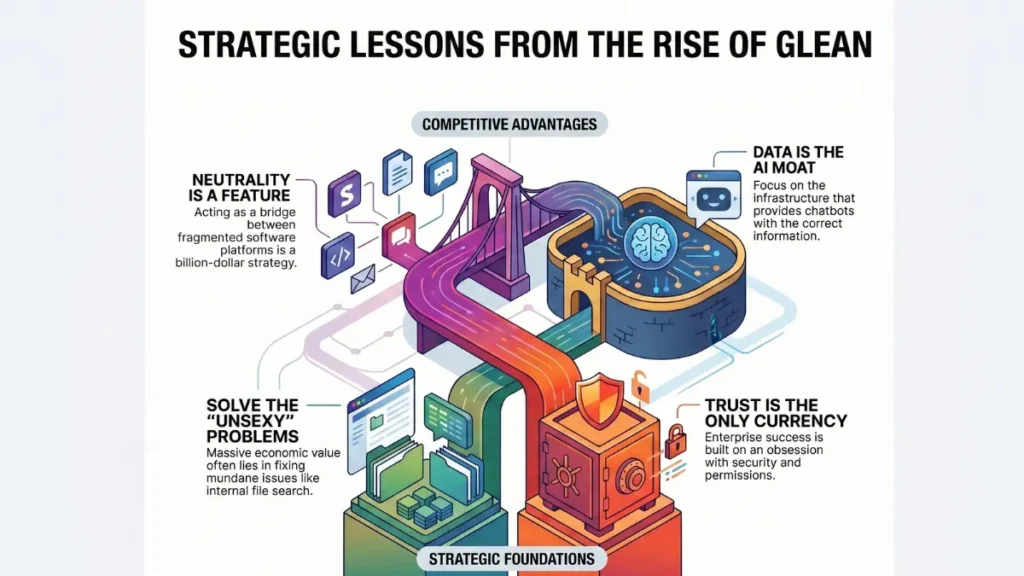
What can we learn from Arvind Jain and the rise of Glean?
- Solve the “Unsexy” Problems: Everyone wants to build the next social media app or a flying car. Very few people want to fix internal file search. Yet, the unsexy problems often hold the most massive economic value.
- Trust is the Only Currency: In the enterprise world, you don’t win with the best features; you win with the best trust. Glean’s obsession with security and permissions was the key to their success.
- Neutrality is a Feature: In a world of fragmented software, being the bridge between platforms is a billion-dollar strategy.
- Data is the AI Moat: Don’t just build a better chatbot. Build the infrastructure that gives the chatbot the right information.
Conclusion: The Quiet Revolution
The rise of Glean is a masterclass in patient, disciplined innovation. Arvind Jain didn’t try to “disrupt” everything at once. He identified a single, agonizing pain point—the inability to find information at work—and applied world-class engineering to solve it. While the rest of the world was distracted by the “next big thing,” Glean was quietly building the foundation for how we will work for the next fifty years.
The success of this $12 billion powerhouse proves that there is still massive room for “underdog” companies to beat the tech titans, provided they have a deeper understanding of the user’s pain and a relentless commitment to solving it better than anyone else. According to a report by Gartner, AI spending is set to explode, but only companies that can organize their data will see a return on that investment. Glean didn’t just give us a better search bar; it gave us our time back. And in the world of business, time is the only thing more valuable than money.
Key Takeaways
- Glean’s Core Mission: Solving the “productivity tax” by organizing internal company data.
- Competitive Edge: A “neutral” platform that works across all SaaS tools, unlike Microsoft or Google.
- Technical Foundation: Using a “Knowledge Graph” and RAG to provide hallucination-free AI answers.
- Valuation Driver: Being the essential data infrastructure for the Generative AI revolution.
Frequently Asked Questions (FAQ)
1. What exactly does Glean do?
Glean is an AI-powered enterprise search and assistant platform. It connects to all of a company’s internal tools (like Slack, Google Drive, Jira, and Salesforce) to help employees find information, summarize documents, and answer questions based on internal company data.
2. Who founded Glean?
Glean was founded by Arvind Jain, a former Google distinguished engineer and the co-founder of Nutanix. He brought together a team of experts from top tech firms to solve the problem of fragmented workplace information.
3. How is Glean different from ChatGPT?
While ChatGPT is trained on public internet data, Glean is trained on your company’s specific, private data. It understands your company’s acronyms, projects, and people, and it follows all your existing security permissions so people only see what they are authorized to see.
4. Why is the Glean AI success story so significant for VCs?
Glean proved that “enterprise search”—previously a “dead” category—could be revitalized by AI. Its $12B valuation shows that the market prizes “data access” and “security” above simple AI generation.
5. Is Glean secure for sensitive company data?
Yes. Glean was built with a “security-first” architecture. It respects all existing source permissions, meaning if a user doesn’t have access to a file in Google Drive, they won’t see it in Glean results either.


[…] Read More: Glean AI Success Story: How a $12B “Brain” Won the AI Gold Rush […]