

How GPT-5.5 Spud Model Is Solving the World’s Hardest Scientific Equations
The scientific community just hit a “Newtonian moment,” and the catalyst isn’t a human in a lab coat—it’s a series of neural weights codenamed “Spud.” In late April 2026, OpenAI quietly shifted the trajectory of modern research with the release of the GPT-5.5 Spud model. While the public was busy debating AI’s creative flair, the “Spud” iteration was busy doing something far more profound: solving postdoctoral-level mathematical proofs that have stumped experts for decades.
We have officially moved past the era of AI as a mere “summarizer.” We are now entering the frontier of AI as a “discoverer.” For the first time, a large language model isn’t just reciting the laws of physics; it is helping us write the next chapters.
Inside the Logic Engine: Why “Spud” Reasons Better Than Its Predecessors
OpenAI didn’t just “patch” GPT-5.4; with the Spud iteration, they went back to the studs, delivering the first total architectural overhaul since the 4.5 release. Unlike previous versions that felt like incremental improvements, the GPT-5.5 Spud model is natively omnimodal and built specifically for agentic reasoning.
In recent internal testing, the model tackled the FrontierMath Tier 4 benchmark—a gauntlet of math problems so difficult they typically take human PhDs days to solve. While previous state-of-the-art models languished with low double-digit scores, the GPT-5.5 Pro variant surged to a 39.6% success rate.
But the real headline wasn’t a score; it was a solution. OpenAI confirmed that a customized version of the model assisted researchers in discovering a new mathematical proof regarding Ramsey numbers in combinatorics. This isn’t just “fast math”; this is the resolution of complex structural relationships that define the limits of order in a chaotic system. According to the Official ArXiv Paper on Ramsey Numbers (2026), these findings represent a leap in our understanding of mathematical bounds.
Solving the “Unsolvable”: The Hardware-Software Synergy
What makes the GPT-5.5 Spud model different from its predecessors like GPT-4 or the o1 series? It comes down to a strategic shift in how the machine “thinks.”
- Hardware-Software Co-Design: Built on NVIDIA’s GB300 NVL72 systems, the model features specialized “Thinking” modes. This allows for massive internal compute-time—effectively “System 2” thinking—before an answer is rendered. This drastically reduces LLM latency in high-stakes reasoning.
- Autonomous Iteration: Spud doesn’t just guess an answer. It acts as an agent, writing its own code to test hypotheses, identifying bugs in its logic, and self-correcting until the equation balances.
This agentic workflow is a game-changer for U.S. tech giants like Tesla and Amazon. These firms are already integrating these reasoning capabilities into autonomous logistics and robotics. If an AI can solve a Ramsey number, it can certainly optimize a global supply chain or a self-driving neural net in real-time.
Real-World Impact: The $800B R&D Revolution
Data from McKinsey & Company paints a staggering picture: we’re looking at trillions in unlocked value as AI shifts from guessing to discovering. The GPT-5.5 Spud model is the first tangible proof of that potential.
Case Study: Combinatorics and Cybersecurity
By cracking complex combinatorial equations, GPT-5.5 is directly impacting the “Trusted Access for Cyber” framework. For enterprise security leaders, this means AI can now identify “zero-day” vulnerabilities in encryption methods previously thought to be mathematically secure.
While this presents a “High” risk classification under OpenAI’s Preparedness Framework, the defensive capabilities for national security are unparalleled. Security teams can now use GPT-5.5 to stress-test their infrastructure against mathematical attacks that were once purely theoretical.
Read more on Johny Millionaire: The Future of Human-AI Orchestration: Inside Anthropic’s Project Glasswing
Why Investors and Founders Should Pay Attention
The shift from “Generative AI” to “Scientific AI” changes the investment thesis for the entire sector. We are seeing a move away from simple consumer apps toward heavy-duty industrial applications.
- The Agentic R&D Efficiency Index: Using the GPT-5.5 Spud model, early-stage biotech and materials science startups are reporting an average saving of 10 hours of high-level logic work per week.
- Token Efficiency: GPT-5.5 Pro uses 40% fewer output tokens for complex tasks compared to GPT-5.4, making “deep thinking” more affordable for lean teams.
- The Super App Foundation: CEO Sam Altman has hinted that Spud will serve as the backbone for OpenAI’s upcoming “Super App,” designed to handle professional-grade scientific and legal workloads.
As Harvard Business Review has noted, the companies that thrive in the next five years will be those that integrate “Reasoning AI” into their core IP development.
Read More: GPT-5 is Coming: OpenAI’s Secret Testing Exposed
Key Takeaways
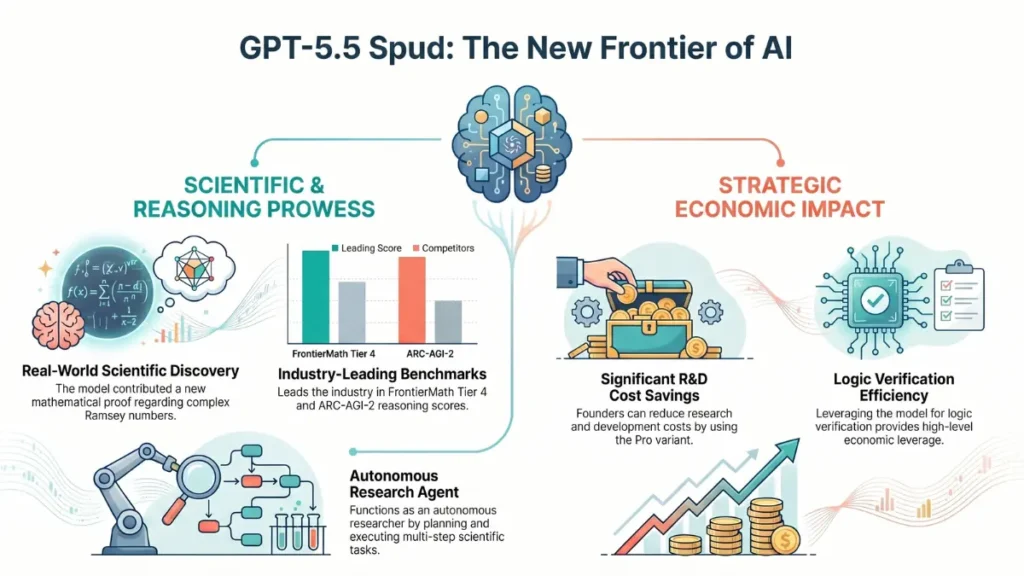
- Scientific Discovery: GPT-5.5 Spud has already contributed to a new mathematical proof regarding Ramsey numbers.
- Benchmark Dominance: It leads the industry in FrontierMath Tier 4 and ARC-AGI-2 reasoning scores.
- Agentic Nature: The model functions as an autonomous researcher, planning and executing multi-step scientific tasks.
- Economic Leverage: Founders can save significantly on R&D costs by leveraging the model’s Pro variant for logic verification.
FAQ: Understanding the GPT-5.5 Spud Model
Is “Spud” a different model than GPT-5.5? “Spud” was the internal code name for the model during development. It was officially released as GPT-5.5.
Can GPT-5.5 solve any math problem? While it is significantly better at postdoctoral math, it is not yet infallible and requires expert oversight for verification.
How can I access the GPT-5.5 Spud model? It is currently available to ChatGPT Plus, Pro, Business, and Enterprise subscribers, with API access rolling out to Tier 5 developers first.
The Bottom Line
The GPT-5.5 Spud model is no longer just a tool for writing emails or generating images; it is a collaborative partner in the hardest intellectual endeavors known to humanity. By bridging the gap between human intuition and machine computation, OpenAI has turned the “impossible” into a “work in progress.”
The future of science is no longer a solo journey—it’s a dialogue with a machine that finally knows how to think.
Read more on Johny Millionaire: Agentic AI & The Robotics Convergence: Why 2026 is the Year the “Brain” Met the “Body”


[…] Read more on Johny Millionaire: GPT-5.5 Spud Model: Solving the World’s Hardest Scientific Equations […]
[…] Read More: GPT-5.5 Spud Model: Solving the World’s Hardest Scientific Equations […]