



Walking through the Mission Bay innovation hubs today, you’ll notice a visceral shift in the local uniform. The Patagonia vest is still there, but the conversation has moved from “user acquisition loops” and “ad-stack optimization” to “protein folding sequences” and “FDA Phase II readouts.” There is a quiet, intense hum in the air—the sound of capital fleeing the ephemeral world of software for the tangible, high-stakes frontier of biology.
For the better part of three years, the venture capital world was intoxicated by the “SaaS-ification” of everything. But as we cross the threshold of April 2026, the Biotech Boom 2026 has officially arrived. The software-heavy “growth at all costs” era has met its match in a sector that offers something code alone cannot: the ability to rewire the human blueprint. We are no longer just building tools; we are programming life itself.
As of Q1 2026, the U.S. market has witnessed a seismic reallocation of capital. While speculative software companies face a brutal “valuation reset” due to eroding AI moats, biotechnology is surging. In the first three months of this year alone, 22 traditional IPOs hit the public markets, raising a combined $9.4 billion. Notably, biotech issuers represented nearly a third of that volume, marking the strongest opening quarter for the sector since the record-breaking heights of 2021.
This isn’t just a market correction; it’s a fundamental evolution. Rumors are swirling that one of the most prominent Silicon Valley “Tiger” funds recently liquidated 40% of its enterprise software holdings to go all-in on precision medicine. They aren’t alone. We are witnessing the birth of the “Tech-Bio” hybrid—companies that treat biology not as a mystery to be solved by trial and error, but as a system to be decoded, debugged, and optimized.
The Great Rotation: Why Investors are Fleeing SaaS for Life Sciences
For a decade, the “Unicorn” was synonymous with a 20-something founder in a hoodie building a social app or a productivity tool. In 2026, the hoodie has been replaced by a lab coat, and the “app” is a programmable mRNA strand or a generative protein model. This shift isn’t just aesthetic; it’s a cold, calculated move based on the death of the traditional software moat.
The Software Saturation Point and the 2026 Churn
The logic behind this rotation is simple: saturation and commoditization. In the U.S. tech market, enterprise software has become a “red ocean.” Every conceivable niche—from HR tech to CRM—has been digitized. Furthermore, the arrival of ubiquitous AI agents has lowered the barrier to entry so significantly that a single developer can recreate a mid-tier SaaS platform in a weekend.
In 2025, we saw the “SaaS Churn Crisis,” where mid-market companies realized they were paying for 40+ subscriptions that offered overlapping AI features. By contrast, Biotech retention is near 100% for successful therapies because there is no “cheaper alternative” to a life-saving drug. In the world of Biotech Boom 2026, the intellectual property (IP) is protected by the most rigorous gatekeeper on earth: the U.S. Patent and Trademark Office and the FDA.
Why Healthcare is the “Safe” AI Bet
In contrast, healthcare offers “Hard Tech” moats that are defensible by design. You cannot “prompt-engineer” your way through an FDA Phase III clinical trial. Investors are realizing that the most valuable application of Artificial Intelligence isn’t writing emails or generating marketing copy—it’s folding proteins and predicting molecular toxicity.
According to PwC’s US Capital Markets Watch, biopharma companies banked a median of $287.5 million per IPO in Q1 2026—more than double the median from the same period last year. The message from Wall Street is clear: if you can prove your science, the capital is infinite.
[Read more on Johny Millionaire: What It Takes to Build a $1B Company in America Today]
The Millionaire Bio-Moat Framework: Valuing “Drug-as-a-Service”
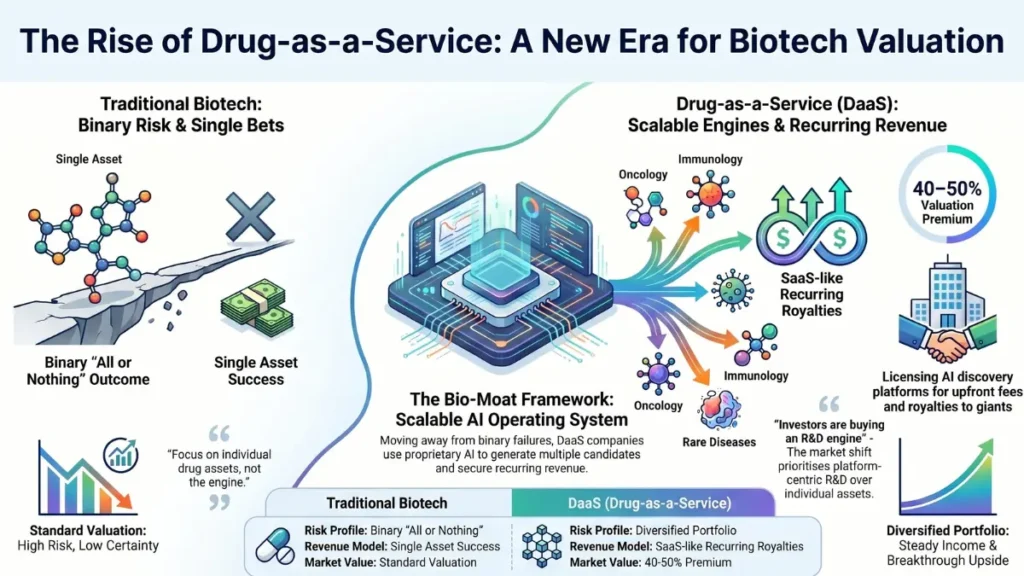
Historically, investing in biotech was akin to high-stakes poker where the house always won. It was a binary world of “All or Nothing”—a single failed clinical trial could wipe out a decade of work and billions in market cap overnight. This “single-asset” risk made biotech the “Failure Files” capital of the world.
The 2026 Unicorns are different. They utilize what we call the Millionaire Bio-Moat Framework. Instead of betting on one “blockbuster” drug, they are building proprietary operating systems—like the Recursion OS—that can generate dozens of drug candidates across oncology, rare diseases, and immunology simultaneously.
The Rise of DaaS (Drug-as-a-Service)
We are seeing the emergence of Drug-as-a-Service (DaaS). These companies don’t just develop their own pipeline; they license their AI-driven discovery platforms to Big Pharma giants like Pfizer or Eli Lilly for massive upfront fees and milestone royalties. This provides a “SaaS-like” recurring revenue stream while keeping the high-upside potential of a clinical breakthrough.
As noted by McKinsey & Company, the shift toward precision medicine and platform-centric R&D is creating a “valuation gap” where tech-enabled biotechs command a 40–50% premium over traditional peers. Investors are no longer just buying a drug; they are buying an R&D engine.
Angle 1: AI-Driven Drug Discovery — From 10 Years to 10 Months
The traditional drug discovery process is famously described as looking for one specific corrupted line of code in the entire global internet infrastructure. Historically, bringing a new drug to market took 10 to 12 years and cost upwards of $2.6 billion.
Speed-to-Market: The 70% Reduction
In the Biotech Boom 2026, the “Unicorn Blueprint” relies on slashing those timelines. Leading firms are using generative AI to cut the early-stage discovery phase—the “Target to Lead” period—by as much as 70%. Instead of physical chemists manually testing thousands of compounds in a wet lab, “digital twins” of human cells are simulated in massive GPU clusters. This allows researchers to identify the most promising candidates before they ever touch a petri dish.
The Hallucination Risk: Human-in-the-Loop
However, it’s not all automated. A key lesson from early 2026 is the “Hallucination Risk” in molecular design. AI can sometimes design proteins that look perfect on a screen but are physically impossible to manufacture or toxic to human tissue. The most successful Biotech Boom 2026 unicorns are those that maintain a “Human-in-the-Loop” strategy, where master chemists audit AI designs before they reach the synthesis stage.
Detailed Case Study: Eikon Therapeutics and the “Live Cell” Revolution
One of the standout performers of Q1 2026 is Eikon Therapeutics. Led by industry veterans from Merck, Eikon netted a $381 million IPO in February. Their secret weapon isn’t just AI—it’s their specific technology stack involving single-molecule tracking.
The Technology: Super-Resolution Microscopy
Eikon uses Nobel Prize-winning super-resolution microscopy to watch how proteins move and interact inside living cells in real-time. They then feed this massive data stream into their proprietary AI models. While competitors are looking at static snapshots of dead cells, Eikon is watching the movie of life.
This deep “Bio-convergence” of physics, software, and biology has allowed them to identify drug targets that were previously considered “undruggable.” Their $381 million raise is a testament to the market’s hunger for companies that own their own data generation.
Angle 2: The $9.4B IPO Momentum — Analyzing the Q1 Success Stories
The first quarter of 2026 wasn’t just about volume; it was about quality. The 22 traditional IPOs that raised over $9.4 billion weren’t the “zombie” companies of the low-interest-rate era. They were highly selective, clinically-grounded firms.
The 2026 IPO Honor Roll
- Aktis Oncology: Raised $318 million in the year’s first biotech IPO (January 11). They specialize in “radiopharmaceuticals”—delivering radiation directly to cancer cells like a GPS-guided missile.
- Generate Biomedicines: Captured the market’s imagination with a $400 million raise in late March. Their platform doesn’t just “search” for proteins; it generates them from scratch to solve specific biological problems.
- Eikon Therapeutics: As discussed, their $381M raise proved that “Hard Tech” microscopy combined with AI is a winning formula.
The End of “Exuberance”
Unlike the 2021 bubble, the 2026 boom is defined by investment discipline. Investors are demanding “Phase III data” or at least “mid-stage clinical testing” before they open their wallets. Of the six successful biotech IPOs in Q1, five had drugs already in advanced testing. This maturity is what makes the 2026 boom sustainable—it’s built on science, not just “bio-bucks” hype.
Angle 3: The Longevity Market — Bio-Hacking for the Global Elite
In the broader VC landscape, the “Millionaire Mindset” has shifted toward Longevity. According to Forbes, the longevity economy is projected to reach $600 billion this year. High-performance CEOs are no longer satisfied with standard healthcare; they want “Bio-optimization.”
The Ultimate Luxury is Time
We are seeing a surge in startups focused on “Senolytics”—drugs that clear out “zombie” cells that cause aging. For the Johny Millionaire audience, this is the ultimate strategic play. If you can extend the high-performance window of a billionaire founder by 20 years, the economic value is incalculable.
Bio-Hacking the C-Suite
The most successful healthcare unicorns of 2026 are those offering personalized, AI-driven wellness stacks. Imagine a system that monitors your blood chemistry in real-time via a wearable and adjusts your micronutrient intake and sleep protocols via an AI coach. This is the Precision Medicine revolution in action.
[Read more on Johny Millionaire: Why Quantum Advantage is No Longer a “Maybe” for 2026]
CRISPR 2.0: The Geopolitics of the Global Bio-Race
We cannot talk about the Biotech Boom 2026 without mentioning CRISPR. If AI is the architect, CRISPR is the construction crew. But in 2026, the story has moved from the lab to the global stage.
The U.S. vs. China Bio-Race
There is currently a “Cold War” for gene-editing supremacy. China has historically had more lax regulations regarding human germline editing, but the U.S. has maintained a lead in in vivo editing—fixing genetic defects directly inside the patient’s body with a single injection.
In April 2026, the U.S. government announced a massive federal grant program specifically for “Strategic Bio-Defense.” This has turned CRISPR unicorns into defense-adjacent assets. Fixing a rare blood disorder is a humanitarian win; being able to “reprogram” a population’s immune response to a novel pathogen is a national security necessity.
From Lab to Living Room
The integration of Generative AI has allowed these companies to design “guides” for CRISPR that are 100x more precise than those available just two years ago, virtually eliminating “off-target” edits. We are moving toward a world where “genetic errors” are treated like bugs in a software update.
Challenges to the Throne: The “Failure Files” of 2026
Even in a boom, there are lessons in the rubble. Not every biotech startup will become a unicorn.
The “AI-Wrapper” Trap
Just as in the software world, there are “AI-wrapper” biotechs—companies that use third-party models without owning any proprietary biological data. These firms are failing at record rates in 2026. Without a proprietary “wet lab” to validate AI predictions, these companies are essentially guessing. If you don’t own the data, you don’t own the moat.
The Regulatory Cliff
The FDA’s final AI guidance, expected in late 2026, will require sponsors to submit detailed documentation on model architectures and training data. Companies that haven’t prioritized “Governance” and “Auditability” from Day 1 will find themselves locked out of the market. The “move fast and break things” ethos of Silicon Valley does not work when “breaking things” means risking human lives.
Key Takeaways for the Strategic Investor
- Platform over Product: Look for companies building “engines” (DaaS), not just single-drug bets.
- Data Sovereignty: The most valuable biotechs are those that own their own “Wet Lab” data to train their AI (like Eikon).
- Defensible AI: Biotech is the only sector where AI is protected by a multi-billion dollar regulatory “moat.”
- The Longevity Rotation: Capital is moving toward the $600B longevity market—time is the new gold.
FAQs: Navigating the 2026 Biotech Landscape
1. Why is 2026 specifically called the “Year of the Healthcare Unicorn”?
Due to a record $9.4 billion raised in Q1 IPOs—nearly a third of which was Biotech—and a strategic rotation of capital from “soft” SaaS into “hard” life sciences and AI-driven drug discovery.
2. Is the “Biotech Boom 2026” a bubble like 2021?
No. The 2021 boom was driven by low interest rates and “COVID hype.” The 2026 boom is driven by Clinical Validation and high-rate discipline. Investors are only funding companies with advanced-stage data.
3. What is the “Bio-convergence” I keep hearing about?
It is the merging of traditionally separate fields: AI software, super-resolution physics, and CRISPR biology. This convergence allows us to see, model, and edit life with unprecedented accuracy.
4. How can I invest in this trend without being a scientist?
Focus on “Platform” companies or ETFs that track the Tech-Bio hybrid sector. Look for firms with strong partnerships with Big Pharma, which acts as a “seal of approval” for the science.
Conclusion: The New Frontier of Wealth
The Biotech Boom 2026 is more than a financial rally; it is the moment human biology became a programmable technology. For the founders, investors, and strategists of the Johny Millionaire brand, the lesson is clear: the next generation of billion-dollar empires will not be built on screens, but in sequences.
As we navigate this “Hard Tech” renaissance, the winners will be those who recognize that code is no longer just for computers—it is the language of life itself. The healthcare unicorn isn’t just a mythical beast of the stock market; it is the architect of our future. We are moving from a world where we “manage” disease to a world where we “edit” it out of existence.
Wealth is no longer just about what you own; in 2026, wealth is about what you can heal.


[…] Read More: The Biotech Boom: Why 2026 is the Year of the Healthcare Unicorn […]
[…] Read More: The Biotech Boom: Why 2026 is the Year of the Healthcare Unicorn […]