

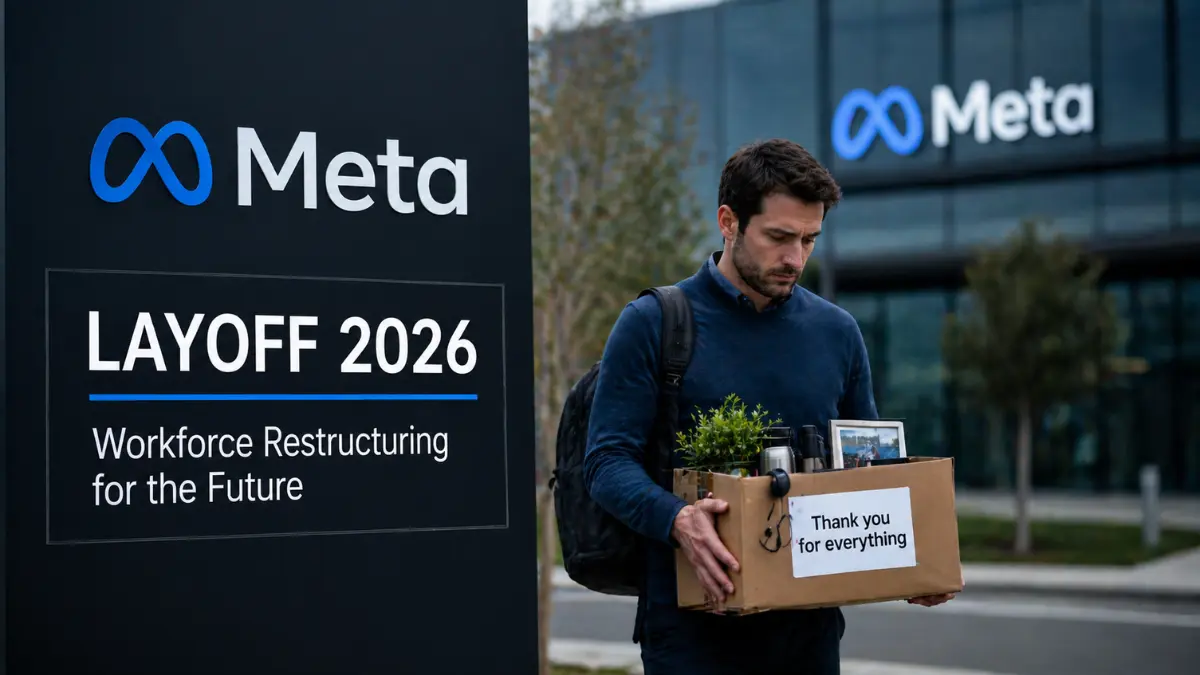
The “Year of Efficiency” at Menlo Park has officially transitioned from a temporary strategy into a permanent corporate philosophy. Mark Zuckerberg’s Meta Platforms Inc. sent shockwaves through Silicon Valley on Friday morning, confirming a fresh round of Meta layoffs 2026 that will eliminate approximately 8,000 roles. Unlike the broad-based reductions seen in 2023, this strategic contraction is surgical, targeting departments where the company’s own generative AI models have rendered human oversight redundant.
The Breakdown: Who is Impacted?
The cuts, representing roughly 10% of Meta’s remaining workforce, are heavily concentrated in mid-level product management, technical recruiting, and legal compliance tiers. Internal memos suggest that the deployment of Llama 4-based internal agents has streamlined software debugging and content policy enforcement to such a degree that manual intervention has dropped by nearly 40% in the last six months.
“We are not simply shrinking; we are evolving,” Zuckerberg stated in a town hall address. “The AI breakthroughs we’ve integrated into our internal stack allow us to operate with a much leaner core, reinvesting that capital into the $45 billion annual GPU infrastructure required to stay ahead of the curve.”
Why It Matters: The Investor vs. Employee Divide
For the market, the news of the Meta layoffs 2026 acted as a catalyst. Shares of META climbed 3.8% in premarket trading to $582.15, as analysts at Goldman Sachs raised their price target. Investors are applauding the margin expansion, noting that the reduction in payroll could add an estimated $1.6 billion to annual free cash flow.
However, the move signals a grim milestone for the tech industry. This is the first “Magnificent Seven” member to explicitly cite “AI displacement” rather than “macroeconomic headwinds” as the primary driver for mass workforce reduction. According to real-time tracking on Layoffs.fyi, the 2026 tech sector contraction has now surpassed 45,000 jobs, with AI efficiency cited in nearly 60% of cases.
Read More : Zuckerberg’s “Orion” Glasses Go Viral: Is the Smartphone Dead?
Bigger Context: From Metaverse to AI Supremacy
This move marks the fourth major headcount reduction since late 2022. While the “Reality Labs” division continues to burn through nearly $3.8 billion per quarter, Meta’s pivot to a “compute-first” company is nearly complete. By trimming human overhead, Meta is effectively financing its bid to own the world’s most powerful open-source AI ecosystem.
Historically, tech giants scaled by adding headcount to match revenue growth. In 2026, the industry standard has flipped: valuation is now increasingly tied to revenue-per-employee. Meta’s current revenue-per-employee sits at a staggering $1.9 million, and this latest round is designed to push that figure toward the $2.3 million mark by 2027.
What Comes Next?
The market will focus on Meta’s upcoming Q2 earnings report on July 29. Key metrics to watch include:
- Severance Costs: Expected to hit a one-time charge of $550 million.
- AI Tooling Adoption: Whether the automated workflows maintain product ship-cycles without increasing error rates.
- Regulatory Scrutiny: Increased attention from the U.S. Department of Labor regarding the ethical implications of algorithmic management and AI-driven displacement.
Conclusion: A Leaner, Colder Future
The Meta layoffs 2026 are a sobering reminder that in the age of Llama 4, even “top-tier” technical talent is not immune to the search for an optimized bottom line. Meta is no longer just a social media company; it is a lean, AI-driven machine that views human capital as a variable, not a constant.
Read More: The Nuclear Startup Surge: Why VCs Are Betting Billions on Small Modular Reactors