


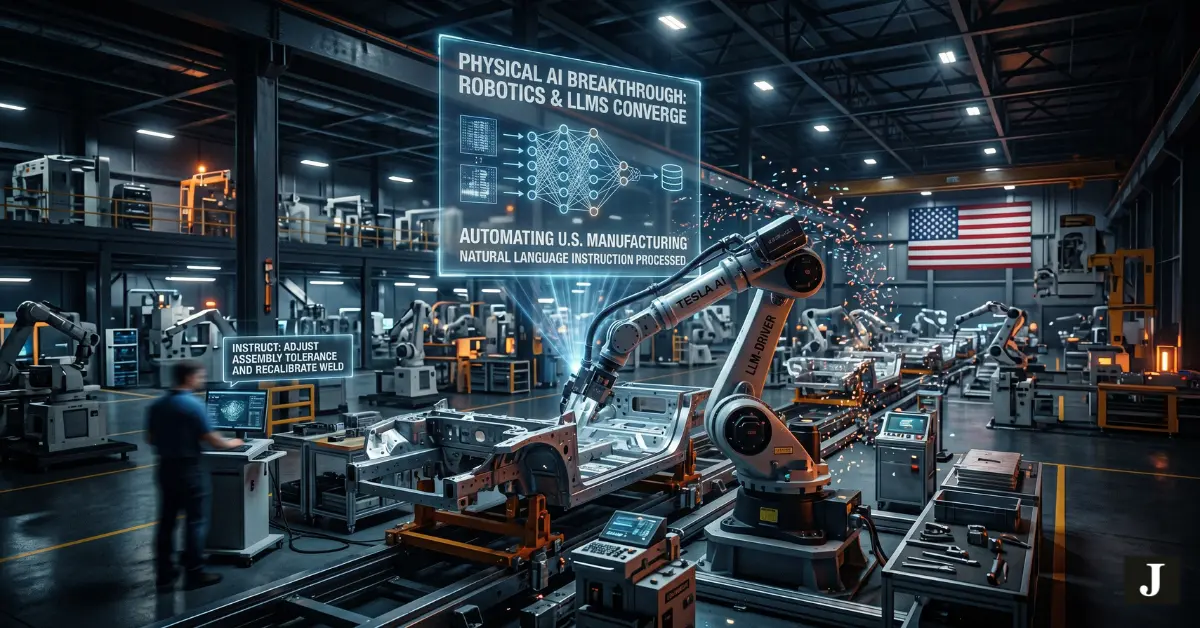
DETROIT — The American industrial landscape is witnessing a seismic shift as the theoretical promise of artificial intelligence finally gains a physical form. In a landmark Physical AI breakthrough, a coalition of leading robotics firms and Silicon Valley labs have successfully integrated Large Language Models (LLMs) with multi-modal robotic systems, effectively bridging the gap between digital reasoning and manual labor. This convergence is poised to automate complex U.S. manufacturing tasks that were previously deemed “too human” for traditional automation.
For decades, industrial robots were rigid, programmed to perform singular, repetitive motions. However, this new generation of Physical AI allows machines to understand natural language instructions and adapt to unstructured environments. Instead of thousands of lines of code, a floor manager can now simply tell a robotic unit to “sort the damaged components and recalibrate the assembly jig.” The system uses its LLM backbone to parse the intent and its visual-spatial sensors to execute the physical task.
This shift is a massive win for the domestic “re-shoring” movement. As labor shortages persist across the Rust Belt, the ability to deploy flexible, intelligent automation is becoming a matter of survival. According to the National Association of Manufacturers, the integration of autonomous systems could close the skills gap that has left hundreds of thousands of high-tech manufacturing roles unfilled.
For investors, the implications are profound. We are moving beyond the era of “Software as a Service” (SaaS) and into “Intelligence as a Service” (IaaS) for the physical world. Companies at the forefront of this convergence, such as Boston Dynamics and specialized AI labs, are seeing record-breaking venture capital inflows. Market analysts at NIST suggest that this automation wave could increase U.S. manufacturing productivity by as much as 30% over the next five years.
The broader market context is one of urgent modernization. With global supply chains remaining volatile, the U.S. is racing to build a “dark factory” infrastructure—facilities that can operate with minimal lighting and heating because the “workers” are silicon and steel.
In conclusion, the convergence of robotics and Large Language Models isn’t just a technical milestone; it is an economic imperative. By giving AI a body, the U.S. is not just automating jobs—it is reinventing the very foundation of industrial power for the 21st century.
Read More: Green Computing Mandate: Microsoft and Google Unveil First-Generation Carbon-Neutral Data Hubs


[…] Read More: How Robotics and LLMs are Converging to Automate U.S. Manufacturing […]