


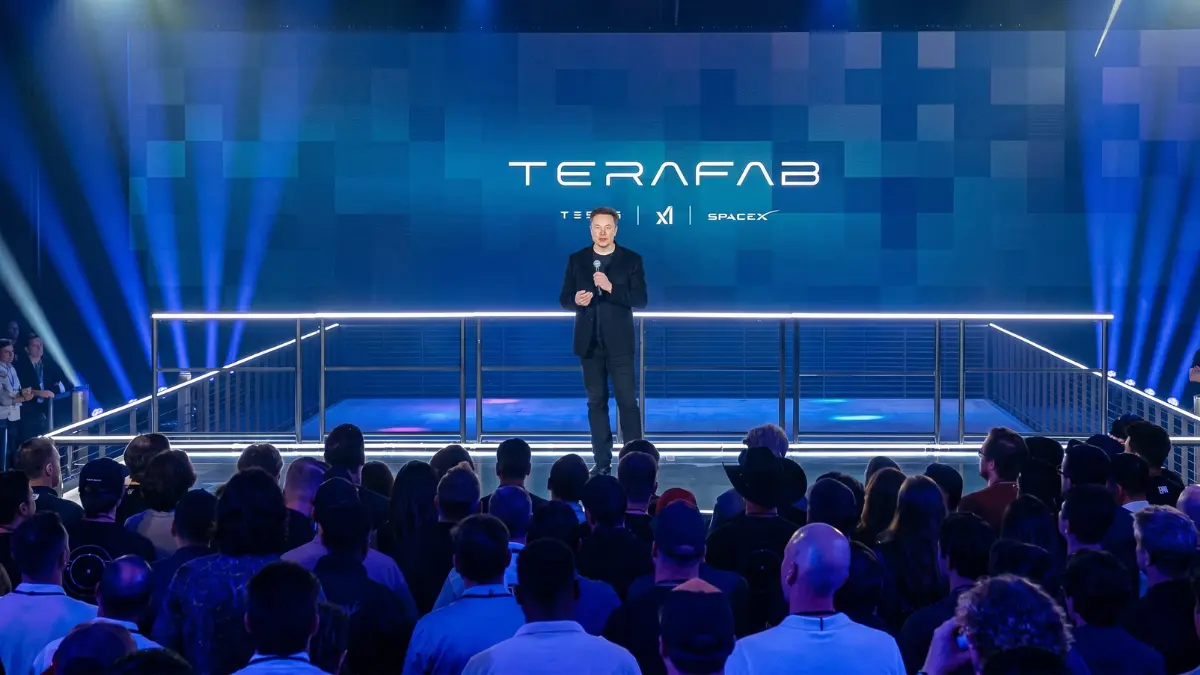
The $839 Billion Man: Inside Elon Musk’s 2026 “Terafab” Masterplan and the Race to $1 Trillion
History usually remembers the titans—Rockefeller, Ford, Carnegie—by the raw steel they forged and the railways they laid. But as of April 14, 2026, we are witnessing a wealth accumulation event that renders those Gilded Age fortunes almost quaint by comparison. Today, Elon Musk is forging something less tangible but far more potent: a monopoly on the very systems that create products.
Elon Musk’s net worth has officially surged to a staggering $839 billion. This isn’t just a vanity metric on a Bloomberg terminal; it is the financial manifestation of a “Closed-Loop Sovereignty” between Tesla’s robotics, SpaceX’s orbital dominance, and the raw computational muscle of X.ai. While many point to simple stock speculation, the real catalyst is more grounded: the quiet activation of the Elon Musk Terafab Masterplan—a move that effectively turns manufacturing into a software problem.
As the financial world braces for the imminent SpaceX IPO—projected to be a seismic event in public markets—the question is no longer if Musk will become the world’s first trillionaire. The question is exactly which Tuesday in late 2026 the ticker will cross the twelve-zero threshold.
Speculation Box: Will the SpaceX IPO be a 2026 “Black Swan” event? The sheer scale of the private-to-public transition could potentially destabilize traditional aerospace indices while catapulting Musk’s personal liquidity to levels never seen in a democratic state.
Case Study: The Austin Terafab vs. The Legacy Giants
To understand why the market is valuing Musk’s vision at nearly a trillion dollars, we have to look at the “Ground Zero” of the new industrial age: Austin, Texas. A recent audit comparing the Austin Terafab to a leading German luxury automaker’s flagship plant in Bavaria tells the story of a dying era versus a nascent one.
The Human-Machine Delta
The German plant, a marvel of 20th-century engineering, employs 12,000 workers to produce 400,000 vehicles per year. It is a place of noise, rhythmic clanging, and the smell of hot grease.
In contrast, the Austin Terafab is eerily quiet—a high-tech cathedral where the only sound is the low-frequency hum of liquid-cooled servers. It produces 650,000 vehicles annually with a skeleton crew of just 1,200 technicians. The “heavy lifting” is performed by a fleet of 8,000 Optimus Gen-3 units. These aren’t just tools; they are autonomous industrial organisms that don’t take lunch breaks or file grievances.
Energy Sovereignty
While the rest of the U.S. manufacturing sector grappled with the energy price spikes of early 2026, the Terafab remained insulated. By utilizing on-site SMRs (Small Modular Reactors) and a massive, integrated solar-glass roof, the facility is essentially an energy island. This “Unicorn Blueprint” applied to heavy industry creates a marginal cost curve that traditional OEMs like Ford or GM—burdened by legacy pension costs and rigid supply chains—simply cannot replicate.
The Genesis of the Terafab: Manufacturing at the Limit of Physics
For years, the “Gigafactory” was the gold standard of industrial efficiency. However, in the high-velocity market of 2026, the Gigafactory is a relic. The Terafab represents a shift from “large-scale manufacturing” to “autonomous industrial synthesis.”
The Elon Musk Terafab Masterplan focuses on a “lights-out” manufacturing philosophy. The goal is to decouple human labor from industrial output entirely. But how does this actually work on the floor?
A Technical Walkthrough of the Production Line
In a traditional factory, the assembly line is a linear path. In a Terafab, the line is a “Neural Mesh.”
- The Digital Twin Phase: Before a single piece of aluminum is cast, X.ai runs six million simulations of that specific production run. It identifies potential thermal bottlenecks in the casting process that a human engineer would miss.
- Synchronous Design: Most companies design a product and then figure out how to build it. Musk’s “Closed-Loop” system designs the Tesla Bot and the vehicle chassis simultaneously. Every bolt is placed so that an Optimus Gen-3 hand can reach it at the optimal torque angle without human-assist sensors.
- The Self-Healing Chain: If a shipment of sensors is delayed at the Port of Houston, the Terafab’s AI doesn’t wait for a manager to make a call. It automatically re-configures the assembly sequence, prioritizing models that don’t require that specific sensor, maintaining 98% uptime while competitors sit idle.
The Power of X.ai Integration
The “Neural Backbone” of the Terafab is what separates it from a standard automated plant. Using proprietary action models, X.ai allows the factory to learn. If a robotic arm detects a 0.1mm deviation in a weld, that data is instantly shared across every Tesla facility globally. The entire fleet of factories “learns” to correct the error in milliseconds.
The SpaceX IPO Math: The $75 Billion Catalyst
While Tesla provides the terrestrial cash flow, SpaceX is the vehicle carrying Musk toward the trillion-dollar finish line. The rumors of a 2026 IPO have moved from speculative whispered conversations in Manhattan boardrooms to an official SEC filing timeline.
Wall Street analysts at Morgan Stanley have hinted that the private-to-public transition of SpaceX could unlock $75 billion in immediate liquid value for Musk personally. This is based on a total company valuation exceeding $600 billion—a number driven by two factors: Starlink and Starship.
Starlink: The Global Connectivity Monopoly
The secret to the SpaceX valuation isn’t just Mars; it’s the ubiquitous connectivity of Starlink. By mid-2026, Starlink has captured nearly 40% of the rural and maritime internet market globally. This high-margin, recurring subscription revenue is the “boring” business that funds the “exciting” rocket business.
Starship and the New Orbital Economy
The successful deployment of Starship has reduced the cost to orbit by an order of magnitude. We are no longer talking about $2,500 per kilogram; we are talking about $100. This has birthed a “New Orbital Economy”—including space-based manufacturing of pharmaceuticals and fiber optics that can only be created in zero-G.
Unlike the traditional aerospace giants (Boeing, Lockheed), SpaceX doesn’t just build the rockets; they own the “toll road” to the stars. If the IPO proceeds as expected in Q3 2026, the influx of public capital will likely trigger a re-valuation of Musk’s entire portfolio, providing the final velocity needed to break the $1 trillion barrier.
Strategy and Insights: What Can We Learn?
Even if you aren’t aiming for a trillion-dollar net worth, the Elon Musk Terafab Masterplan offers critical lessons for any modern entrepreneur or investor:
- Iterate on the Machine, Not Just the Product: Musk’s greatest innovation isn’t the Tesla car; it’s the factory that builds the car. In your business, focus on your internal systems as your primary product.
- Vertical Integration as Sovereignty: By owning the rockets, the satellites, the chips, and the AI, Musk has eliminated “middleman risk.” In an unstable 2026 economy, control is more valuable than capital.
- The Convergence Play: Wealth is created at the intersection of industries. Don’t just be an “AI company” or a “Logistics company.” Find the overlap where one fuels the other.
- Embrace the Radical Step-Function: In a world of incremental gains, the market rewards the 10x change. The Terafab isn’t 10% better; it’s a fundamental re-imagining of physics in the workplace.
[Read more on Johny Millionaire: Why Musk is Finally Preparing to Unbundle His Starlink Empire]
The Road to $1 Trillion: Projections and Milestones
To understand the trajectory to $1,000,000,000,000, we have to look at the 2026–2028 window. This isn’t just about stock price appreciation; it’s about the convergence of three distinct “S-Curves” hitting their stride.
Wealth Trajectory Table (2024-2027)
| Milestone Year | Estimated Net Worth | Primary Growth Driver |
| 2024 | $250 Billion | Tesla Recovery & Starlink Growth |
| 2025 | $500 Billion | X.ai Monetization & Optimus Pilot |
| Early 2026 | $839 Billion | Terafab Announcement & SpaceX IPO Filing |
| Late 2026 | $1.02 Trillion | Full SpaceX Public Launch |
| 2027 | $1.3 Trillion | Tesla Robotaxi Fleet Deployment |
The “Trillionaire Mindset” is not about hoarding cash. Musk’s wealth is almost entirely illiquid, tied to the equity of companies he founded or rescued. This “All-In” approach is a hallmark of the millionaire mindset, but at this scale, it becomes a geopolitical force. When a single individual controls the satellite communications of nations and the launch capability of the world’s superpower, the traditional rules of business leadership are replaced by something akin to statecraft.
The “Musk Risk” Factor: Politics, Regulation, and the Case Against the Trillion
Of course, this assumes the SEC doesn’t clip his wings first. No deep dive into the $839 billion man is complete without addressing the volatility that comes with the brand. The “Musk Risk” factor is at an all-time high in 2026.
The Political Lightning Rod
Musk’s overt involvement in U.S. politics—specifically his “Department of Government Efficiency” (DOGE) initiatives—has made him a polarizing figure. While his supporters see him as a disruptor of bureaucracy, regulators see him as a monopoly risk that transcends industry.
The Case Against the Trillion: Why the Terafab Might Fail
There is a non-zero chance that the Terafab becomes “Production Hell 2.0.”
- The Complexity Ceiling: There is a point where a system becomes so complex that a single software bug can paralyze the entire global network.
- The Regulatory Hammer: The Federal Trade Commission (FTC) and various EU bodies have intensified their scrutiny of the “Musk Ecosystem.” Specifically, the way X.ai uses data from Tesla vehicles to train its models has sparked a series of high-stakes legal battles.
- The Cognitive Load: Managing four world-changing companies simultaneously is a psychological weight that would bankrupt any other CEO. If Musk falters, the “key man risk” could wipe out $300 billion in value overnight.
Energy Independence: The SMR Revolution
A critical, often overlooked component of the Elon Musk Terafab Masterplan is the move into nuclear energy. To power the massive training clusters for X.ai and the 24/7 operations of the Terafab, Musk has moved aggressively into the Small Modular Reactor (SMR) market.
Energy independence is the new “gold.” In 2026, the power grid is the primary bottleneck for AI and manufacturing. By building his own power sources, Musk isn’t just saving on utility bills; he is ensuring that his companies can operate when the rest of the world goes dark. This is the ultimate expression of his “Sovereignty” strategy—a business that requires nothing from the outside world but raw materials.
The Future of the Trillion-Dollar Frontier
As we look toward the remainder of 2026, the gravitational pull of Musk’s wealth is reshaping the American economy. We are entering the era of the “Sovereign Entrepreneur”—individuals whose resources rival those of mid-sized nations.
The race to $1 trillion is about more than ego. It is a race to prove that a single, unified vision, powered by autonomous manufacturing and extraterrestrial expansion, can solve the most pressing bottlenecks of human civilization. Whether Musk reaches the milestone in September or December is irrelevant; the era of the industrial-digital titan is here, and the Terafab is its cathedral.
The trillion-dollar barrier is no longer a question of “if”—it is a countdown.
Key Takeaways
- Wealth Milestone: Musk’s $839 billion net worth is driven by the synergy of Tesla, SpaceX, and X.ai.
- The Terafab: A new manufacturing standard aiming for 90% automation through robotics and AI digital twins.
- SpaceX IPO: The projected $75 billion liquidity event that serves as the final catalyst for trillionaire status.
- Energy Sovereignty: The use of SMRs to ensure the Elon Musk Terafab Masterplan remains independent of grid volatility.
- The Musk Risk: High-stakes regulatory and political battles remain the primary threat to this wealth accumulation.
FAQs
Q: When is the SpaceX IPO expected to happen?
A: Current filings and market sentiment point toward a Q3 or early Q4 2026 launch, pending SEC finalization and Starship’s upcoming “commercial ready” certification.
Q: What exactly is a Terafab?
A: It is the evolution of the Gigafactory. A Terafab uses AI-driven “lights-out” manufacturing, heavily utilizing humanoid robots (Optimus) to achieve near-total automation of complex assembly.
Q: Can anyone else beat Musk to the $1 trillion mark?
A: While Jeff Bezos and Jensen Huang (NVIDIA) have seen massive gains, Musk’s ownership percentage of his companies and the upcoming SpaceX IPO give him a mathematical lead that is currently insurmountable in the 2026 calendar year.
Q: How does Musk’s political involvement affect his companies?
A: It creates high volatility. While it can lead to favorable domestic manufacturing policies, it also risks alienating key consumer demographics in California and Europe, creating a “brand tax” that the companies must overcome.
Conclusion
The $839 billion valuation of Elon Musk is not the ceiling; it is the launchpad. Through the Elon Musk Terafab Masterplan and the relentless expansion into the orbital economy, he is rewriting the rules of what a single human can achieve in the business world. As we watch the final sprint toward $1 trillion, it becomes clear that we are no longer just watching a business story—we are watching the birth of a new era of human enterprise.