


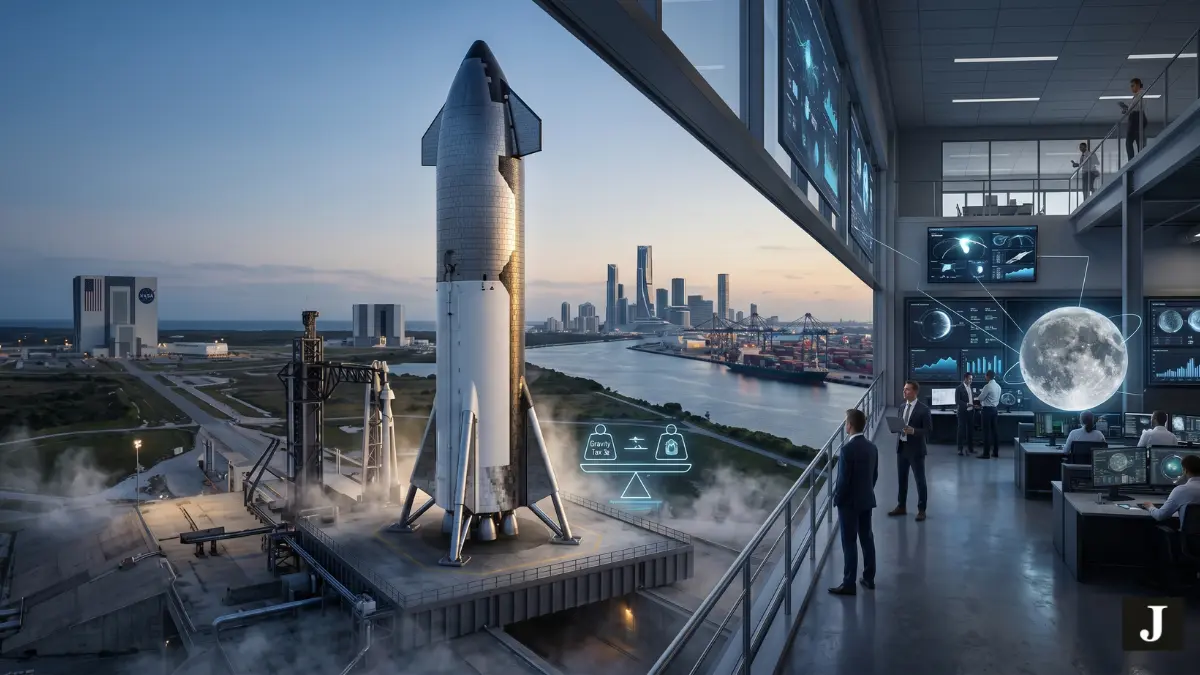
The thunderous sonic booms that rolled across Cape Canaveral early Tuesday morning signaled more than just a successful touchdown; they announced the end of an era. At 2:53 a.m. EDT, SpaceX successfully landed its heavy-lift Starship booster at its dedicated Florida facility, completing a mission that effectively clears the regulatory and technical flight-path for the first commercial moon missions. For investors and geopolitical strategists, this landing represents the definitive “Green Light” for the industrialization of Low Earth Orbit (LEO).
The Collapse of the ‘Gravity Tax’
For decades, the “Gravity Tax”—the prohibitively high cost of escaping Earth’s atmosphere—has stifled space-bound innovation. In 2010, the cost to orbit sat at roughly $25,000 per kilogram. By 2024, the Falcon 9 had slashed that to approximately $2,700. Today, with the full reusability demonstrated by Starship, analysts at firms like Quilty Space project a catastrophic drop toward a target of $10 per kilogram.
This 99% reduction in cost-to-orbit fundamentally alters the EBITDA math for thousands of industries. When launch costs transition from a capital-expenditure barrier to a line-item operating expense, the “multi-trillion dollar space economy” ceases to be a venture capital buzzword and becomes a tangible market reality.
Starlink: The Minimum Viable Product
While Starlink—now serving over 17 million users with projected 2026 revenues of $20 billion—is often viewed as SpaceX’s crown jewel, today’s landing proves it was merely the “Minimum Viable Product” (MVP). The massive cash flow from Starlink has essentially functioned as the R&D fund for Starship. SpaceX’s internal valuation, recently pegged at $1.5 trillion ahead of its anticipated June 2026 IPO, is now being recalibrated. The true value lies not in satellite internet, but in the transportation infrastructure that makes Starlink-sized constellations a weekly occurrence.
The Dawn of Orbital Manufacturing
The industrial focus is shifting from “exploration” to “extraction and production.” In the microgravity environment of LEO, manufacturers can produce ZBLAN fiber optics with 100x less signal loss than silica, and pharmaceutical giants like Varda Space are already refining protein crystals for cancer treatments with a purity unattainable on Earth. With Starship’s 100-ton payload capacity, these “lab-in-a-box” experiments are scaling into “factory-on-a-wing” operations.
Geopolitics: The Race for the Lunar South Pole
Beyond the economic windfall lies a stark geopolitical reality. The successful Florida landing accelerates the Artemis timeline at a critical juncture. China’s ILRS program (International Lunar Research Station) is moving with state-led precision toward a 2030 crewed landing. The Lunar South Pole, rich in water ice for hydrogen fuel and Helium-3 for future fusion energy, is the new “Suez Canal.” This morning’s landing confirms that the U.S., via its private-sector proxy, currently holds the logistical high ground.
SpaceX Starship: The Most Powerful Rocket Ever Built
This video provides a deep technical dive into the Starship architecture, explaining why full reusability is the key to the economic and geopolitical shifts discussed in the article.
Read More: The SpaceX IPO Fever: Why Musk is Finally Preparing to Unbundle His Starlink Empire