



The De-Dollarization Update: How 2026 Trade Policies are Strengthening BRICS
For eighty years, the U.S. dollar wasn’t just money—it was the world’s ultimate geopolitical hall pass. But in the second quarter of 2026, that pass is being revoked. The topic of de-dollarization is no longer a localized academic debate; it is trending across financial corridors following a landmark SCOTUS tariff ruling and a pivot toward aggressive U.S. protectionism. Geopolitical analysts are sounding the alarm: domestic policy is inadvertently providing the ultimate recruitment tool for the BRICS bloc.
As the U.S. implements an 11% average tariff across various sectors, even our closest neighbors are flinching. Canada and Mexico—partners we once considered “dollar-locked”—are actively vetting non-dollar alternatives. What was once a fringe theoretical discussion has become a boardroom reality for every multinational corporation attempting to navigate this shifting landscape.
The 11% Wall: Straining the USMCA Alliance
The most immediate consequence of this new trade posture is the visible fracture within the United States-Mexico-Canada Agreement (USMCA). By imposing an 11% average tariff on key imports, the “special relationship” is facing its greatest test since the 1940s.
For Canada (CAD) and Mexico (MXN), these tariffs represent a massive inflationary shock. When the cost of doing business with the U.S. spikes, the incentive to diversify trade partners isn’t just strategic—it’s a matter of survival. Mexico is already exploring “payment rail” alternatives that bypass the SWIFT system for agricultural exports to the Global South. This isn’t just about moving goods; it’s about the currency used to settle those transactions. If our neighbors begin settling trade in local currencies or a BRICS-basket alternative, the demand for USD naturally softens, leading to the very currency shocks investors fear most.
But the North American strain is only half the story; across the Atlantic, a separate stalemate is handing the BRICS bloc their biggest win yet.
Why the EU Trade Delay is a BRICS Victory
While Washington focuses on protectionism, the European Union has hit a stalemate in its trade negotiations with the U.S. The delay of the 2026 Transatlantic Trade Accord has left a vacuum that the BRICS+ nations are eager to fill. BRICS—which recently expanded to include several major energy producers—has evolved into a functional economic alliance.
According to the latest IMF Currency Composition of Official Foreign Exchange Reserves (COFER) data, the shift toward multipolar trade is accelerating faster than most Western models anticipated. By offering streamlined trade settlements in non-dollar currencies, BRICS is positioning itself as the “stability alternative” for nations frustrated by U.S. policy pivots. For every month the U.S. remains locked in a protectionist stance, the BRICS infrastructure grows more integrated, making the eventual return to a dollar-centric world nearly impossible.
[Read more on Johny Millionaire: The 2026 Energy Crisis: Why the U.S. is Forced to Balance Sanctions with Survival
The Sovereign Supply Shift: Moving to Regionalism
We are witnessing the death of “Globalism 1.0.” In its place, we find a new era of “The Sovereign Supply Shift.” The supply chain risks of 2026 are characterized by a desire for proximity and security over mere cost-efficiency.
Consider Apple’s recent maneuver: the tech giant has diversified its manufacturing hubs into India and Vietnam as a direct hedge against U.S.-China trade friction. Currently, Apple is reportedly aiming to move 25% of its iPhone production to India by 2027. This regionalization encourages the use of local currency for trade settlements. As supply chains shorten, the need for a global “middleman” currency—the Dollar—diminishes. When a Malaysian chip manufacturer sells to a Vietnamese assembler, there is a growing economic logic to settle that trade in a local currency pair rather than converting twice through the USD.
How Investors Can Hedge Against Currency Shocks
In this fragmented landscape, the risk of a “currency shock” is higher than at any point in recent memory. Investors must move beyond the traditional “60/40” portfolio and consider a more nuanced approach.
- Diversify Cash Holdings: Maintain a portion of liquid reserves in “neutral” currencies or hard assets like physical gold.
- Target Commodity-Linked Assets: BRICS expansion is heavily weighted toward commodity producers. Exposure to these markets acts as a natural hedge against USD devaluation.
- Monitor “Digital Rails”: Pay close attention to Central Bank Digital Currencies (CBDCs) and non-SWIFT payment systems gaining traction in the East.
As Harvard Business Review has noted in previous cycles, the real threat to the dollar isn’t a single competitor, but a thousand small cuts to its utility. Understanding the flow of energy and technology is now more vital than tracking the Federal Reserve’s every word.
Read more on Johny Millionaire: The Biotech Boom: Why 2026 is the Year of the Healthcare Unicorn
The 30-Second Wealth Hedge
If you hold more than 90% of your liquid assets in USD-denominated accounts, your portfolio is effectively a bet on U.S. trade policy. Consider rebalancing 10-15% into “hard” assets or commodity-producing equities to insulate yourself from the next round of tariff-driven volatility.
Key Takeaways
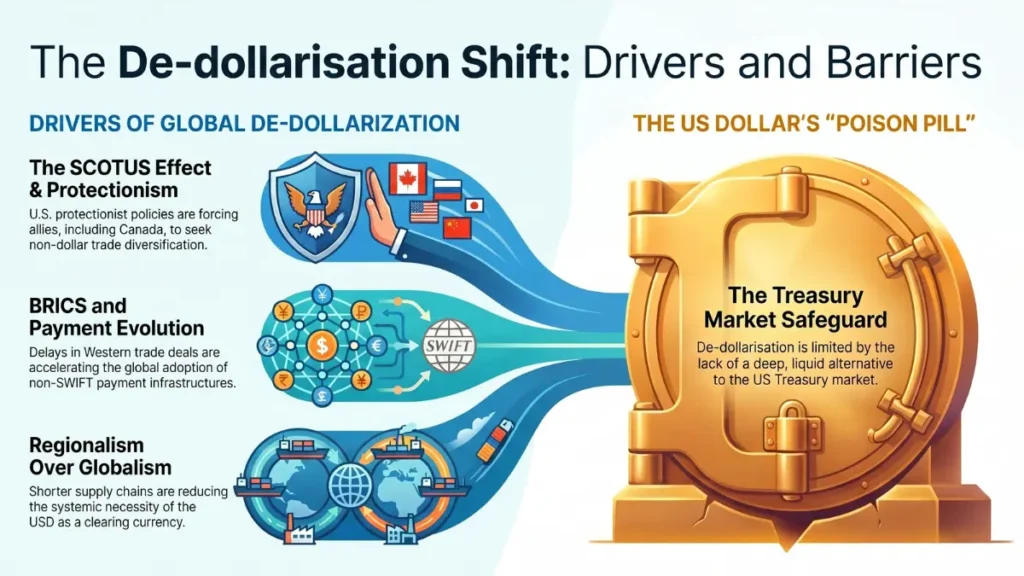
- The SCOTUS Effect: U.S. protectionism is forcing even allies like Canada to seek non-dollar trade diversifications.
- BRICS Momentum: Western trade deal delays are accelerating the global adoption of non-SWIFT payment infrastructures.
- Regionalism Over Globalism: Shorter supply chains are reducing the systemic necessity of the USD as a clearing currency.
- The “Poison Pill”: While de-dollarization is real, the Dollar’s ultimate protection remains the lack of a deep, liquid alternative to the US Treasury market.
Conclusion
Washington’s attempt to “strengthen the core” via 11% tariffs has triggered an ironic backlash: by building a wall around the dollar, we’ve effectively locked the rest of the world out. For the Johny Millionaire reader, the message is clear: the global order is shifting from a monopoly to a marketplace. Those who recognize the rise of BRICS and the pivot to regionalism will be the ones who protect their wealth in the decade to come. The Dollar isn’t facing an extinction event; it’s facing an eviction from its position as the world’s only clearinghouse.
Read more on Johny Millionaire: The Strait of Hormuz Standoff: Why a Fragile Ceasefire is the Only Thing Standing Between $150 Oil and a Global Recession
Frequently Asked Questions (FAQ)
1. Is the U.S. Dollar going to lose its reserve status overnight? No. De-dollarization is a “slow-burn” process. While the Dollar’s share of global Foreign Exchange Reserves is declining, it remains the most liquid currency. It is moving from a monopoly to a prominence in a multipolar system.
2. How do U.S. tariffs specifically hurt the Dollar? Tariffs make USD-based trade more expensive. When the cost of using the Dollar rises, nations find ways to bypass it, reducing global demand.
3. What role does technology play in this shift? Blockchain and CBDCs allow nations to trade directly without needing the U.S. banking system as an intermediary, making de-dollarization technically feasible.