


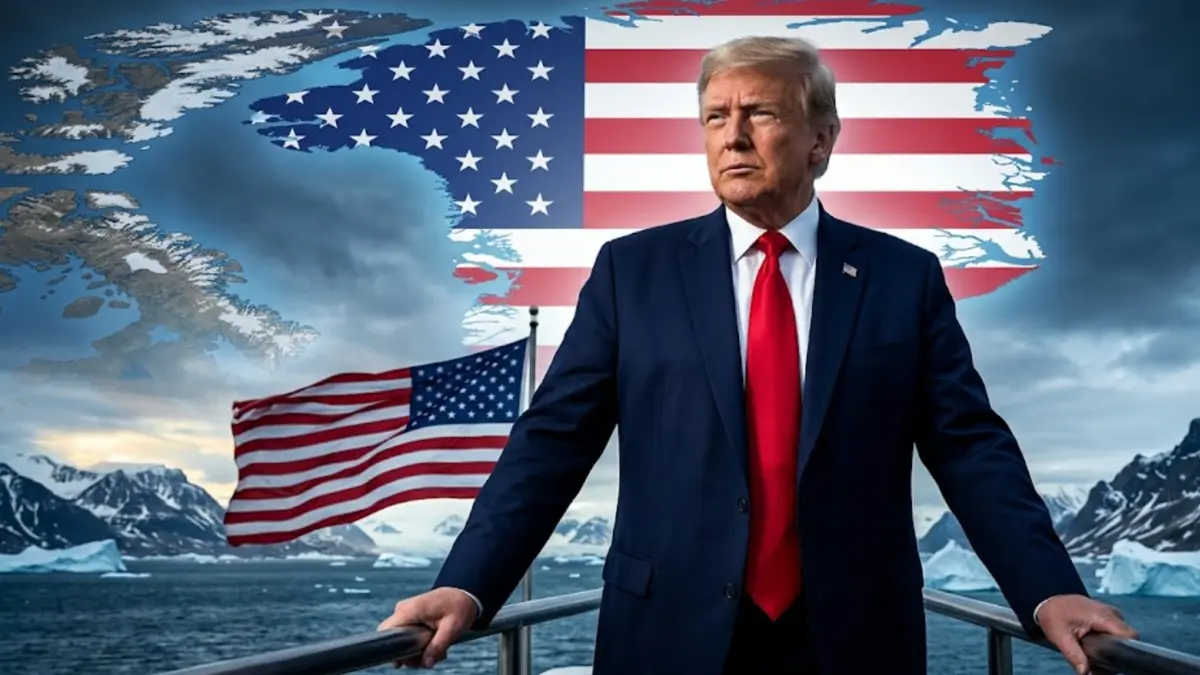
As we cracked open the books for Q2 2026, the White House didn’t just walk into the trade arena—they stormed it with a two-pronged strategy that has global markets gasping for air. The boardroom of 2026 looks nothing like the boardroom of 2019. If the early 2020s were a desperate scramble for pandemic resilience, the mid-2020s are being forged by something far more aggressive: The Tariff Doctrine.
This isn’t just about protectionism; it’s about a U.S. administration that views national borders as economic high-pressure valves. By leveraging the International Emergency Economic Powers Act (IEEPA) of 2025, the executive branch has fundamentally altered the DNA of global commerce. We are no longer debating “free trade.” We are navigating a landscape of strategic leverage where the tax code is the primary weapon of diplomacy.
Executive Summary: The 30-Second Strategist
- The Move: A double-offensive involving the “Greenland Escalation” for mineral sovereignty and a 10% universal tariff threat against the EU.
- The Impact: Massive supply chain decoupling forcing a migration to Mexico and Vietnam.
- The Deadline: October 2026 marks the expiration of the China Trade Deal—the “Black Swan” on every CEO’s calendar.
- The Play: Adopt the “Millionaire’s Triangle of Protectionism”—Audit sourcing, hedge currency, and automate compliance.
1. Ghosts of Trade Past: Why 2026 is Not 1930
To understand the sheer scale of the Tariff Doctrine, we have to look at the historical mirror. In 1930, the Smoot-Hawley Tariff Act famously spiraled the world into a trade-war abyss, exacerbating the Great Depression. Critics today scream that we are repeating history. However, the 2026 play is different.
Unlike the 1930s, which was a broad, blunt-force trauma to all imports, the current doctrine is a “Coercive Surgeon.” In the 1980s, the U.S. used “Voluntary Export Restraints” to throttle the Japanese automotive surge. Today, the White House uses the IEEPA to create instant, targeted leverage. Markets don’t just react to these tariffs; they obsess over them. We’re in an era where a single late-night social media post can trigger a 500-point DOW tailspin before your first cup of coffee.
The difference today is the “Supply Chain Decoupling” speed. In the 80s, shifting a factory took a decade. In 2026, the combination of modular manufacturing and AI-driven logistics allows the elite to pivot sourcing in months, not years. The Tariff Doctrine isn’t trying to stop trade—it’s trying to redirect it into a “U.S.-First” orbit.
2. The Greenland Escalation: More Than Just Ice and Rare Earths
When news broke of the renewed “Greenland Escalation,” the uninitiated laughed about buying icebergs. But for the Johny Millionaire audience, Greenland represents the ultimate “geopolitical bypass.” It is the cornerstone of Critical Mineral Sovereignty.
Greenland sits atop the world’s most significant untapped deposits of Rare Earth Elements (REMs)—the neodymium, praseodymium, and dysprosium that serve as the “oxygen” for the EV and defense sectors. Currently, China controls nearly 90% of refined REMs. By securing strategic control of Greenlandic mining rights, the U.S. isn’t just buying land; it’s buying an insurance policy against a Chinese export ban. High-authority analysis from organizations like The Brookings Institution suggests that such mineral independence is now a prerequisite for national security in the digital age.
The “Arctic Silk Road” Narrative
Beyond the minerals lies the “Arctic Silk Road.” As Arctic ice reaches record lows in the summer of 2026, the Northern Sea Route is no longer a dream—it’s a viable logistical artery. Controlling Greenland means controlling the gateway to a shipping route that is 40% shorter than going through the Suez Canal.
However, this isn’t a guaranteed win. The “Greenland Play” faces a “Millionaire’s Hurdle” of ESG (Environmental, Social, and Governance) obstacles. The Danish government and local Greenlandic authorities remain wary of environmental degradation. An elite investor knows that the real opportunity isn’t just in the mines, but in the Clean-Tech Remediation companies that will be contracted to make these mines “Greenland-Approved.”
3. The Millionaire’s Triangle of Protectionism: A Sourcing Blueprint
Let’s cut through the jargon: Strategic protectionism is basically a massive, unavoidable surcharge on your bottom line. It’s the price of building an economic fortress. To survive, you must apply the Millionaire’s Triangle of Protectionism:
I. Sourcing (Nearshoring Mexico)
Mexico has become the “New China” for the U.S. market. The proximity isn’t just about lower shipping costs; it’s about the USMCA (United States-Mexico-Canada Agreement) shield. Under the Tariff Doctrine, “close” is the new “cheap.” If your product doesn’t have a “Hecho en México” stamp in 2026, you are likely losing 10-15% of your margin to the IEEPA waves.
II. Hedging (Currency Volatility)
Tariffs and currency values are tethered. When the U.S. threatens EU tariffs, the Euro dips. Elite strategists don’t just move factories; they hedge the Euro-Dollar pair to offset the increased cost of imported machinery from Germany or Italy.
III. Compliance (The AI Sentry)
Navigating the 2025 IEEPA rules is a nightmare for humans but a playground for AI. Large-scale importers are now using “Compliance Agents”—autonomous AI that scans global trade registries in real-time to ensure no sub-component in their product originated from a sanctioned “Stage 4” jurisdiction. Research published by Harvard Business Review confirms that AI-integrated supply chains are currently 3x more resilient to geopolitical shocks than traditional models.
4. Detailed Sector Breakdown: Who Gets Hit the Hardest?
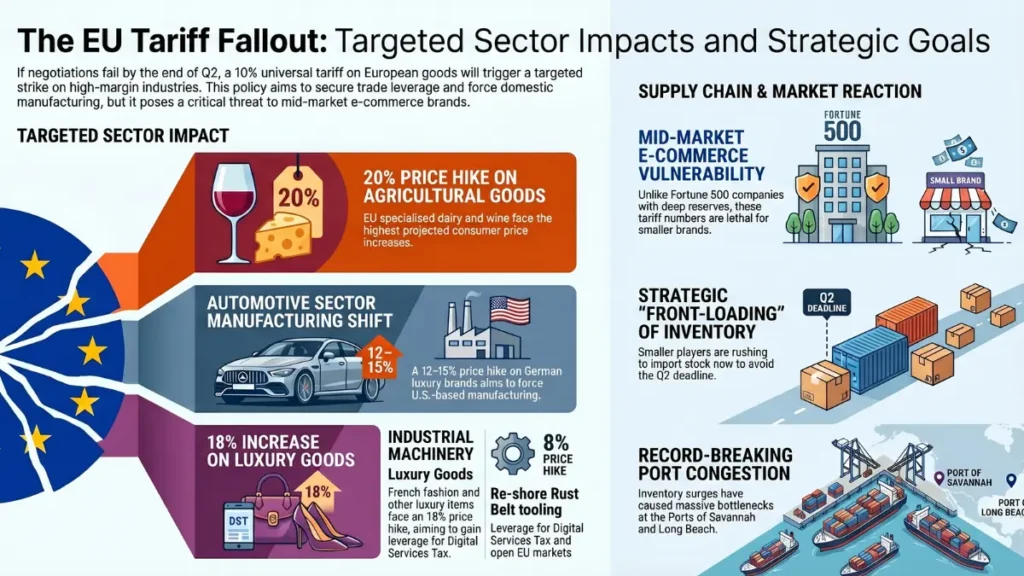
The 10% universal tariff on European goods isn’t a blanket threat; it’s a targeted strike on specific high-margin industries. If the negotiations fail by the end of Q2, here is the projected fallout:
| Industry | Primary Target | Est. Consumer Price Hike | The “Doctrine” Goal |
| Automotive | German Luxury (BMW, Mercedes) | 12-15% | Force U.S.-based manufacturing |
| Luxury Goods | French Fashion/LVMH | 18% | Leverage for Digital Services Tax |
| Industrial Machinery | Italian Precision Tools | 8% | Re-shore the “Rust Belt” tooling |
| Agricultural | EU Specialized Dairy/Wine | 20% | Open EU markets to U.S. Farmers |
For a mid-market e-commerce brand, these numbers are lethal. While a Fortune 500 company can absorb the hit through tax inversions or deep reserves, the smaller player must “Front-load” inventory now. This is why we are seeing record-breaking congestion at the Port of Savannah and Long Beach this month.
5. The “Apple Paradox” and the Proprietary Pivot
Apple Inc. remains the quintessential case study. They spent two decades perfecting the “Designed in California, Made in China” model. Today, they are caught in the “Apple Paradox.” They are successfully shifting 35% of production to India and Vietnam, but their high-end Pro displays still rely on REMs currently refined in Chinese-controlled zones.
The proprietary angle here is the Vertical Mineral Integration. Apple isn’t just buying chips; rumors in the Valley suggest they are bidding on Greenlandic mineral leases themselves. This is the ultimate evolution of the Tariff Doctrine: the corporation becoming a nation-state actor. When you can’t rely on the trade route, you own the mine.
[Read more on Johny Millionaire: What It Takes to Build a $1B Company in America Today]
6. The October Deadline: The “Black Swan” on the Calendar
While Greenland and the EU dominate current headlines, every serious player is looking at October 2026. This is the expiration date of the 2020/2025 U.S.-China trade deal.
3 MONTHS UNTIL THE CHINA TRADE RESET
If a “Hard Reset” occurs, we are looking at “Stage 4” tariffs. This means every toy, every plastic component, and every base metal from China could see a 25-50% surcharge.
Geopolitical Impact: Small vs. Large Business
- The Giants: Corporations like Walmart have already secured 18-month “Forward-Contracts” with Vietnamese and Indian suppliers. They have the scale to move entire cities of production.
- The Mid-Market: The e-commerce brand doing $50M-$200M is at the highest risk. They often lack the capital to “Front-load” a year of inventory. Their play? “White-Label Reshoring.” Finding U.S.-based manufacturers who can provide a “good enough” alternative to Chinese components to avoid the October cliff.
7. Strategist’s Q&A: Navigating the 2026 Trade War
Q: Is the Greenland Escalation just a bluff to lower Denmark’s defense demands?
A: No. The data on REM deposits is too significant. This is a multi-decade play for energy independence. If the U.S. doesn’t secure Greenland, the transition to EVs remains a Chinese-controlled endeavor.
Q: Will the 10% EU tariff lead to a “Currency War”?
A: We are already in one. Watch the European Central Bank (ECB) closely. If they devalue the Euro to keep their exports competitive despite the 10% tariff, the U.S. Treasury will likely label them a “Currency Manipulator,” triggering the next phase of the Tariff Doctrine.
Q: Should I move my manufacturing out of Vietnam if they get hit next?
A: Vietnam is currently a “Friendshored” darling. However, the Doctrine rewards balance. The smartest move is a 60/40 Split: 60% Mexico (Nearshore) and 40% SE Asia (Friendshore). Never put your entire margin in one geopolitical basket.
8. Key Takeaways Section
- Strategic Leverage: The tax code is now a primary tool of U.S. foreign policy, not just a revenue stream.
- Mineral Sovereignty: The Greenland move is about breaking the tech-metal monopoly, not just Arctic territory.
- The Nearshore Winner: Mexico is the primary beneficiary of the Tariff Doctrine, offering the safest harbor for U.S. capital.
- Inflationary Bias: Protectionism is structurally inflationary. Success requires a permanent shift from “Cost-Efficiency” to “Pricing Power.”
Conclusion: The New Map of Success
The “Tariff Doctrine” has effectively ended the thirty-year experiment of frictionless global trade. We have moved from a world of “Maximum Efficiency” to a world of “Maximum Resilience.” The “Greenland Escalation” and the threats toward the EU are simply the latest chapters in a book that is being rewritten in real-time.
For the Johny Millionaire brand, the message is clear: the future belongs to those who can read a geopolitical map as fluently as a balance sheet. Success in 2026 requires more than a great product; it requires a strategic alignment with the new trade alliances being formed in the Arctic and across the borders of our “Friendshored” allies. The walls are going up, but for the strategic thinker, those walls are just new opportunities to build a more resilient, more dominant empire.
In a world defined by the Tariff Doctrine, the only thing more expensive than a 10% tariff is the cost of being unprepared.


[…] Read More: The Tariff Doctrine: How Trump’s “Greenland Escalation” and EU Threats are Redefining … […]