


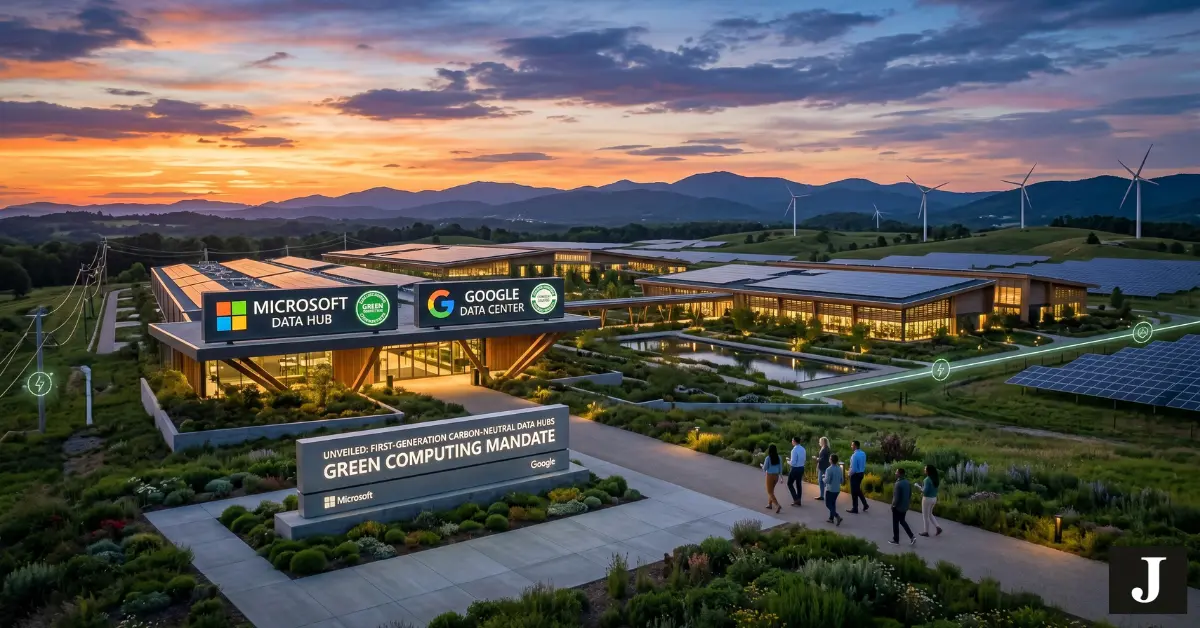
SILICON VALLEY — In a landmark move that sets a new industry standard, Microsoft and Google today jointly announced the activation of their first-generation carbon-neutral data hubs. This “Green Computing Mandate” represents a pivotal shift in the race to harmonize the explosive growth of generative artificial intelligence with aggressive global sustainability targets.
The new facilities, located in strategic corridors in Iowa and Arizona, are the first hyperscale centers to operate entirely on 24/7 carbon-free energy without relying on traditional, and often criticized, carbon offsets. By integrating small modular reactors (SMRs) and advanced geothermal cooling systems, these hubs effectively solve the “intermittency problem” that has long plagued renewable energy-backed infrastructure.
For investors, this unveiling is a critical proof of concept. As the demand for AI training expands, the energy consumption of data centers has come under intense scrutiny from ESG-focused funds and federal regulators. Microsoft and Google are signaling that they can scale their compute power without proportionally scaling their environmental footprint. This technological breakthrough is expected to insulate both companies from potential carbon taxes and rising energy costs that threaten the margins of less-prepared competitors.
The industry context is clear: according to recent data from the International Energy Agency (IEA), data centers currently account for a significant and growing portion of global electricity demand. By pioneering this carbon-neutral roadmap, these tech giants are creating a blueprint for the Green Computing Mandate that smaller cloud providers will eventually be forced to adopt. Market analysts suggest this move will trigger a massive capital reallocation toward green energy startups specializing in grid-firming technologies.
Looking ahead, the success of these hubs will likely dictate the future of U.S. domestic manufacturing. As the federal government continues to push for American leadership in the CHIPS and Science Act framework, the ability to power energy-hungry industries sustainably has become a matter of national economic security.
In conclusion, while the initial capital expenditure for these hubs is staggering, the long-term strategic advantage is undeniable. Microsoft and Google have moved beyond rhetoric, proving that the future of the digital economy is not just high-speed, but high-efficiency and zero-emission.
Read More: Middle East Ceasefire Extension: How US-Iran Diplomacy Triggered a Global Market Relief Rally


[…] Read More: Green Computing Mandate: Microsoft and Google Unveil First-Generation Carbon-Neutral Data Hubs […]