


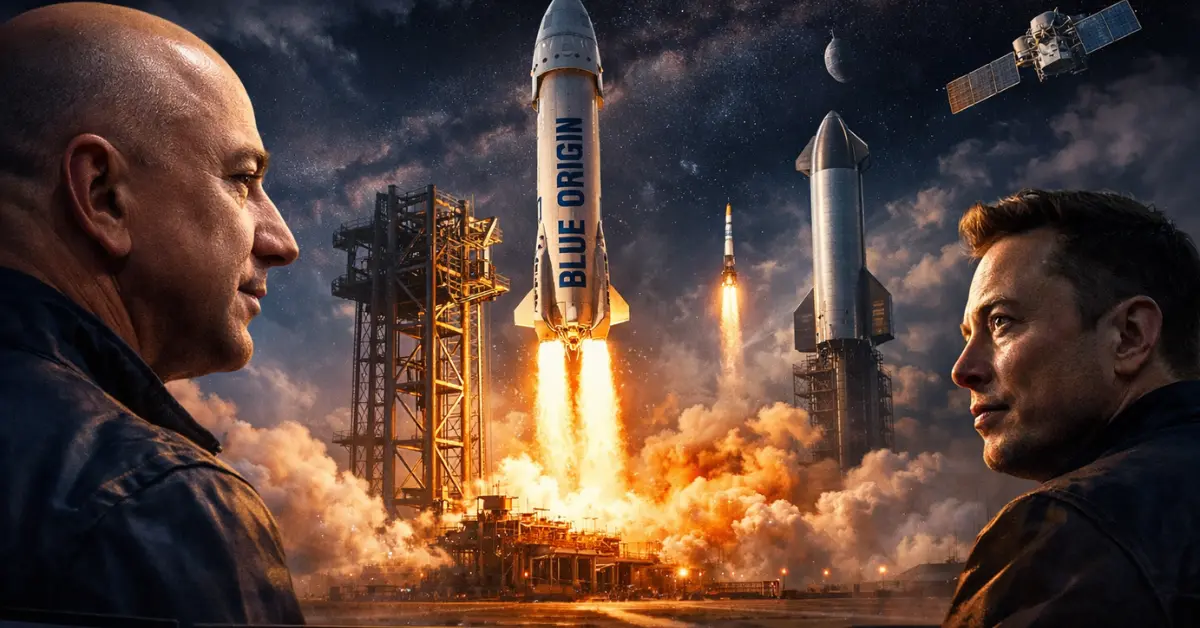
The billionaire space race is entering a decisive new chapter as Jeff Bezos reportedly pivots his daily operational focus toward Blue Origin’s 2026 launch manifest. This strategic shift comes at a critical juncture for the private space industry, as the Amazon founder seeks to accelerate the development of the New Glenn heavy-lift rocket. For years, Elon Musk’s SpaceX has maintained an iron grip on the heavy-lift satellite market, but Bezos is now signaling that the era of uncontested dominance is coming to an end.
The New Glenn flight tests are not merely technical milestones; they represent Blue Origin’s bid to become a reliable alternative for commercial and government entities looking to deploy massive satellite constellations. To bridge the gap, Blue Origin has embarked on an aggressive recruitment drive, poaching top-tier talent from legacy aerospace giants such as Boeing and Lockheed Martin. This influx of veteran expertise is essential to fulfilling the company’s burgeoning obligations, including multi-billion dollar contracts for NASA’s Artemis lunar missions and the development of private space stations like Orbital Reef.
However, the competition is no longer confined to engineering hangars and launch pads. The rivalry between Bezos and Musk has moved into the legislative arena, with both billionaires intensifying their lobbying efforts in Washington. A primary focus of this political maneuver is the establishment of “orbital property rights.” As low-Earth orbit (LEO) becomes increasingly crowded, the legal framework governing satellite placement and resource extraction on the moon is becoming a high-stakes battleground for future trillion-dollar markets.
For investors, the timing is particularly poignant. SpaceX is currently navigating its own internal benchmarks as it eyes a potential IPO for Starlink or its broader launch business. Any significant progress from Blue Origin’s New Glenn could shift the valuation narrative, introducing a credible competitor into a market that has long lacked one. As we move deeper into 2026, the success of Bezos’s hands-on approach will determine whether the second space age remains a monopoly or evolves into a robust, multi-player economy.
Read More: The SpaceX IPO Fever: Why Musk is Finally Preparing to Unbundle His Starlink Empire