

Blockbuster Failure: Blockbuster Had the Future in Its Hands… Then Netflix Destroyed the Empire.
How can a billion-dollar empire disappear so fast? How does a brand that was synonymous with “Friday night” in millions of households across the globe become a punchline for obsolescence? What happens when success blinds leadership to the point where they laugh at their future executioner?
The Blockbuster failure is not just a story about DVDs and VHS tapes; it is a cautionary tale of corporate hubris, a fatal misunderstanding of customer pain points, and a refusal to adapt to a world that was moving faster than a rewind button. At its peak, Blockbuster was an apex predator. It controlled the flow of culture, deciding which movies we saw and how much we paid to see them. With over 9,000 stores and a valuation that soared into the billions, it seemed untouchable.
Yet, behind the bright blue-and-yellow neon signs, a rot was setting in. Leadership became addicted to a revenue model that customers despised—late fees. They viewed their physical real estate as an invincible fortress rather than a mounting liability. When a small, struggling startup called Netflix offered itself up for sale, Blockbuster’s leadership didn’t just say no; they reportedly laughed the founders out of the room. This single moment of arrogance catalyzed one of the most dramatic collapses in retail history. Can one decision destroy decades of dominance? In the case of Blockbuster, the answer was a resounding, billion-dollar “yes.”
The Birth of a Blue-and-Yellow Giant
The story of Blockbuster didn’t start in Hollywood, but in Dallas, Texas, in 1985. David Cook, a man who specialized in data services for the oil and gas industry, saw a massive inefficiency in the fragmented “mom-and-pop” video rental market. He used his data expertise to create a massive database that tracked inventory with surgical precision.
By the time Wayne Huizenga, the entrepreneurial force behind Waste Management, took the reins, Blockbuster was on a trajectory to the moon. Huizenga applied a “cluster” strategy—opening stores so frequently that customers were never more than a ten-minute drive from a Blockbuster. By 1994, the company was acquired by Viacom for a staggering $8.4 billion. It wasn’t just a store; it was a cultural gatekeeper.
The Peak of Power: The Illusion of Invincibility
At its height in 2004, Blockbuster employed 84,000 people. It had reached a level of market saturation where it didn’t just compete in the market; it was the market. If you wanted to see the latest blockbuster—hence the name—you went to their stores.
The financial engine was humming, but it was fueled by a controversial source: late fees. By the late 90s, late fees accounted for roughly 16% of the company’s total revenue. Essentially, the Blockbuster failure was being financed by customer dissatisfaction. The company was making hundreds of millions of dollars by penalizing the very people it served. This created a “negative brand equity” that left the door wide open for any competitor who promised a friendlier experience.
The $50 Million Laugh: The Netflix Meeting
In the year 2000, Reed Hastings, the co-founder of a fledgling DVD-by-mail service called Netflix, flew to Dallas to meet with Blockbuster CEO John Antioco. Netflix was losing money and struggling to stay afloat. Hastings offered to sell Netflix to Blockbuster for $50 million. In exchange, Netflix would run Blockbuster’s online brand.
Antioco and his team reportedly found the offer hilarious. To them, Netflix was a niche service for a tiny segment of tech nerds. They couldn’t imagine a world where people would wait two days for a DVD in the mail when they could drive to a blue-and-yellow store in ten minutes. This meeting is now cited as one of the greatest strategic blunders in business history. Today, Netflix is worth over $200 billion; Blockbuster exists as a single franchise store in Bend, Oregon, kept alive primarily for nostalgia.
The Turning Point: Ignoring the Digital Horizon
As high-speed internet began to penetrate American homes, the “Plot” of the Blockbuster failure thickened. Management viewed the internet as a threat to their physical stores—their “crown jewels.” They suffered from classic “Innovator’s Dilemma”: they were so protective of their existing profit margins (the stores and late fees) that they refused to invest in the technology that would eventually replace them.
According to Forbes, the inability to cannibalize one’s own business for the sake of future survival is the primary reason legacy companies die. Blockbuster was afraid that if they started a successful online service, it would hurt their store traffic. By the time they launched “Blockbuster Online” in 2004, Netflix had already captured the early adopters and perfected the logistics of disc distribution.
Leadership Failures and Internal Civil War
The collapse wasn’t just caused by external competition; it was an inside job. In the mid-2000s, John Antioco actually recognized the danger. He proposed a bold plan: eliminate late fees and invest $200 million into the digital platform. It was a “Hail Mary” that actually started to work. Blockbuster began gaining ground on Netflix.
However, the board of directors and activist investor Carl Icahn balked at the cost. They saw the falling profits from the loss of late fees and panicked. Antioco was eventually ousted over a compensation dispute, and the new leadership, led by James Keyes, reversed the digital-first strategy. Keyes famously stated that Netflix wasn’t even on his radar as a major competitor. Instead of fighting the future, Blockbuster decided to double down on being a high-end convenience store. It was a fatal miscalculation.
Read More: The $1.75 Billion Quibi Failure: A Post-Mortem on Hubris
The Financial Red Flags and The Final Fall
The 2008 financial crisis was the final nail in the coffin. Blockbuster was saddled with nearly $1 billion in debt. As consumer spending plummeted and Redbox kiosks began popping up in grocery stores, Blockbuster’s high-overhead model became unsustainable.
In 2010, the company filed for Chapter 11 bankruptcy. It was eventually bought by Dish Network in 2011 for a measly $320 million—mostly for its remaining spectrum and customer data. The stores were shuttered in waves, leaving behind empty skeletons in strip malls across America.
Where are they now?
- John Antioco: Post-Blockbuster, he became a successful private equity investor and chairman of several food chains. He is often remembered as the man who almost saved Blockbuster.
- Reed Hastings: The man who was laughed at went on to revolutionize global media, shifting Netflix from DVD-by-mail to the world’s premier streaming service and content studio.
- The Last Blockbuster: Located in Bend, Oregon, it has become a tourist destination, a symbol of a bygone era, and even the subject of a popular Netflix documentary—the ultimate irony.
Biggest Lessons for Modern Entrepreneurs
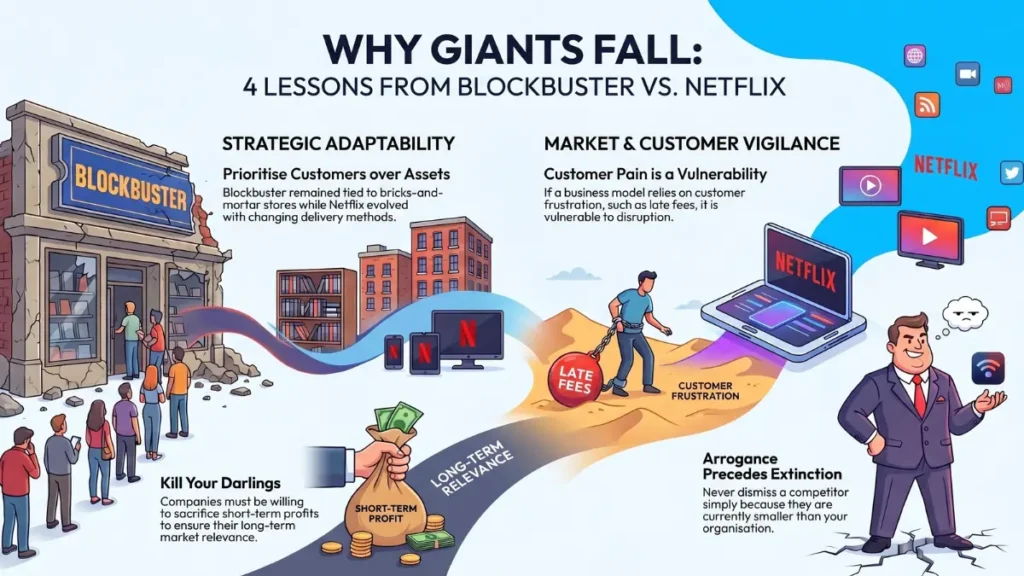
- Don’t Fall in Love with Your Assets: Blockbuster loved its stores; Netflix loved its customers. When the delivery method changed, Blockbuster was stuck with bricks and mortar, while Netflix was mobile.
- Kill Your Darlings: If you don’t cannibalize your own revenue streams, someone else will do it for you. Harvard Business Review explained that companies must be willing to sacrifice short-term profits for long-term relevance.
- Customer Pain is a Business Opportunity: If your business model relies on “late fees” or any form of customer frustration, you are vulnerable.
- Arrogance is the Precursor to Extinction: Never dismiss a competitor just because they are currently smaller than you.
The Hidden Psychology of Failure
The Blockbuster failure was driven by “Status Quo Bias.” Leadership believed that because they had won the last twenty years, they were entitled to win the next twenty. They mistook a temporary dominance for a permanent law of nature. They failed to realize that they weren’t in the “video rental business”; they were in the “home entertainment business.”
CONCLUSION
The Blockbuster failure serves as the ultimate ghost story for the corporate world. It is a haunting reminder that size offers no protection against stupidity. A $5 billion empire didn’t just collapse because of a new technology; it collapsed because it stopped listening to its customers and started listening to its own ego.
We often look back at the blue-and-yellow signs with a sense of warm nostalgia—the smell of popcorn, the rows of candy, the excitement of finding the last copy of a new release on a Saturday night. But that nostalgia masks a cold reality: the world changed, and Blockbuster refused to change with it. They had the capital, the brand recognition, and even the opportunity to buy their successor for the price of a mid-budget movie. They chose to stay still.
Today, we see the same patterns in other industries. Legacy giants in automotive, finance, and healthcare are currently staring at their own “Netflix moments.” The lesson is clear: your past success is not a down payment on future survival. In the digital age, you are either the disruptor or the disrupted. There is no middle ground.
Could your business survive if the market changed tomorrow? Are today’s tech giants—the very ones who disrupted companies like Blockbuster—becoming just as bloated and arrogant as the empires they replaced?
Read More:
FAQ
Q: Why did Blockbuster fail while Netflix succeeded?
A: The Blockbuster failure was primarily due to its heavy debt, reliance on physical retail overhead, and a slow transition to digital streaming. Netflix succeeded by focusing on a subscription model without late fees and aggressively pivoting to streaming technology early.
Q: Did Blockbuster really have the chance to buy Netflix?
A: Yes. In 2000, Netflix offered itself to Blockbuster for $50 million. Blockbuster’s CEO declined the offer, viewing Netflix as a small-scale, unprofitable niche business.
Q: What happened to Blockbuster’s late fees?
A: Blockbuster eventually tried to eliminate late fees in 2005 under CEO John Antioco, but the move was costly and confused customers because of “restocking fees.” The internal conflict over this loss of revenue contributed to Antioco’s departure.
Q: Is there any Blockbuster store left?
A: Yes, there is exactly one franchised Blockbuster store remaining in Bend, Oregon. It operates largely as a nostalgic tourist attraction.