


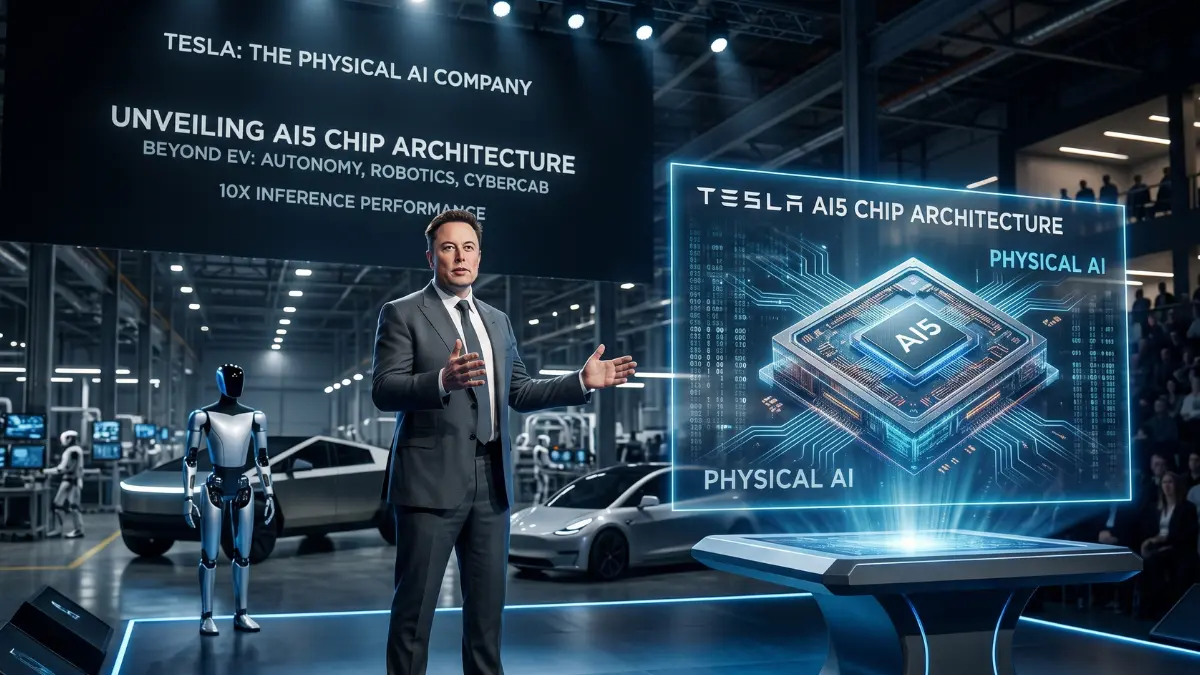
AUSTIN, Texas — Facing a cooling electric vehicle market and plateauing delivery numbers, Tesla CEO Elon Musk has officially signaled the beginning of a new era for the Texas-based automaker. During a highly anticipated keynote Thursday, Musk unveiled the AI5 chip architecture—a custom-designed silicon powerhouse engineered to transition Tesla from a traditional car company into a dominant force in the emerging sector of “Physical AI.”
The shift comes at a critical juncture for the company. For the second consecutive quarter, Tesla’s global delivery figures have failed to meet aggressive analyst expectations, hampered by persistent high interest rates and intensifying competition from lower-cost Chinese rivals. However, Musk’s strategic pivot suggests that the company’s valuation should no longer be tied solely to units sold, but rather to the intelligence and autonomy of its machines.
The AI5 architecture represents a massive leap over current hardware, boasting roughly 10 times the inference capacity of the previous generation. While earlier iterations focused primarily on road navigation, AI5 is purpose-built for the “embodied AI” market. This includes the high-performance demands of the Optimus humanoid robot and a planned fleet of truly autonomous Cybercabs. Musk described the chip as the “nervous system of the future,” capable of processing complex real-world physics in real-time with minimal energy draw.
“The car was just the first robot,” Musk told investors. “Physical AI is about training machines to interact with a complex, unpredictable world. AI5 is the foundation of that autonomy.”
For investors, the pivot is both a gamble and a necessity. Wall Street has grown weary of the aggressive price wars eroding Tesla’s margins. By positioning Tesla as a foundational AI firm, Musk is attempting to capture the premium valuation multiples currently enjoyed by semiconductor giants like Nvidia.
Analysts note that if Tesla can successfully monetize its FSD (Full Self-Driving) software licensing and robotics division, the stagnant EV delivery numbers may eventually become a secondary metric. However, significant execution risks remain. Regulatory hurdles for Level 4 autonomy in the U.S. and Europe are steep, and the hardware-software integration required for reliable Physical AI is a frontier that has humbled many tech giants. As Tesla reallocates billions in R&D toward silicon and robotics, the market remains divided on whether this is a visionary evolution or a tactical distraction from its core manufacturing struggles.


[…] Read More : Tesla Pivots to ‘Physical AI’: Musk Unveils New AI5 Chip Architecture as EV Deliveries Stall […]