


Why Agentic Workflows Are Replacing Traditional Automation in the Modern Office
We are witnessing the funeral of the “if-this-then-that” script. In the high-stakes corridors of the modern office, rigid automation is no longer an asset; it’s a bottleneck. For nearly a decade, Robotic Process Automation (RPA) was the crown jewel of digital transformation, promising to liberate workers from the drudgery of data entry. But as we move through April 2026, the “Zero-Shot” era—where you throw a prompt at a model and pray for a usable result—just hit its terminal velocity.
The shift toward agentic workflows is the single most important trend in enterprise technology today. Unlike traditional automation, which breaks the moment a web form changes or a vendor sends a fragmented PDF, agentic systems act as digital coworkers with the capacity to plan, reason, and self-heal. They don’t just follow rules; they navigate the gray areas of business logic that once required a human set of eyes.
The Fatal Flaw: Why Deterministic Bots are Failing
To understand why agentic workflows are cannibalizing the RPA market, we must look at the fragility of deterministic scripts. Traditional automation is a line of dominoes; if one falls out of place—perhaps an API response changes or a customer’s email contains a typo—the entire sequence grinds to a halt. This creates “technical debt” where humans spend more time fixing the “time-saving” bots than doing their actual jobs.
In contrast, agentic AI leverages what cognitive scientists call “System 2 thinking.” If an AI agent encounters an error, it doesn’t crash. It reflects. It utilizes agentic reasoning loops to troubleshoot its own path. An agent might realize, “I couldn’t find the invoice number in the header, so I will now cross-reference the footer metadata and the purchase order database to verify.” This resilience is why 65% of enterprises are currently transitioning away from rigid, rule-based software.
The Andrew Ng Effect: The Power of the Iterative Loop
One of the primary drivers of this shift is the realization that smarter workflows matter more than just “smarter” models. Research popularized by DeepLearning.ai has proven that an iterative, agentic approach can make a smaller AI model outperform a much larger, “static” one.
At Johny Millionaire, we call this the Agentic Decision Loop (ADL). Instead of one AI model doing a task in a single shot, the ADL breaks the task into roles:
- The Planner: Outlines the steps required.
- The Executor: Performs the specific sub-tasks.
- The Critic: Reviews the output for errors or logic gaps.
According to the latest McKinsey’s State of AI 2026 Report, organizations moving to multi-agent orchestration have seen a 40–60% reduction in operational costs. By letting AI “critique” itself in a loop, accuracy rates in fields like legal document review and financial triage have hit levels once considered impossible for machines.
Read More: Jensen Huang’s Prediction: Why Every Home Will Have a Robot by 2030
Real-World Impact: The “Agentic Dividend”
The U.S. market is already reaping the rewards of this technological pivot. At Amazon, the implementation of Amazon Bedrock AgentCore has allowed supply chain systems to handle disruptions autonomously. When a logistics delay is detected, the agent doesn’t just flag it; it analyzes alternative routes, initiates rerouting, and updates the customer—all before a human supervisor even logs in for the day.
The “agentic dividend” is also transforming the mid-market:
- Customer Support: Scripted bots are being replaced by agents that can check order history, apply nuance-based policy discounts, and resolve refunds end-to-end.
- Financial Triage: Firms use autonomous remediation agents to investigate suspicious transactions across multiple databases, reducing the need for manual fraud investigation by 70%.
- Strategic Sales: Multi-agent teams now research prospects, draft context-aware outreach, and schedule meetings based on real-time calendar sentiment analysis.
The Economic Reality: 300% ROI Within Three Years
The financial case for agentic workflows is now undeniable. While traditional RPA has lower upfront costs, it carries massive maintenance baggage. Agentic platforms are “self-healing,” meaning they adapt to changes in software environments without needing a developer to rewrite the script.
RPA vs. Agentic Workflows: A Quick Comparison
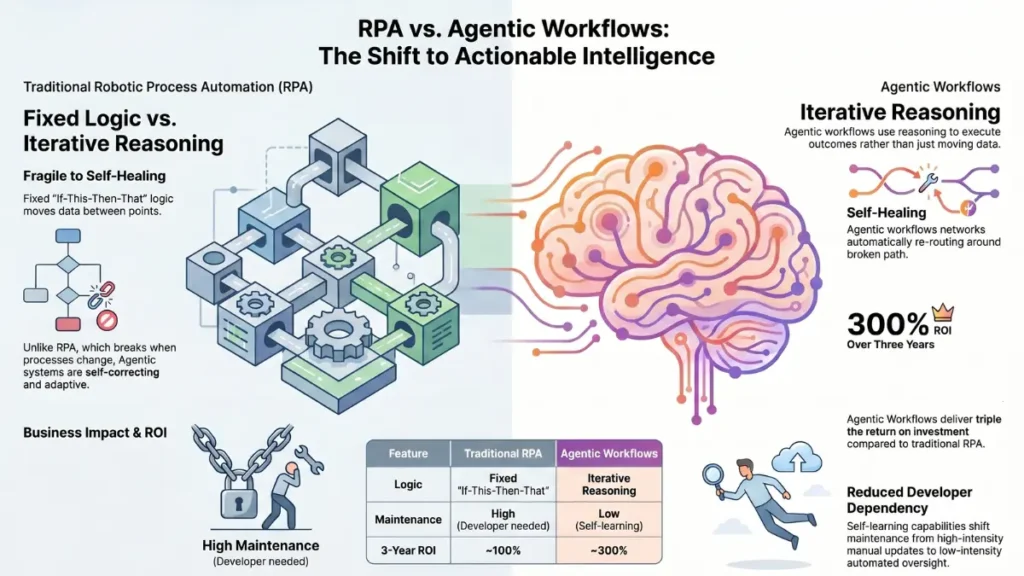
| Feature | Traditional RPA | Agentic Workflows |
| Logic | Fixed “If-This-Then-That” | Iterative Reasoning |
| Adaptability | Breaks on change | Self-correcting / Healing |
| Maintenance | High (Developer needed) | Low (Self-learning) |
| ROI (3 Years) | ~100% | ~300% |
Market analysts suggest the ROI delta is largely due to “Actionable Intelligence.” Agents don’t just move data from Point A to Point B; they execute outcomes.
Key Takeaways
- Resilience: Agentic AI adapts to data drift where traditional automation fails.
- Accuracy: Multi-agent “critic loops” eliminate the hallucinations common in single-prompt AI.
- Human-Centricity: Employees move from “bot programmers” to “strategic supervisors” of agentic teams.
- Operational Velocity: Processing cycles are improving by 20–30% across the board.
FAQs: Navigating the Agentic Era
1. Will agentic workflows replace my current RPA tools?
Not immediately. The smartest founders are “agentizing” their legacy bots—using AI agents to manage the triggers and exceptions of their existing RPA infrastructure.
2. How do I measure the success of an agentic loop?
Focus on the Autonomous Task Completion (ATC) rate. Unlike RPA, which measures speed, agentic success is measured by how often the agent successfully completes a task without human intervention.
3. What is the biggest risk?
Governance. Agents have more autonomy, so establishing rigid guardrails and “human-in-the-loop” checkpoints for high-value financial or legal decisions is critical.
Conclusion: The New Office Hierarchy
The modern office is no longer a collection of static tools; it is a dynamic ecosystem of humans and agents working in tandem. By moving away from the rigid scripts of the past and toward the fluid, reasoning-based agentic workflows of the future, businesses are finally realizing the true promise of the AI era.The question for leaders today is no longer “What can we automate?” but “How much autonomy are we brave enough to delegate?”
Read More: Agentic AI & The Robotics Convergence: Why 2026 is the Year the “Brain” Met the “Body”


[…] Read More: Why Agentic Workflows Are Replacing RPA: The 2026 Office Revolution […]
[…] Read More: Why Agentic Workflows Are Replacing Traditional Automation in the Modern Office […]