

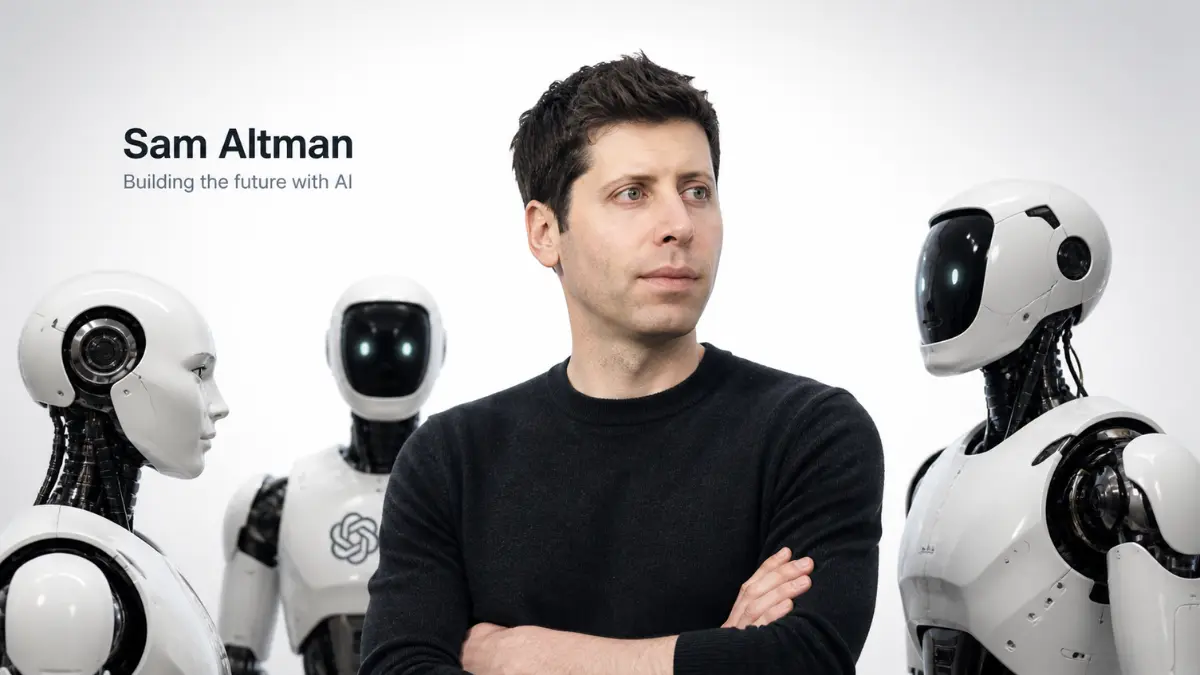
Why the Sam Altman Superintelligence Blueprint is Polarizing Washington Right Now
In the quiet, wood-paneled corridors of the Rayburn House Office Building, the conversation among lawmakers has undergone a jarring shift. It is no longer about the theoretical ethics of chatbots; it is about the cold, hard reality of “Industrial Policy for the Intelligence Age.” When OpenAI CEO Sam Altman released his 13-page manifesto, he wasn’t just pitching a product—he was delivering a political hand grenade. The Sam Altman superintelligence roadmap is now the most polarizing document in the Beltway, forcing a high-stakes collision between Silicon Valley’s accelerationist dreams and Washington’s cautious, often glacial, bureaucracy.
Why This Topic is Trending is simple: The blueprint moves AI out of the realm of science fiction and into the halls of national security and tax law. We are witnessing the first major attempt by a private tech titan to rewrite the American social contract for an era where human labor might no longer be the primary driver of economic value.
The 13-Page Vision: Decoding the “Intelligence Age”
At its core, Altman’s blueprint argues that the arrival of superintelligence—AI that surpasses human cognitive ability across every economically valuable task—is an inevitability, potentially arriving as early as 2028. To survive this transition, Altman suggests that the U.S. government must treat AI infrastructure with the same existential urgency as the Manhattan Project or the development of the Interstate Highway System.
The proposal hinges on three radical pillars:
- A Public Wealth Fund: A sovereign fund that gives every American a literal “slice” of the AI-driven economy.
- The Robot Tax: A fundamental shift in the tax code, moving the burden from human payroll to “automated capital.”
- Massive Infrastructure: A call for upwards of $7 trillion in investment to build the data centers and energy grids required for the next generation of compute.
Why D.C. is Divided: The “Policymercial” vs. The New Deal
Washington’s reaction has been anything but uniform. On one side, progressive proponents see a visionary leader attempting to head off a social uprising. By proposing a public wealth fund, Altman is offering a preemptive solution to the massive job displacement that experts at The Brookings Institution have warned could destabilize the middle class. They view this blueprint as a “New Deal” for the 21st century.
However, the skepticism in the Beltway is palpable. Many seasoned analysts have labeled the document a “policymercial”—a brilliant piece of corporate lobbying cleverly disguised as a humanitarian manifesto. The timing is particularly scrutinized; OpenAI is currently in the process of transitioning into a for-profit entity and eyeing a historic valuation.
Read more on Johny Millionaire: 10 GPT-5 Business Use Cases That Will Redefine the Future of Work
The Peril of Regulatory Capture
“FDR wasn’t running Standard Oil while proposing antitrust law,” noted a senior legislative aide during a recent closed-door briefing. The core of the polarization lies in the fear of “regulatory capture.” Critics argue that by handing the responsibility of “safety” to the government while keeping the proprietary “intelligence” private, Altman is asking the public to subsidize his risks while he privatizes the rewards. This creates a “too big to fail” scenario for OpenAI before the technology is even fully mature.
The Energy Crisis: The Invisible Wall to Superintelligence
You cannot achieve the vision of Sam Altman superintelligence without an unprecedented amount of electricity. The blueprint calls for the U.S. to “accelerate the expansion of energy infrastructure,” specifically pushing for a revival of nuclear power and the deployment of advanced semiconductors.
For Washington, this is a logistical nightmare. The U.S. power grid is already at its breaking point. A report from the International Energy Agency (IEA) highlights that data centers’ electricity consumption could double by 2026. Transitioning to an AI-first economy requires a level of deregulation in the energy sector that makes environmental advocates uneasy and national security experts wary of creating centralized “mega-hubs” that become easy targets for cyber warfare.
Real-World Stakes: Lessons from Amazon and Tesla
We have seen this script before. When Amazon revolutionized logistics, it took Washington over a decade to catch up to the tax and labor implications. When Tesla pushed for electric vehicles, the government had to scramble to build a charging infrastructure that is still incomplete. Altman is trying to jumpstart that entire process for AI, but the scale is exponentially larger.
The question isn’t just about the “how much”—it is about the “who.” If the government builds the data centers, who owns the data? If a robot tax is implemented, who determines the rate?
Key Takeaways: The Blueprint at a Glance
- The Timeline: OpenAI anticipates superintelligence could be reached within 3–5 years.
- The Funding: Proposals for a sovereign wealth fund to mitigate wealth inequality.
- The Infrastructure: A trillion-dollar demand for “compute” power and nuclear energy.
- The Polarization: Sharp divides over whether this is altruism or a monopoly play.
FAQs: Understanding the Superintelligence Debate
What is Sam Altman’s “Superintelligence Blueprint”?
It is a policy document titled Industrial Policy for the Intelligence Age that outlines the infrastructure and social safety nets required for a world with human-level AI.
Why does it propose a “Robot Tax”?
To offset the loss of income tax revenue as AI replaces human roles, ensuring the government can still fund public services.
Is superintelligence actually coming by 2028?
While Altman suggests this timeline, many computer scientists remain skeptical, though the blueprint treats it as a certainty to spur immediate government action.
Read more on Johny Millionaire: Nvidia AI earnings 2026: Is the Artificial Intelligence Bubble Finally Bursting?
Conclusion: A High-Stakes Gamble for the Future
The debate over Sam Altman superintelligence is more than a technical dispute; it is a battle for the soul of the American economy. Whether Altman is a modern-day architect of a better world or a master of corporate spin remains the trillion-dollar question. What is clear, however, is that the blueprint has successfully moved AI out of the “lab” and onto the “floor” of the Senate. In the Intelligence Age, the most valuable currency won’t be data—it will be the trust between the innovators who build the future and the society that must endure it.