

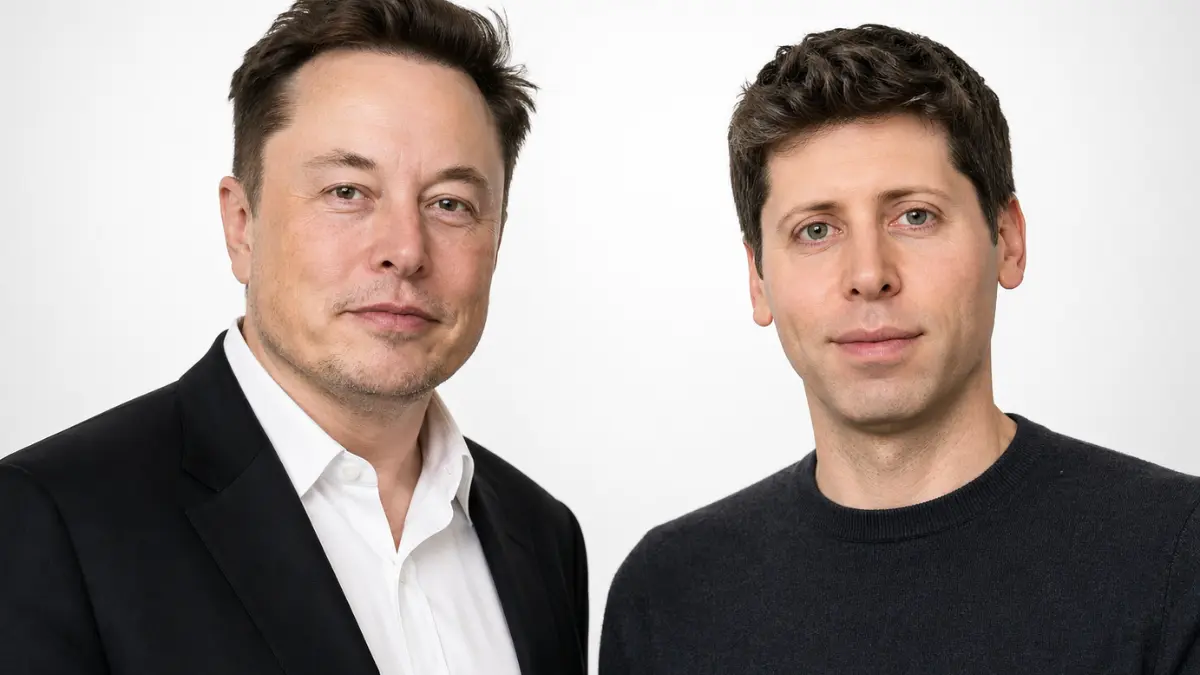
Silicon Valley’s Trial of the Century: Musk vs Altman Trial Opens with $150 Billion at Stake
SAN FRANCISCO — The most consequential legal battle in the history of artificial intelligence officially commenced today as the Musk vs Altman trial reached the U.S. District Court in Oakland. Elon Musk, the billionaire CEO of Tesla and xAI, is squaring off against Sam Altman and OpenAI in a high-stakes confrontation that could redefine the ownership, commercialization, and definition of Artificial General Intelligence (AGI).
The “Broken Promise” and a $150 Billion Claim
At the heart of the case is what Musk’s legal team describes as a “betrayal of Shakespearean proportions.” Musk, an original co-founder who provided roughly $44 million in seed funding to OpenAI between 2016 and 2020, alleges that the company has abandoned its founding mission as an open-source non-profit dedicated to the “benefit of humanity.”
While District Judge Yvonne Gonzalez Rogers recently dismissed several fraud claims, the trial is proceeding on two critical pillars: breach of charitable trust and unjust enrichment. Musk is reportedly seeking $150 billion in damages, with the caveat that the funds be redirected to OpenAI’s original non-profit arm rather than his personal accounts.
“OpenAI has been transformed into a closed-source de facto subsidiary of the largest technology company in the world: Microsoft,” Musk’s filing asserts.
Why the Future of AGI Hangs in the Balance
The trial’s most explosive element isn’t just the money—it’s the technical definition of AGI. OpenAI’s multi-billion-dollar partnership with Microsoft (MSFT) is governed by a contract that grants Microsoft rights to OpenAI’s technology until AGI is achieved.
Musk’s attorneys plan to argue that current models, including the newly released GPT-5.4 and the internal project known as Q*, already constitute AGI. If the jury agrees, it could legally sever Microsoft’s exclusive access to OpenAI’s most advanced models, sending shockwaves through the $3.15 trillion software giant’s valuation.
Market Implications: Valuation vs. Litigation
Despite the legal turmoil, OpenAI recently closed a $122 billion funding round in March 2026, propelling its valuation to a staggering $852 billion. However, the company is also burning cash at an unprecedented rate, with projected losses of $14 billion this year due to the astronomical costs of compute and talent.
| Metric | OpenAI (Estimated 2026) | xAI (Estimated 2026) |
| Valuation | $852 Billion | $55 Billion |
| Monthly Revenue | $2 Billion | $450 Million |
| Active Users | 1.1 Billion (Weekly) | 180 Million |
The Defense: “Competitive Jealousy”
Sam Altman and OpenAI’s legal team, led by elite Silicon Valley litigators, have dismissed the suit as a “distraction fueled by competitive jealousy.” They argue that Musk’s aggressive pursuit of the trial is a strategic move to hamper a rival while he builds xAI and its flagship model, Grok. According to official OpenAI statements, Musk was fully aware of and supported the transition to a “capped-profit” model in 2019 before his departure.
What Comes Next?
The trial is expected to last three weeks. Key witnesses slated to testify include:
- Sam Altman: To defend the restructuring and the Microsoft alliance.
- Ilya Sutskever: The former Chief Scientist whose “safety concerns” are central to Musk’s narrative.
- Elon Musk: To testify on the “Founding Agreement” he claims was signed at OpenAI’s inception.
Investors are watching closely. A ruling against Altman could force a radical restructuring of OpenAI, potentially leading to an IPO delay or the public release of proprietary weights—a move that would reset the entire AI arms race.