

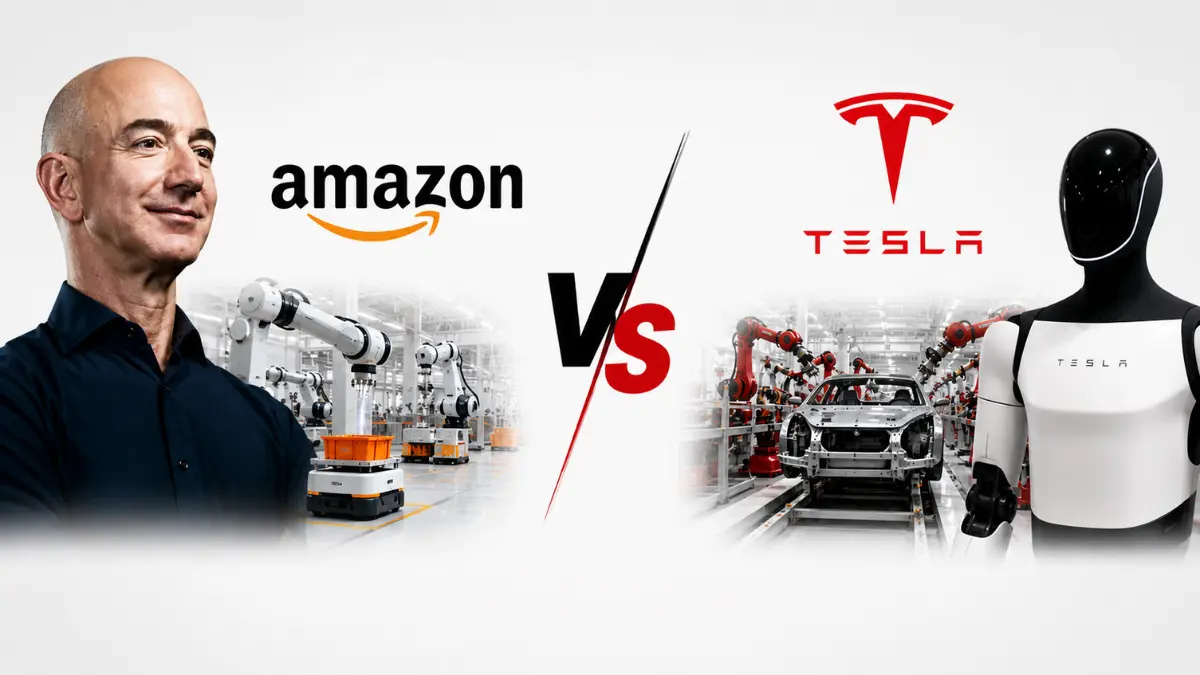
Jeff Bezos’ Project Prometheus vs Tesla: The Race to Control the Autonomous Factory Future.
The titans of industry have officially moved their rivalry from the stars to the factory floor. While the “Space Race” between Blue Origin and SpaceX continues, a more immediate, multi-billion dollar conflict is erupting over the future of labor. Jeff Bezos Project Prometheus, a stealth industrial AI venture, is now positioning itself as the primary challenger to Elon Musk’s Tesla Optimus program in a bid to dominate the autonomous factory floor.
What Happened: The $38 Billion Stealth Move
In a massive capital injection reported late last month, Jeff Bezos Project Prometheus successfully closed a $10 billion funding round, catapulting the startup to a $38 billion valuation. The round, supported by heavyweights like JPMorgan Chase and BlackRock, signals a shift in investor appetite from digital-only LLMs (like ChatGPT) to “Physical AI”—intelligence designed to navigate and manipulate the three-dimensional world.
While Tesla is betting on the humanoid form factor with Optimus 3, which enters mass production in Summer 2026, Prometheus is taking a different path. Led by Bezos and former Google executive Vik Bajaj, the project focuses on “World Models” that simulate physical environments. Instead of just building a robot, Prometheus is building the “brain” for the entire factory ecosystem, targeting aerospace, semiconductors, and heavy manufacturing.
Why It Matters: The Industrial AI Pivot
This isn’t just about cool tech; it’s about the $426 billion smart factory market.
- For Investors: The entry of Bezos into “blue-collar AI” suggests that the next phase of the AI gold rush is in hardware integration.
- For Competitors: Tesla’s Optimus is a general-purpose tool, but Prometheus is designed to integrate deeply with Enterprise Resource Planning (ERP) systems, potentially offering a more “plug-and-play” solution for existing industrial giants.
- For Labor: Both companies are racing to solve the global labor shortage. Tesla targets a per-unit cost of $20,000–$30,000, making humanoid labor cheaper than human shifts in many markets.
The Bigger Context: Two Different Visions
The battle for the autonomous factory floor highlights a fundamental split in engineering philosophy:
- Tesla’s “Bot-First” Approach: Musk believes the humanoid form is optimal because the world is already built for humans. By leveraging Tesla’s FSD (Full Self-Driving) neural networks, Optimus can theoretically walk into any factory and start working.
- Bezos’s “Environment-First” Approach: Through Project Prometheus, Bezos is doubling down on “Physical AI.” This involves AI that understands fluid dynamics, structural integrity, and complex logistics. It is less about a single robot and more about an autonomous, self-correcting organism that manages the entire production line.
What Comes Next: The 2026 Showdown
As we move into the second half of 2026, the industry is watching three key milestones:
- Tesla’s Summer Ramp: Musk has promised a “classic S-curve” ramp for Optimus 3 at the Fremont Factory, aiming for 1 million units of capacity.
- Prometheus Acquisitions: Reports indicate Prometheus is seeking up to $100 billion to outright acquire manufacturing firms, effectively turning them into “Model Factories” to showcase their Physical AI.
- The “Demo-to-Deployment” Gap: The biggest risk for both is the transition from controlled demos to the messy, unpredictable reality of a 24/7 manufacturing environment.
Strong Conclusion
The rivalry between Musk and Bezos has shifted from vanity projects to the very backbone of the global economy. As Jeff Bezos Project Prometheus exits stealth with a war chest that rivals some of the world’s largest industrial conglomerates, the race to automate the physical world has begun in earnest. For the global robotics market, 2026 isn’t just another year of growth—it’s the year the factory floor went fully sentient.
Read More: Elon Musk’s $839B Wealth: The 2026 Terafab Masterplan Explained