

BRICS GDP Growth 2026: Smart Allocation Strategies for U.S. Investors
For decades, the global economic narrative was written in English, edited in Washington, and published by the G7. But as we move through 2026, the ink is changing color. If you are a US investor still viewing the “BRICS” nations—Brazil, Russia, India, China, South Africa, and their newest members—as mere “emerging” players, you aren’t just behind the curve; you’re missing the shift of the century. The BRICS GDP growth 2026 projections are no longer just numbers on a spreadsheet; they represent a tectonic migration of capital, influence, and industrial capacity from the West to the Global South.
Why the Global Market is Obsessed with 2026
The buzz around BRICS GDP growth 2026 has reached a fever pitch in boardrooms from Manhattan to Palo Alto. While the US economy targets a steady 2.0% growth rate, recent data suggests the expanded BRICS+ bloc is on track to see an average growth of 3.7%. This effectively triples the projected 1.1% average of G7 nations. This isn’t just a statistical anomaly; it is a fundamental reordering of global purchasing power.
For the American investor, this creates a paradox. While the domestic market remains a bastion of stability, the “alpha”—the excess return above a benchmark—is increasingly found in the corridors of Riyadh, New Delhi, and Abu Dhabi. To ignore this divergence is to ignore the primary engine of global wealth creation in the late 2020s.
The 2026 Divergence: Data Behind the Disruption
According to recent projections from the IMF World Economic Outlook, the gap between the “Old Guard” and the “New Vanguard” has never been wider. While the US remains the world’s most resilient developed economy, it faces headwinds from a softening labor market and the long tail of fiscal tightening. The European theater, meanwhile, remains sluggish as it grapples with energy transition costs and demographic stagnation.
In contrast, the BRICS engine is being supercharged by two specific titans: India and China.
India: The World’s Growth Engine
India is leading the pack with a staggering 6.6% expansion forecast for 2026. This isn’t just about a large population; it’s about a massive surge in public infrastructure, digital transformation, and domestic consumption. The “India Stack”—the country’s digital public infrastructure—has enabled a level of financial inclusion that was unthinkable a decade ago. For US capital, India represents the ultimate “long-term hold.”
China: The High-Tech Stabilization
China, despite its structural shifts and real estate recalibrations, is stabilizing at a healthy 4.6%. However, the quality of this growth has changed. The focus has shifted from “bricks and mortar” to AI, green energy manufacturing, and semiconductor self-sufficiency. As China pivots toward “New Quality Productive Forces,” it remains an indispensable node in the global supply chain, regardless of geopolitical rhetoric.
The Expansion Multiplier: From BRICS to BRICS+
The inclusion of powerhouses like the UAE, Egypt, and Iran into the bloc has shifted the focus from simple “manufacturing hubs” to “energy and fintech controllers.” This expansion has given the group a combined GDP (PPP) that now exceeds the G7.
The entry of Saudi Arabia and the UAE is particularly significant. These are no longer just “oil states”; they are massive sovereign wealth hubs looking to deploy trillions of dollars into non-oil sectors. When these nations align their investment strategies with the BRICS GDP growth 2026 roadmap, they create a self-sustaining ecosystem that is increasingly less dependent on Western consumer demand.
A New Consumer Class
By 2026, the middle-class population within BRICS+ is expected to surpass 1.5 billion people. This is a consumer base that is young, tech-literate, and hungry for Western brands—but also increasingly loyal to homegrown champions. For companies in the S&P 500, the ability to penetrate these markets will be the difference between stagnation and double-digit earnings growth.
De-Dollarization: Threat or Opportunity?
For the American investor, the most “uncomfortable” part of the BRICS GDP growth 2026 narrative is the move toward de-dollarization. The bloc’s recent announcement of a blockchain-based payment system—often referred to as “BRICS Pay”—is no longer a theoretical threat. It is a functional alternative to the SWIFT system.
The Mechanics of the Shift
- Reduced Transaction Costs: By bypassing the SWIFT system, these nations are lowering the cost of doing business with one another, removing the “middleman fee” of dollar conversion.
- Commodity Pricing: We are seeing more “petroyuan” and “petrorupee” settlements. This erodes the “exorbitant privilege” the US Dollar has enjoyed since the Bretton Woods era.
- Central Bank Reserves: Emerging market central banks are increasingly diversifying their reserves into gold and local currencies, reducing their vulnerability to US sanctions and interest rate hikes.
However, where there is disruption, there is profit. Savvy US investors are no longer fleeing this trend; they are hedging against it by diversifying into currency-neutral assets, hard commodities, and international equities that trade in local denominations.
Read More: The De-Dollarization Update: How 2026 Trade Policies are Strengthening BRICS
Strategic Sectors for US Capital
If you’re looking to capitalize on the BRICS GDP growth 2026 trend, you have to look beyond traditional ETFs. The real “alpha” is found in the intersection of US technology and BRICS scale.
1. The AI and Infrastructure Play
While the US leads in AI research (OpenAI, Google, NVIDIA), the BRICS nations are the primary “implementers.” From AI-driven agriculture in Brazil to smart cities in the UAE, the application of these technologies is happening at a scale the West cannot match. The 2026 winner’s circle includes firms specializing in the hardware-software bridge.
2. Fintech & Digital Payments
Particularly in Brazil and India, where “leapfrogging” traditional banking is the norm. Brazil’s Pix system and India’s UPI are global gold standards. US investors should look for companies providing the underlying security and cloud infrastructure for these regional giants.
3. Green Energy Supply Chains
BRICS nations control the lion’s share of rare earth minerals required for the EV revolution. China’s dominance in battery tech and Brazil’s vast hydroelectric potential make them essential partners in the global transition to Net Zero.
4. Agri-Tech and Food Security
As the global population nears 8.3 billion, the BRICS agricultural corridor (led by Brazil and Russia) becomes the world’s breadbasket. Investing in the logistics and technology that improve crop yields in these regions is a high-conviction play for 2026.
Mini Case Study: The “India Pivot”
Take a page from the playbook of major institutional investors. In early 2026, we saw a significant rotation of capital from Eurozone equities into Indian infrastructure funds.
The Logic:
The ROI on a 6.6% GDP growth environment—fueled by a young, tech-literate workforce—is simply too high to ignore. While European markets struggled with 0.5% growth, the Indian Nifty 50 reached new all-time highs, driven by domestic retail participation and massive FDI inflows. For a US retail investor, this might look like increasing exposure to specialized emerging market ADRs or ETFs that exclude the stagnant parts of the developed world.
Risks to the BRICS Narrative
No investment thesis is without risk. While the BRICS GDP growth 2026 outlook is bullish, investors must remain vigilant regarding:
- Geopolitical Volatility: Tensions between China and India, or the ongoing isolation of Russia, can create sudden market shocks.
- Currency Volatility: While de-dollarization is a trend, local currencies can be volatile. Inflation in nations like Egypt or Turkey (if they deepen ties) remains a concern.
- Regulatory Shifts: The “rules of the game” in emerging markets can change overnight. Transparency and corporate governance vary significantly across the bloc.
According to a recent report by McKinsey & Company, the key to surviving these risks is “local-first” analysis—not applying Western valuation models to Eastern markets.
Key Takeaways for Your Portfolio
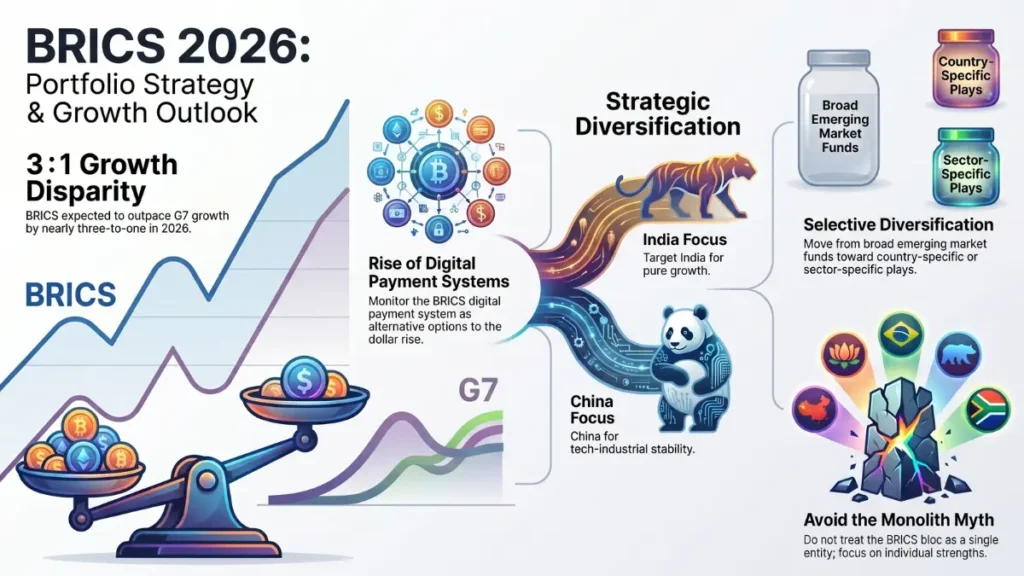
- Growth Disparity: Expect BRICS to outpace G7 growth by nearly 3:1 in 2026. This is the new “normal.”
- Regional Leadership: Focus on India for pure growth and China for tech-industrial stability. Don’t treat the bloc as a monolith.
- Currency Awareness: Monitor the rise of the BRICS digital payment system. It’s not just about the dollar “falling”; it’s about other options rising.
- Selective Diversification: Move away from “broad” emerging market funds and toward country-specific or sector-specific plays that align with the BRICS GDP growth 2026 forecast.
FAQ: Navigating the New Frontier
Is it safe for US citizens to invest in BRICS markets in 2026?
Yes, but the method matters. While geopolitical tensions exist, most BRICS nations remain open to foreign indirect investment. Using US-listed ADRs (American Depositary Receipts) or regulated ETFs remains the safest path for retail investors to gain exposure without dealing with local custody issues.
How does BRICS expansion affect the S&P 500?
Many S&P 500 companies (like Apple, Coca-Cola, and NVIDIA) derive a huge portion of their revenue from these markets. When BRICS grow, the “Global 100” US companies often grow with them. Investing in the US can still be a “proxy play” for BRICS growth.
What is the “BRICS Pay” system?
It is a decentralized, blockchain-based payment system designed to allow member nations to settle trade in their own currencies. It aims to reduce reliance on the US dollar and insulate these economies from Western sanctions.
Which country is the “dark horse” of 2026?
The UAE. Its role as a global financial hub and its strategic entry into BRICS+ makes it a massive connector between Western capital and Eastern growth.
Final Thoughts: The Multipolar Dividend
The story of BRICS GDP growth 2026 isn’t about the “downfall” of the West; it’s about the “rise of the rest.” We are entering a multipolar era where economic power is distributed more broadly than at any time since the Industrial Revolution.
As an investor, your goal isn’t to pick a side in a geopolitical tug-of-war. Your goal is to follow the growth. In 2026, that growth has a new zip code. The world is no longer a monopoly—it’s a marketplace. The most successful portfolios of the next decade will be those that embrace this shift, diversifying away from home-country bias and toward the regions where the future is actually being built.
Make sure your portfolio is invited to the grand opening of the new global economy.


[…] Read More: BRICS GDP Growth 2026: A Strategic Guide for US Investors […]
[…] More: BRICS GDP Growth 2026: A Strategic Guide for US […]