

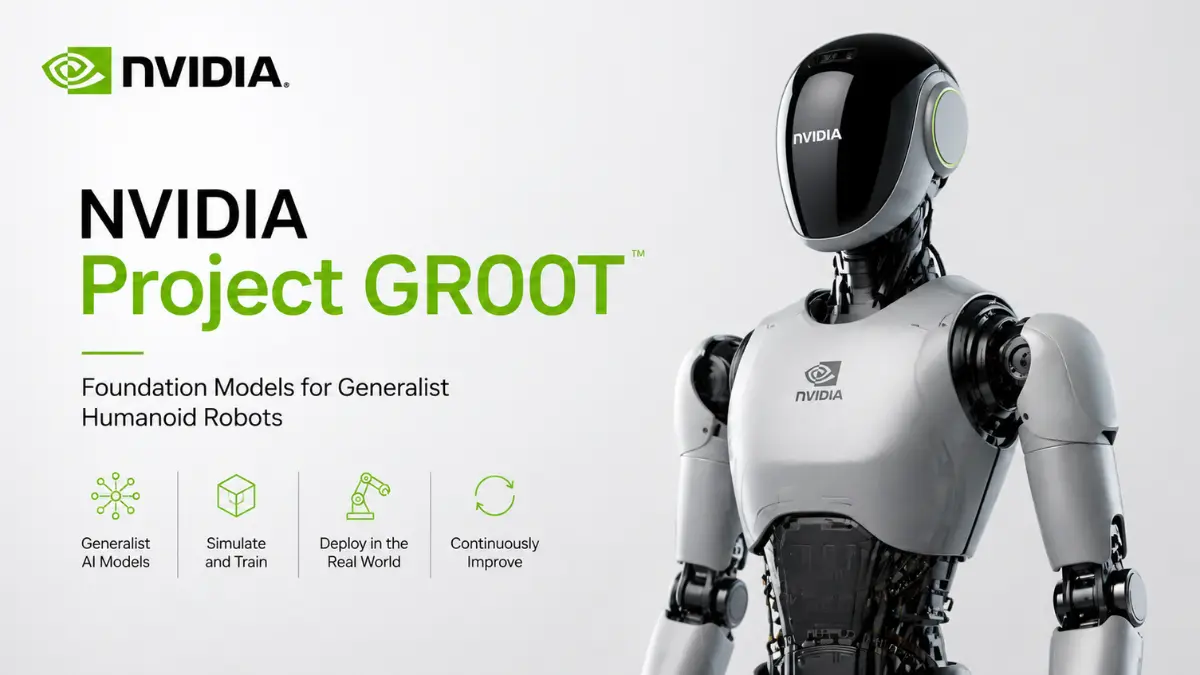
The Silicon Ghost: Why NVIDIA Project GR00T Just Made Every Other Robot Look Like a Toy
What if the future arrived faster than expected? For decades, we have been promised a world where robots walk among us—not as rigid, pre-programmed machines confined to factory cages, but as intelligent, adaptable partners. We were told this was a 20-year dream, a distant horizon for the next generation. But what if that timeline just collapsed into months?
In the last 90 days, the landscape of robotics changed forever. The silence of the laboratory has been replaced by the hum of NVIDIA Project GR00T, and if you aren’t paying attention, you’re already behind. This isn’t just an upgrade; it is the moment the “Silicon Ghost” entered the machine. We are no longer talking about robots that can perform a single task; we are witnessing the birth of a general-purpose consciousness for anything with two arms and two legs.
The Breakthrough: Defining NVIDIA Project GR00T
In the heart of Silicon Valley, during the most recent GTC conference, NVIDIA CEO Jensen Huang stood on stage surrounded by a “squad” of humanoid robots from various manufacturers—Figure, Sanctuary AI, Agility Robotics, and Unitree. But the star wasn’t the hardware. It was NVIDIA Project GR00T (Generalist Robot 00-Technology).
Project GR00T is a multi-modal foundation model that acts as the “mind” for humanoid robots. It allows robots to take in text, voice, and even video demonstrations of human movement, and then translate those into physical actions. This is the “ChatGPT moment” for robotics. Previously, to teach a robot to fold a shirt, you had to code every joint rotation manually. With GR00T, the robot watches a video of a human folding a shirt, simulates it a million times in a digital world via Isaac Lab, and then executes it in the real world with eerie precision.
The significance of this model cannot be overstated. According to official technical specifications on NVIDIA’s Developer Blog, the model is designed to enable robots to learn from a mix of human demonstrations and massive-scale reinforcement learning. This creates a feedback loop where the AI constantly refines its motor skills based on what it perceives in its environment.
Why It Matters Now: The Convergence of Blackwell and AI
The world is currently facing a labor shortage crisis in manufacturing and logistics. Simultaneously, we have reached a plateau in how much “pure software” AI can do. To truly impact the global GDP, AI must move. It must have a physical presence.
The breakthrough matters now because NVIDIA has finally solved the “Sim-to-Real” gap. For years, robots learned in simulations but failed in the messy, unpredictable real world. NVIDIA Project GR00T utilizes NVIDIA’s new Blackwell architecture and Jetson Thor computers to process massive amounts of sensory data in real-time. This allows the robot to adjust its balance, grip, and stride as fluidly as a human.
When Jensen Huang unveiled the Blackwell GPU, he didn’t just showcase a faster chip for gamers; he showcased the engine for the “Second Industrial Revolution.” Blackwell provides the computational density required to run massive neural networks locally on the robot’s “edge” hardware. This means the robot doesn’t have to wait for a signal from the cloud to decide not to trip over a stray pallet on a warehouse floor.
The Architect: Jensen Huang’s Masterstroke
Jensen Huang has transitioned NVIDIA from a “gaming chip company” to the “engine of the world.” His leadership style is focused on “full-stack” innovation. He didn’t just build a chip; he built the software (GR00T), the training ground (Isaac Lab), and the hardware (Thor).
This vertical integration makes NVIDIA the gatekeeper of the robotics era. While others are trying to build the perfect mechanical leg, NVIDIA is building the nervous system that makes the leg move. By focusing on the “Brain,” NVIDIA has made itself indispensable to every robotics company on the planet. As noted in recent financial analysis by Reuters, this shift toward robotics and AI foundation models has propelled NVIDIA into a valuation category previously reserved for oil giants and national economies.
Read More: Agentic AI & The Robotics Convergence: Why 2026 is the Year the “Brain” Met the “Body”
The Technology Deep Dive: Jetson Thor and Isaac Lab
At the core of this innovation is the Jetson Thor computer. This is a system-on-a-chip (SoC) designed specifically for the generative AI needs of humanoid robots. It delivers 800 teraflops of 8-bit floating point AI performance. To put that in perspective, this is a supercomputer shrunk down to the size of a lunchbox, capable of running complex transformer models that allow the robot to “understand” its surroundings.
To train these brains, NVIDIA uses Isaac Lab, a robot learning application built on the Omniverse platform. In this virtual space, physics are perfect and time can be sped up. A robot can “live” 1,000 years of trial and error in a single afternoon. It falls down and gets up a billion times in a digital void until its gait is perfect. By the time the software is uploaded to the physical robot, it is already an “expert.” This eliminates the risk of destroying expensive hardware during the early stages of training.
From Rigid to Fluid: Solving the Generalization Problem
Previous robotic solutions failed because they were “task-specific.” A robot built to move boxes could not suddenly decide to pick up a strawberry without crushing it. They lacked generalization. NVIDIA Project GR00T solves this by using “Reinforcement Learning from Human Demonstration.”
It treats physical movement like a language—learning the “grammar” of motion so it can improvise in new environments. If a GR00T-powered robot encounters a door handle it has never seen before, it doesn’t freeze. It uses its foundation model to “infer” how a door handle should work based on the millions of examples it saw during training.
Competitive Landscape: Who is Affected?
The impact is a seismic shift in the valuation of robotics companies.
- Boston Dynamics: Traditionally the king of hydraulic engineering, they are now rushing to integrate AI-first software to keep pace with the cognitive capabilities of GR00T.
- Tesla Optimus: While Tesla has its own vertical stack, the ubiquity of NVIDIA’s tools means that smaller startups can now compete with Tesla’s AI prowess by simply plugging into the NVIDIA ecosystem.
- Closed Ecosystems: Companies trying to build proprietary, closed-loop software are finding it hard to keep up with the collective learning speed of the NVIDIA-partnered network.
NVIDIA is providing the “OS” for the robotics industry. By partnering with companies like 1X Technologies, Apptronik, and Agility Robotics, NVIDIA is ensuring that no matter which physical robot “wins” the market, NVIDIA provides the intelligence.
Industry Reactions and Investor Interest
The “smart money” is pouring into “Embodied AI.” Within weeks of the GR00T announcement, startups in the humanoid space saw their valuations skyrocket. Investors realize that the hardware—the metal, the motors, the plastic—is becoming a commodity. The foundation model (the AI) is where the “moat” lies.
Industry leaders in automotive manufacturing, particularly BMW and Mercedes-Benz, are already testing these brains in their pilot programs. They aren’t looking for a robot that can do one thing; they are looking for a robotic workforce that can be “re-skinned” for different roles on the assembly line simply by downloading a new software update.
Risks, Limitations, and the “Uncanny Valley”
Despite the hype, the path isn’t clear of obstacles. We must address the technical and social hurdles:
- Energy Consumption: Keeping a high-powered AI brain like Jetson Thor running while moving heavy hydraulic or electric limbs drains batteries at an unsustainable rate. Current humanoid robots rarely last more than 2-4 hours on a single charge.
- Safety and Liability: A 200-pound metal robot learning through “trial and error” in a factory near humans is a liability nightmare. If the “Silicon Ghost” makes a mistake in its inference, the physical consequences are real.
- Latency: Any delay in the “thought-to-action” pipeline can result in catastrophic falls. While Blackwell reduces latency, the “edge-to-actuator” speed still needs to match human biological reflexes.
- The Uncanny Valley: As robots become more human-like in their movement (thanks to GR00T’s imitation learning), they enter a psychological space where they are “too human” for comfort, causing revulsion in the very workforce they are meant to assist.
Read More: Beyond the LLM: The Rise of the ‘Agentic AI’ Startup Hub in NYC
The Hidden Psychology: Why the Market is Exploding
Why is everyone so excited? It’s the “Avatar” complex. Humans have a psychological fascination with creating life in our own image. For the market, this represents the ultimate labor force—one that doesn’t sleep, doesn’t join unions, and never tires.
The excitement is fueled by the hope of “infinite productivity.” For the first time in history, we are looking at the possibility of decoupling economic growth from human population growth. This is the ultimate hedge against aging demographics in the West and East Asia.
Global Implications: The New Silicon Arms Race
This isn’t just a tech story; it’s a geopolitical one. China has already announced plans to mass-produce humanoid robots by 2025. The U.S., through NVIDIA, is betting on superior software and chip architecture to maintain the lead.
We are entering an era where a country’s power will be measured not just by its human population or its nuclear arsenal, but by its “silicon population.” The nation with the most efficient foundation models and the largest fleet of general-purpose robots will dominate the manufacturing and service sectors of the 2030s.
What Businesses Can Learn from the GR00T Launch
The lesson for every CEO is clear:
- Modularity is King: Don’t build tools that only do one thing. Build platforms that can be updated.
- Simulation First: If you can simulate your business problems in a “digital twin” (like Isaac Sim) before executing in the real world, you reduce risk to near zero.
- General Purpose Beats Special Purpose: In a rapidly changing economy, the “one-tool machine” is a stranded asset. The future belongs to the adaptable.
The Near Future: 12 to 24 Months Out
In the next two years, we will likely see the first “General Purpose” robots entering the consumer service sector. Think hospital orderlies that can move equipment, elder care assistants that can help people stand, and domestic assistants in high-end homes.
As NVIDIA Project GR00T matures, these robots will begin to learn from each other. This is the “Fleet Learning” effect. When one robot in a warehouse in Tokyo learns a better way to navigate a crowded hallway, that “knowledge” can be instantly flashed to every other robot on the network globally. We are moving toward a collective machine intelligence.
Key Takeaways
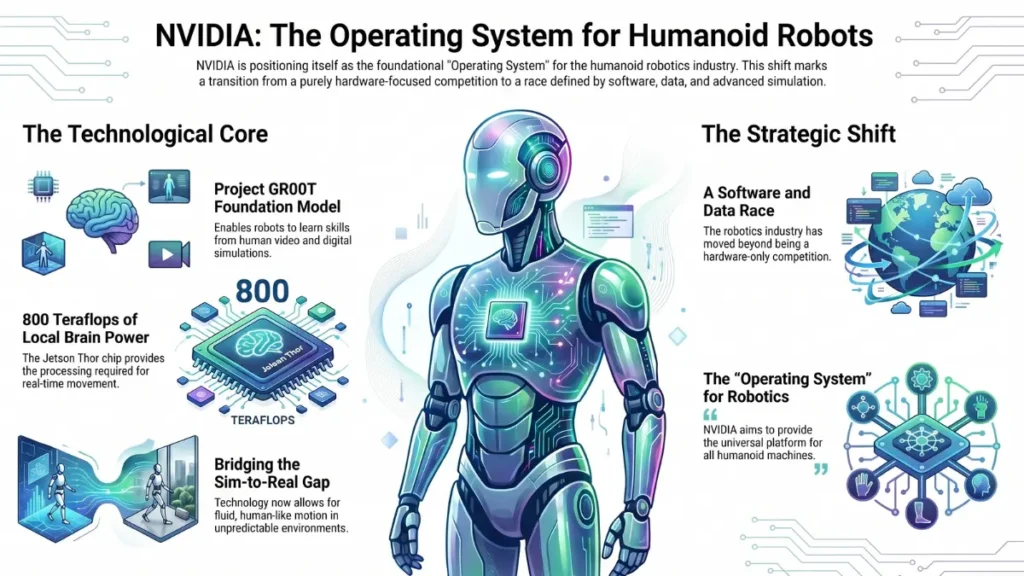
- Project GR00T is a foundation model that allows robots to learn from human video and simulation.
- Jetson Thor provides the localized “brain power” (800 teraflops) needed for real-time movement.
- NVIDIA is positioning itself as the “Operating System” for all humanoid robots.
- The Sim-to-Real gap has been bridged, allowing for fluid, human-like motion in unpredictable environments.
- The robotics race is now a Software and Data race, not just a hardware race.
FAQs
1. What exactly is NVIDIA Project GR00T?
It is a general-purpose foundation model designed for humanoid robots. It acts as the AI “brain,” allowing machines to understand natural language and mimic human movements by watching videos or being guided through simulations.
2. Does NVIDIA build the actual robot hardware?
No. NVIDIA provides the “intelligence stack”—the chips (Jetson Thor) and the software models (GR00T). They partner with hardware companies like Boston Dynamics, Figure, and Agility Robotics who build the physical frames.
3. What is “Embodied AI”?
Embodied AI refers to artificial intelligence that exists within a physical body. Unlike a chatbot (which is just text), Embodied AI can perceive the physical world, move through it, and manipulate objects.
4. How does the robot learn from a YouTube video?
Through “Generative AI for Motion,” GR00T analyzes the pixels of a human moving, maps those movements to a digital skeleton, and then uses reinforcement learning in a virtual environment to find the exact motor commands needed to replicate that movement in the real world.
5. When will these robots be in my house?
While they are currently being deployed in car factories (like BMW) and warehouses, consumer-facing roles in hospitals or homes are expected to emerge within the next 3 to 5 years as the technology scales and costs decrease.
Conclusion: The Point of No Return
The announcement of NVIDIA Project GR00T marks a point of no return in human history. We have moved beyond the era of machines that “calculate” and into the era of machines that “perceive and act.” NVIDIA has effectively provided the blueprint for the physical manifestation of artificial intelligence.
The biggest lesson here is that the barrier between the digital and physical worlds has finally dissolved. Intelligence is no longer trapped behind a glass screen; it has been given a body, a gait, and a grip. This isn’t just about robots; it’s about the fundamental restructuring of how human society functions. When labor is decoupled from human biology, the very concept of “value” and “work” will undergo a radical transformation.
We are standing at the edge of a world where the “Silicon Ghost” isn’t just a metaphor—it’s the person delivering your mail, building your car, and eventually, caring for your loved ones. The speed of this transition will shock those who are still waiting for the “future” to arrive. It’s already here, it’s standing on two legs, and it’s learning faster than we ever could.
Are we underestimating how fast the future is moving, or are we ready to share our world with a new species of our own creation?
Read More: The $852 Billion Bet: How Anthropic is Rewriting the Venture Capital Playbook