

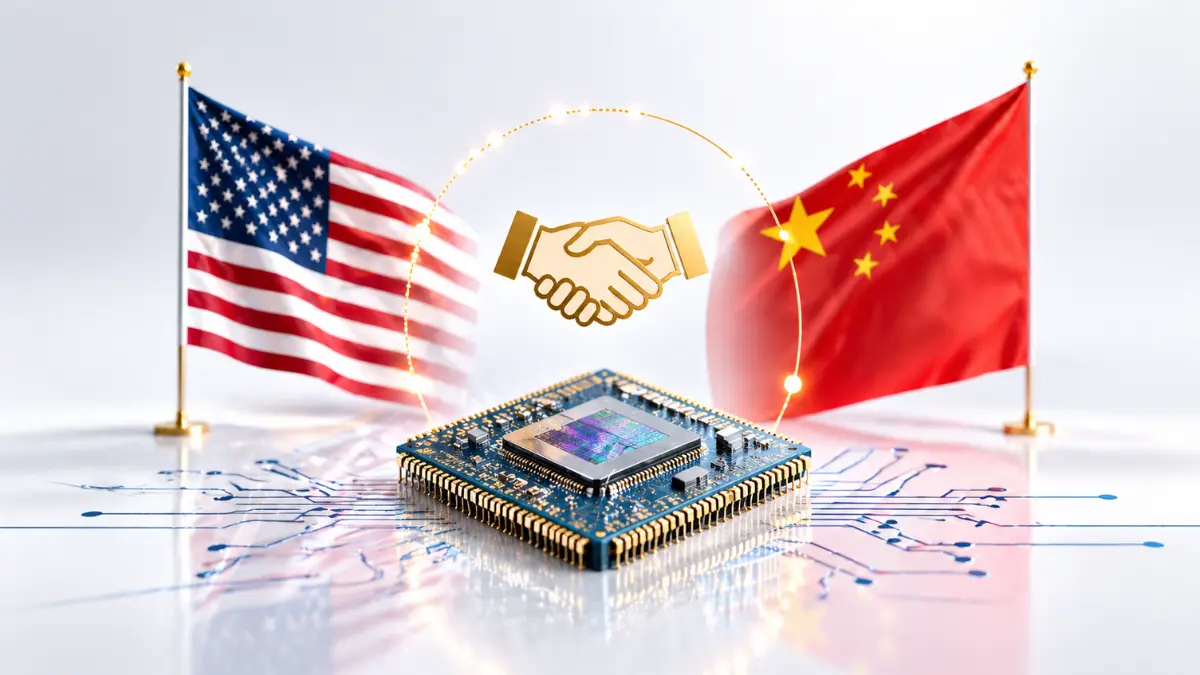
The global technology landscape shifted on its axis today as Washington and Beijing finalized the US-China semiconductor deal, a landmark “Tech Truce” aimed at stabilizing the $600 billion global chip market. After years of escalating export controls and “tit-for-tat” sanctions, this agreement establishes a controlled framework for the exchange of legacy and mid-tier silicon, while maintaining a “high fence” around 2026-era logic chips and quantum-integrated hardware.
The Architecture of the Truce
The deal arrives at a critical juncture. According to a recent McKinsey & Company report on generative AI value chains, the AI revolution is no longer being funded by “fly-by-night” startups, but by the wealthiest corporations in human history with massive cash reserves that act as “Sovereign AI” entities. To keep this engine running, the new agreement allows for the resumption of specific “Non-Dual Use” high-bandwidth memory (HBM) exports to Chinese consumer electronics firms, in exchange for Beijing’s commitment to transparent pricing on legacy-node chips—the “foundational” silicon that powers everything from EVs to medical devices.
The Winners: Efficiency and Infrastructure
For Western tech giants, the deal provides a much-needed cooling period. Alphabet and Meta are early winners, as the stabilization of the supply chain secures the “defensive moats” they have built through core AI advertising integration. Similarly, Tesla stands to benefit as it scales its Nvidia-powered clusters for Level 4 autonomous driving fleets, a mission that requires a stable flow of secondary components often sourced from the Asia-Pacific region.
In the private sector, “Defense Tech 2.0” firms like Anduril and Palantir are seeing a “SaaSification” of their revenue models. With a clearer regulatory horizon, these companies can move away from 5-10 year innovation cycles to 3-6 month “agentic” updates, securing government contracts that are now viewed as high-margin, recurring revenue assets.
The Losers: The “Wrapper” Economy and High-CAC Startups
The truce, however, creates a brutal environment for “wrapper” startups. Those that relied on general APIs to build basic AI tools are being crushed. A representative case is the fall of “Lumina Legal AI,” which saw an 80% churn rate after OpenAI released specialized modules that rendered Lumina’s UI-thin product obsolete.
Furthermore, the “Compute Tax” remains a silent killer. Even with a more stable chip supply, the math for many startups is broken; some are spending $1.10 to generate $1.00 of revenue, essentially subsidizing AI usage with venture capital that is rapidly drying up.
Market Outlook: Data and Discipline
As noted in PwC’s Capital Markets Watch, 2026 IPOs are now pricing with significantly more conservative multiples. The era of “Vibes and Valuations” has been replaced by “Data and Discipline.” Investors are no longer rewarding headcount; they are rewarding “Efficiency as the New Headcount.”
The US-China semiconductor deal may prevent a total “black swan” energy or supply chain collapse, but it does not signal a return to the free-market era of 2019. Instead, it codifies a world where “Baseload is King” and energy-hedging is mandatory. For the strategic investor, the message is clear: the future belongs to those who own the “R&D engine”—proprietary data and modular, resilient networks—rather than those just renting the hardware.
Read more: The De-Dollarization Update: How 2026 Trade Policies are Strengthening BRICS