


Nvidia AI earnings 2026: Is the Artificial Intelligence Bubble Finally Bursting?
The air in Silicon Valley feels heavy this week. As the fiscal first-quarter results for 2026 flicker onto terminal screens across Wall Street, one name commands the spotlight: Nvidia. For the past three years, Jensen Huang’s powerhouse has acted as the de facto heartbeat of the global economy. But as the Nvidia AI earnings 2026 report hits the wire, a haunting question is being whispered from the trading floors of Manhattan to the venture labs of Palo Alto: Have we finally reached the edge of the abyss?
The Trillion-Dollar Question
Are we witnessing the most significant technological evolution in human history, or are we merely watching the most expensive game of musical chairs ever played? In early 2026, the “AI Three”—Nvidia, Microsoft, and Alphabet—have signaled capital expenditures nearing a staggering $650 billion. Investors are no longer satisfied with “potential”; they are demanding “proof of profit.” Nvidia’s earnings serve as the ultimate litmus test for whether this massive capital outlay is a bridge to the future or a pier into the sea of speculation.
Dominance, Deceleration, and the Blackwell Factor
Nvidia’s Q1 numbers are absurd, even by the company’s own inflated standards. With total revenue hitting $78 billion—a 77% increase year-over-year—the question isn’t whether they’re winning; it’s whether their customers can keep up the pace. The Data Center segment alone, now the crown jewel of the Santa Clara giant, accounted for over $70 billion of that total.
However, the “bubble” narrative isn’t built on a lack of revenue; it’s built on the fear of a “demand cliff.” Critics point to the fact that while Nvidia is selling the “shovels” (the Blackwell and Vera Rubin architectures), the “gold miners” (AI software startups) are struggling to find actual gold. According to recent data from Nvidia Investor Relations, the company remains supply-constrained through 2027, but the secondary market for older H100 chips is starting to see its first signs of cooling.
The Blackwell Bottleneck and the ROI Reality
The friction point is simple: Nvidia’s balance sheet looks like a fortress, but their top customers are starting to face uncomfortable questions from their own shareholders about where the actual profit is. If Microsoft, Amazon, and Meta are the primary buyers, what happens when the needle on consumer subscriptions refuses to move?
In the Johny Millionaire playbook, we look for the “Platform Play.” Nvidia isn’t just selling a chip; they are building the operating system of the AI economy. Through their CUDA ecosystem, they have created a moat that makes switching costs prohibitively high for any enterprise. This isn’t just hardware; it’s a locked-in software environment.
Is This 1999 All Over Again?
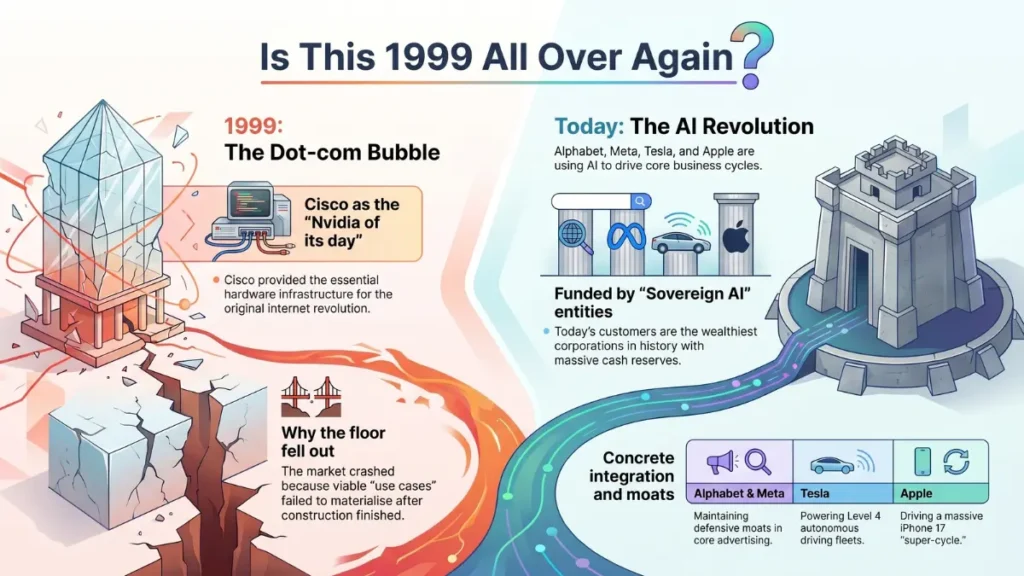
The comparisons to the Dot-com crash are inevitable. In 1999, Cisco was the Nvidia of its day—the hardware provider for the internet revolution. When the build-out finished and the “use cases” didn’t materialize fast enough, the floor fell out.
“The difference today,” as noted in a recent McKinsey & Company report on generative AI value chains, “is that the customers aren’t fly-by-night startups. They are the wealthiest corporations in human history.” Unlike the 90s, the AI revolution is being funded by companies with massive cash reserves that act as “Sovereign AI” entities.
- Alphabet & Meta: Integrating AI into core advertising to maintain defensive moats.
- Tesla: Utilizing Nvidia-powered clusters for Level 4 autonomous driving fleets.
- Apple: Relying on on-device processing via “Apple Intelligence” to drive a massive iPhone 17 super-cycle.
Read more on Johny Millionaire: GPT-5.5 Spud Model: Solving the World’s Hardest Scientific Equations
The Real Risk: Niche vs. Universal AI
If the bubble does pop, it won’t be a total collapse. Instead, we are seeing a “sloughing off” of the unnecessary. The market is tired of “universal assistants” that can write a poem but can’t balance a spreadsheet.
Investors in 2026 are pivoting toward domain-specific AI—tools for cybersecurity, legal compliance, and specialized engineering. The Nvidia AI earnings 2026 report reflects this; while general-purpose GPU sales are steady, the demand for high-performance clusters specialized for “Agentic AI”—autonomous systems that can execute tasks without human oversight—is where the growth remains explosive.
Key Takeaways for Investors
- Revenue vs. ROI: Nvidia’s revenue remains record-breaking, but the focus has shifted to the efficiency of that spend.
- The $1 Trillion Bet: Jensen Huang is betting on a total replacement of traditional data centers with “AI Factories.”
- Valuation Reality: Despite the hype, Nvidia’s P/E ratio remains surprisingly grounded compared to its 5-year median, suggesting the earnings are growing faster than the stock price.
Read more on Johny Millionaire: Why Agentic Workflows Are Replacing RPA: The 2026 Office Revolution
Glossary of Terms: The 2026 Tech Lexicon
- Agentic AI: AI that can plan and execute multi-step goals autonomously.
- Blackwell: Nvidia’s high-efficiency GPU architecture released in late 2024/2025.
- Inference vs. Training: Training is teaching the AI; Inference is the AI actually performing the task for the user. In 2026, the money is shifting to Inference.
FAQs
1. Why is Nvidia’s stock still rising despite bubble fears?
The stock is supported by tangible earnings and a $60 billion share buyback program. It’s hard for a bubble to burst when the underlying cash flow is this massive.
2. What could cause a “CapEx freeze” in AI?
If the “AI Three” (Microsoft, Alphabet, Nvidia) fail to show that AI is significantly reducing their internal costs or increasing their external revenue by the end of 2026.
3. Is Blackwell really a 10x improvement?
Technically, yes. Blackwell offers 10x the throughput per megawatt compared to the Hopper generation, which is the only reason global power grids haven’t collapsed under AI demand yet.
Conclusion: A Correction, Not a Crash
The Nvidia AI earnings 2026 report tells a story of a maturing market. The “Gold Rush” phase—where anyone with an .ai domain could get funding—is dead. We have officially entered the “Infrastructure Phase.” Nvidia sits at the center of a fundamental shift in how the world processes information. The bubble might be leaking in speculative corners, but the foundation remains solid.
The era of AI hype has ended; the era of AI utility has officially begun. But as the market matures, one question remains: Are you investing in the “shovels,” or have you found a company that actually knows how to find the gold?


[…] Read More: Nvidia AI Earnings 2026: Bubble Burst or $1 Trillion Beginning? […]
[…] Read more on Johny Millionaire: Nvidia AI earnings 2026: Is the Artificial Intelligence Bubble Finally Bursting? […]