


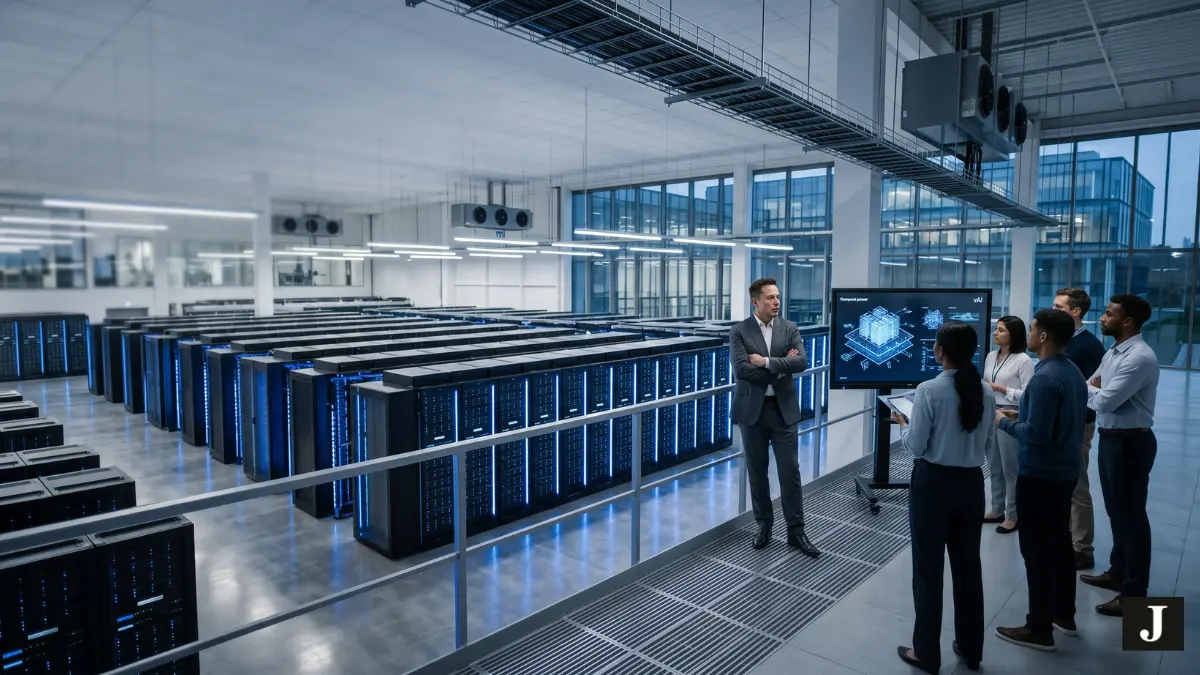
Elon Musk’s artificial intelligence venture, xAI, has officially closed a massive $10 billion Series C funding round, catapulting the company’s valuation toward the $50 billion mark and signaling a definitive shift in the global AI arms race. The capital injection is specifically earmarked for a monumental expansion of the “Colossus” supercluster—a proprietary compute powerhouse designed to move xAI away from its reliance on third-party silicon and toward a future of custom-built, in-house chips.
The Rise of Colossus
At the heart of Musk’s strategy is the technical architecture of the Colossus supercluster, currently located in Memphis. While the first phase utilized 100,000 Nvidia H100 GPUs, this new $10 billion war chest will fund an evolution into custom silicon. By developing its own ASIC (Application-Specific Integrated Circuit) processors, xAI aims to bypass the “Nvidia tax” and solve the supply chain bottlenecks that have hampered competitors. This isn’t just about speed; it’s about architectural efficiency tailored specifically for Grok, xAI’s flagship LLM, which is now being integrated across the entire X (formerly Twitter) ecosystem.
Vertical Integration: The Musk Playbook
Musk is doubling down on his historical doctrine of vertical integration—a strategy that allowed SpaceX to dominate launch costs and Tesla to lead the EV market. By building what he cannot buy, Musk is insulating xAI from the pricing volatility of the GPU market. Industry analysts suggest that if xAI successfully deploys its own silicon by 2027, it could reduce operational costs by as much as 40% compared to OpenAI and Anthropic, who remain heavily tethered to Microsoft and Amazon’s cloud infrastructures.
A Three-Way Rivalry for AGI
The funding arrives as the rivalry between xAI, OpenAI, and Anthropic reaches a fever pitch. While OpenAI benefits from its deep partnership with Microsoft, and Anthropic enjoys backing from Google and Amazon, xAI is positioning itself as the “independent” alternative. The central question among Silicon Valley researchers remains: Can xAI achieve AGI (Artificial General Intelligence) first? With direct access to real-time data from X and the physical-world datasets from Tesla, xAI possesses a unique training advantage that purely digital labs lack.
Impact on Tesla and the FSD Roadmap
The $10 billion raise has significant implications for Tesla’s Full Self-Driving (FSD) roadmap. Previously, Tesla and xAI shared compute resources, but this new funding allows xAI to stand on its own feet, potentially freeing up Tesla’s H100 reserves for its own Dojo supercomputer. The “Compute Swap” agreements between the two companies suggest a symbiotic relationship where xAI’s advancements in reasoning directly inform Tesla’s “End-to-End” neural networks for autonomous driving.
Future Outlook
As xAI scales, the market is watching for a potential IPO or further integration into the “X” super-app. For now, the focus remains on the sheer scale of the Colossus expansion. If Musk’s bet on custom silicon pays off, 2026 will be remembered as the year the compute monopoly finally cracked.
Read More: The Rise of the “One-Person Unicorn”: How AI Founders are Scaling to $1B with Minimal Staff