


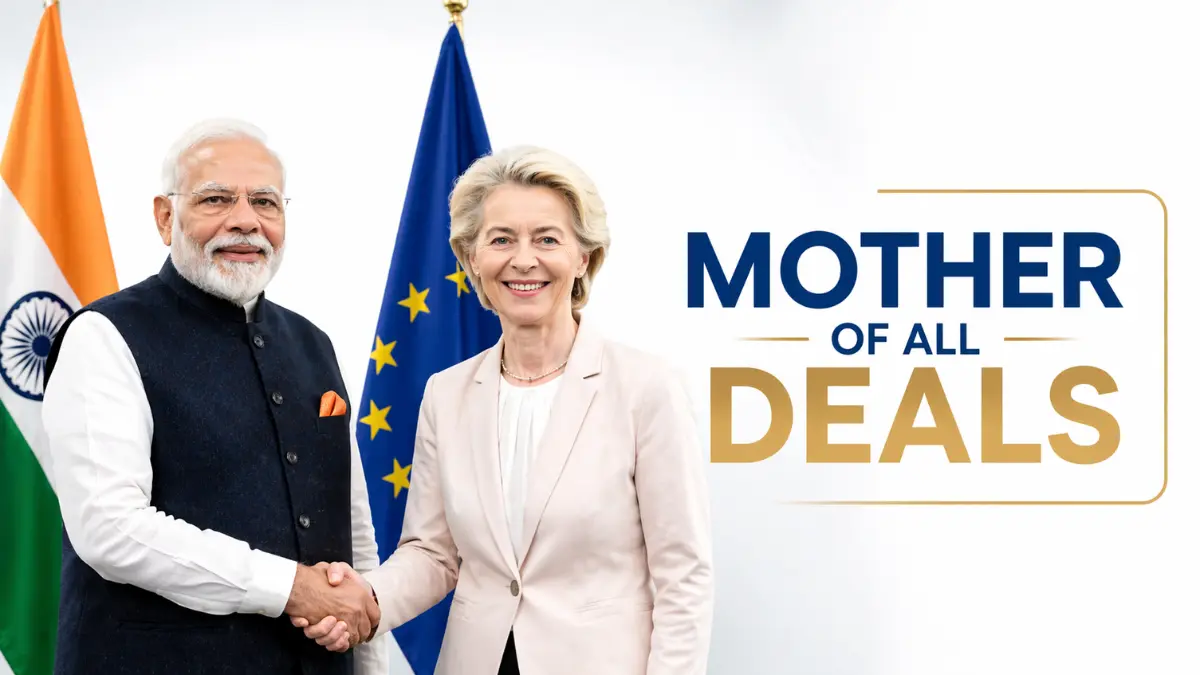
BRUSSELS / NEW DELHI — The global trade map was fundamentally redrawn this week as the European Union and India finalized a historic Free Trade Agreement (FTA), an accord already being hailed by diplomats as the “geopolitical anchor” of the decade. The signing of the EU-India FTA marks a decisive move by two of the world’s largest democratic markets to insulate themselves from the mounting unpredictability of Washington’s “America First” 2.0 agenda. By establishing a direct, friction-less economic corridor, Brussels and New Delhi have effectively signaled that the era of U.S. trade hegemony may be reaching a strategic inflection point.
The €180 Billion Economic Engine
The scale of the agreement is staggering. The European Commission projects that the bilateral trade impact will exceed €180 billion ($193 billion) by 2030, a nearly 40% increase from current levels. The deal eliminates tariffs on over 90% of traded goods, providing European automotive, chemical, and luxury sectors with unprecedented access to India’s 1.4 billion consumers. In return, India secures a major win for its burgeoning services sector and textile industry, while gaining essential European investment in green energy and high-tech infrastructure.
This move is a direct response to the tariff volatility currently emanating from the U.S. Department of Commerce. With the Trump administration signaling a new wave of reciprocal duties, the EU and India are choosing to bypass the “Washington gatekeeper” in favor of mutual strategic autonomy.
A Rejection of the “Nobel Narrative”
The diplomatic friction underlying this deal was laid bare when New Delhi pointedly refused to endorse President Trump’s recent “Peace through Prosperity” narrative—often referred to in D.C. circles as the “Nobel Prize” campaign. While the White House sought global backing for its Middle Eastern mediation efforts, India’s Ministry of External Affairs opted for a pragmatic silence, prioritizing the FTA over symbolic political endorsements. Analysts suggest this cold shoulder reflects a deeper Indian strategy: the refusal to be a junior partner in a U.S.-centric security architecture when a more lucrative, multipolar economic path with Europe is available.
Navigating the Risk of Over-Dependence
For both Brussels and New Delhi, the primary driver is the mitigation of risk. Over-dependence on the U.S. for security and China for supply chains has left both regions vulnerable to the “de-risking” wars of the last three years. This agreement creates a “third pole” of global stability. India, now the world’s fastest-growing major economy with a GDP growth rate holding steady at 6.8%, is positioning itself as the primary alternative to Chinese manufacturing for European firms seeking to diversify their footprints.
Strategic Roadmap for American Companies
The finalized EU-India trade corridor presents a complex challenge for U.S.-based multinationals. American firms now face a “competitive disadvantage” in the Indian market compared to their European rivals, who will enjoy significantly lower duty structures.
To navigate this, U.S. entities are already shifting strategies:
- European Subsidiary Routing: Leading U.S. manufacturers are increasingly leveraging their EU-based subsidiaries to export to India under the new FTA terms.
- Direct Investment Pivot: Corporate giants are accelerating “In India, For the World” initiatives, bypassing export hurdles by scaling domestic Indian production.
What Comes Next
The market reaction has been swift, with the Nifty 50 and DAX indices both closing up 1.8% following the announcement. Investors should watch the upcoming Q3 earnings reports from European industrial conglomerates, which are expected to reveal expanded guidance for the Indian market. As the U.S. continues its inward-looking policy shift, the “Mother of All Deals” serves as a stark reminder: the world is not waiting for Washington to lead the next era of global commerce.