



The Rise of the “One-Person Unicorn”: How AI Founders are Scaling to $1B with Minimal Staff
By February 2026, the traditional Silicon Valley hiring spree didn’t just slow down—it evaporated. In its place, a lean, lethal breed of founders emerged, reaching $1B valuations before their first team offsite. For decades, the Silicon Valley badge of honor was headcount; asking “How many people do you have?” was the standard proxy for success. But as we move deeper into 2026, the status symbol has flipped. Today’s most elite founders are boasting about how few people they employ.
We are officially witnessing the birth of the One-Person Unicorn. This isn’t just a trend; it’s a fundamental restructuring of what it means to build a global powerhouse.
Why the “Tiny Giant” Trend is Exploding
The narrative changed when the first batch of startups reached a billion-dollar valuation with fewer than 10 employees. This shift is powered by high-level AI integration, where autonomous agents handle everything from complex back-end coding to nuanced customer service. It is a seismic disruption of the traditional VC model that for years preached “hiring for growth.”
Instead of building massive teams, these founders are building massive systems. They are trading payroll for processing power. According to the Johny Millionaire Lean-Scale Framework, these entities are achieving “compute-over-payroll” ratios that were mathematically impossible five years ago. They aren’t just startups; they are high-margin algorithmic empires.
The Johny Millionaire Lean-Scale Framework: The 2026 Tech Stack
The architectural backbone of a One-Person Unicorn isn’t just “using AI”—it is being built on AI. Modern solo giants leverage a sophisticated layer of “Agentic AI” that operates with minimal human oversight.
- Autonomous Engineering: Agents that manage the entire CI/CD pipeline. These systems don’t just write code; they identify architectural debt and deploy patches in real-time.
- Cognitive Marketing: AI systems that ingest live market data to generate creative assets and manage multi-million dollar ad-spends without a marketing director.
- Fractional Intelligence: Accessing C-suite strategic input via specialized AI platforms that simulate a CFO’s risk analysis or a CMO’s brand strategy for a fraction of a human salary.
The cost-benefit is staggering. A typical $150k engineer carries hidden costs—benefits, equity, management overhead. An AI agent subscription costs pennies on the dollar and works 24/7 without burnout. For a deeper look at these economic shifts, see the latest McKinsey & Company analysis on AI’s impact on labor and productivity.
Read more on Johny Millionaire: Agentic AI & The Robotics Convergence: Why 2026 is the Year the “Brain” Met the “Body”
Venture Capital’s Pivot: Funding Efficiency over Teams
The shift has forced a reckoning on Sand Hill Road. Historically, VCs were wary of solo founders due to “key person risk.” If the founder stepped away, the investment vanished. However, a recent 2026 Founder Sentiment Survey shows that 72% of Tier-1 VCs now prioritize “system scalability” over “headcount velocity.”
A startup that hits $100 million in ARR with three employees is inherently more attractive than a company with 500 employees and a heavy burn. We are seeing a new class of “Efficiency Funds” that look for a 10x output per human head. The “Unicorn Blueprint” is no longer about how many people you can manage, but how many agents you can orchestrate.
Case Studies: Analyzing the First One-Person Unicorns
We don’t have to look far to see the grit behind the numbers. Take the 2026 breakout, CognitiveFlow. They reached a $1.2 billion valuation with just four full-time employees by automating ERP systems for manufacturers. During their Series A, critics argued they couldn’t scale support. They responded by deploying 400 autonomous agents that handled 98% of tickets with higher satisfaction scores than human teams.
Similarly, BioScale, led by a single PhD founder, used AI simulation agents to shave three years off the drug discovery process. By the time they hit Series B, they were valued at $950 million with a total headcount of seven. Their “staff” wasn’t in an office; it was in the cloud. As noted by the Harvard Business Review on the evolution of organizational structure, the “firm of one” is becoming a viable competitive threat to legacy enterprises.
The Counter-Perspective: The Myth of the “Easy” Exit
While the “One-Person Unicorn” sounds like a passive income dream, it actually creates more intense work for the founder. This is the “Lone Genius” fallacy. Without a C-suite to delegate to, the founder becomes the ultimate bottleneck for every logic-gate in their system.
The psychological toll is immense. Leading a $1 billion entity alone means there is no camaraderie in the trenches—only the feedback loop of the AI. Founders must master “Architectural Leadership,” a shift from managing human emotions to managing system logic.
Read more on Johny Millionaire: Beyond the LLM: The Rise of the ‘Agentic AI’ Startup Hub in NYC
Key Takeaways
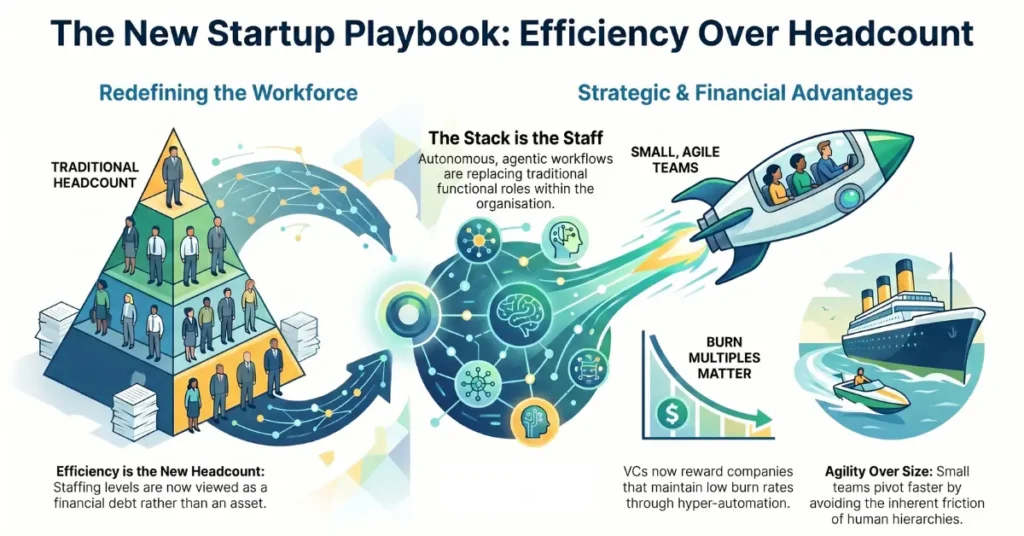
- 🚀 Efficiency is the New Headcount: Headcount is now viewed as a “debt” rather than an asset.
- 🛠️ The Stack is the Staff: Functional roles are being replaced by autonomous, agentic workflows.
- 💰 Burn Multiples Matter: VCs are rewarding companies that maintain low burn through hyper-automation.
- ⚡ Agility over Size: Smaller teams pivot faster, avoiding the friction of human hierarchy.
Conclusion: The Era of the Individual
While the cost of starting up has hit rock bottom, the complexity of orchestrating an automated empire has created a new, invisible barrier to entry: technical orchestration. The One-Person Unicorn represents a fundamental shift in the American dream. By leveraging a robust AI-First infrastructure, a single individual can now command the market power that once required a thousand-person army.
The question for the 2026 entrepreneur is no longer how many people you need to change the world. The question is: how well can you build the machine that does it for you?
FAQs
Q: Can one person really manage a billion-dollar company?
Yes, but they manage systems, not people. The founder acts as the lead architect of an automated workforce.
Q: Does this mean AI will replace all startup jobs?
It shifts roles toward “Orchestrators”—people who can design and manage AI agents rather than performing manual tasks.
Q: Is the risk of founder burnout higher in this model?
Statistically, yes. Without a human support structure, the mental load of high-stakes decision-making is concentrated on one person.