


The Silicon Valley power structure has officially shifted. As of Tuesday’s market close, Nvidia’s market capitalization crossed the historic $4 trillion threshold, catapulting co-founder and CEO Jensen Huang past Amazon’s Jeff Bezos in net worth. With Nvidia shares trading up 3.4% on the day, Huang’s fortune—largely tied to his 3.5% stake in the semiconductor giant—now places him at the vanguard of the generative AI era, a symbolic victory of “Compute” over “Commerce.”
The “30-Year Overnight Success”
While the world views Nvidia as the undisputed king of the AI boom, Huang often reminds his 30,000 employees that the company is a “30-year overnight success.” The journey to $4 trillion was nearly derailed in its infancy. In the mid-1990s, the failure of the RIVA 128’s predecessor almost forced Nvidia into bankruptcy. It was Huang’s “intellectual honesty”—a core company value—that allowed the firm to pivot, abandon failing architectures, and eventually bet the entire company on CUDA, the parallel computing platform that now serves as the industry standard for AI development.
Managing a $4 Trillion “Flat” Organization
Huang’s rise is equally a story of unconventional management. Unlike his peers at the top of the Bloomberg Billionaires Index, Huang famously eschews the traditional corporate hierarchy. He has approximately 50 direct reports and operates with a strict “No-One-on-One” meeting rule. Huang believes that one-on-one meetings create information silos and internal politics. Instead, he conducts group sessions where strategy is debated in the open, ensuring the company maintains the agility of a startup despite its massive scale.
This radical transparency allows Nvidia to execute with terrifying speed. In an industry where a missed product cycle can lead to irrelevance, Huang’s “flat” organization ensures that technical breakthroughs in the lab reach the production line in record time.
The Rise of the Techno-Celebrity
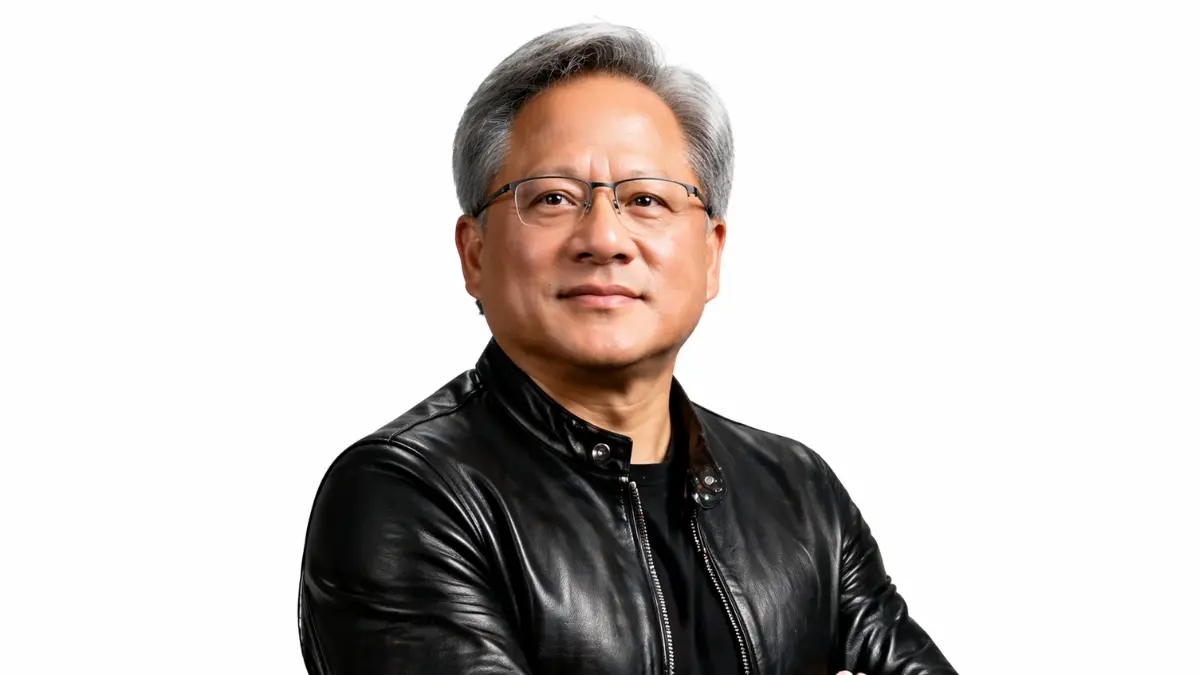
Beyond the balance sheet, Huang has cultivated a brand that is as recognizable as the company’s green logo. His signature black leather jacket has become the uniform of the AI revolution, transforming a hardware engineer into a global “Techno-Celebrity.” While Bezos and Musk lean into space exploration and social media, Huang has positioned himself as the “foundational” leader—the man providing the shovels for the AI gold rush.
What Comes Next
As Nvidia approaches a valuation nearly 25% higher than the current GDP of the United Kingdom, the scrutiny from regulators and competitors will only intensify. With the upcoming release of the “Rubin” chip architecture in late 2026, analysts expect Nvidia to maintain its 80% plus market share in AI accelerators. For investors, the question is no longer about growth, but about the ceiling. If Huang’s management style continues to defy corporate gravity, $4 trillion may just be the baseline for the “Jensen Era.”
Read More: The Biotech Boom: Why 2026 is the Year of the Healthcare Unicorn