


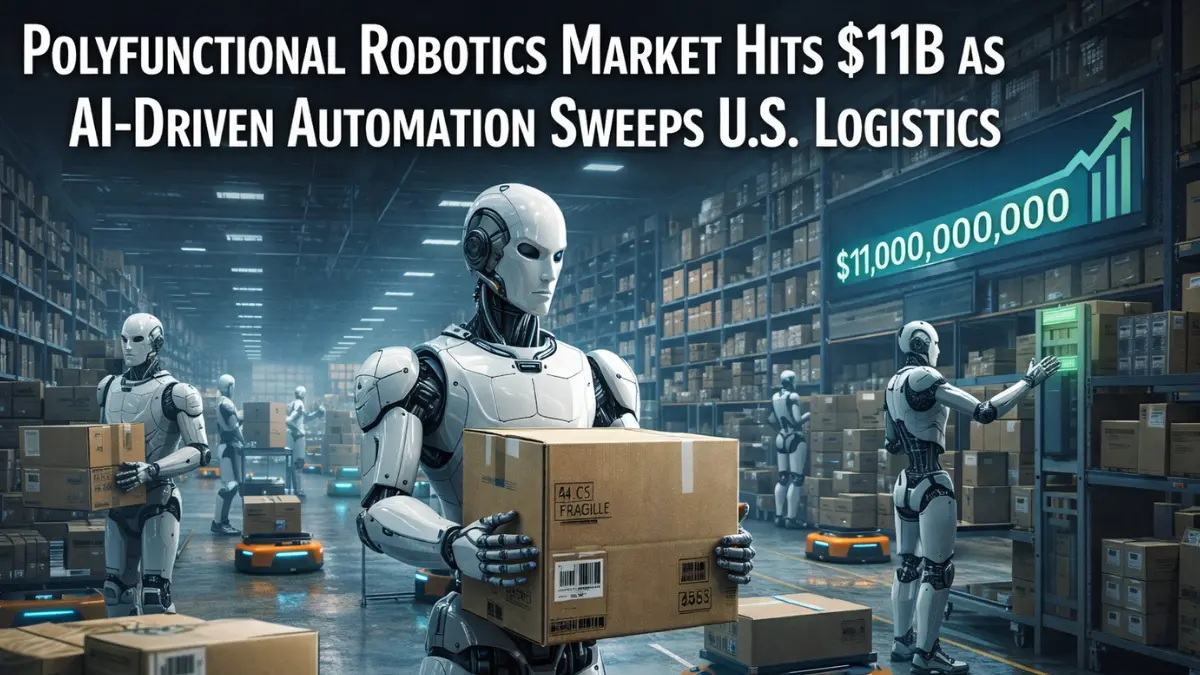
The industrial landscape of the United States is undergoing a profound structural shift as the polyfunctional robotics market officially crossed the $11 billion threshold this quarter. Driven by a surge in AI-driven automation within the logistics and warehousing sectors, this milestone marks the transition of artificial intelligence from digital screens to the physical factory floor.
At the heart of this expansion is the rise of “polyfunctional” bots. Unlike the single-task machines of the previous decade, these new-age systems are designed with versatility in mind—often capable of performing ten or more distinct jobs, ranging from precision sorting to heavy palletization. This hardware flexibility is powered by a pivot in the semiconductor industry. Most notably, Nvidia’s chip dominance has shifted from training Large Language Models (LLMs) to sophisticated “physical world modeling.” According to recent analysis by Nvidia Investor Relations, the demand for specialized edge-computing hardware that can process real-time spatial physics is now outstripping the growth of generative text AI.
Beyond autonomous units, the “Cobot” revolution is redefining human-robot collaboration. Rather than replacing human workers entirely, these collaborative robots are being integrated alongside them to handle repetitive or ergonomically hazardous tasks. This hybrid model has proved essential in stabilizing U.S. supply chains, allowing logistics giants to scale operations without the friction of traditional labor shortages.
For those looking to capitalize on this trend, the investment thesis for the next five years is clear: the value has moved to “full-stack” robotics companies. These are firms that control both the sophisticated AI software and the durable hardware. While legacy manufacturers struggle to adapt, agile players and well-positioned incumbents like Teradyne and Intuitive Surgical are emerging as top-tier robotics stocks.As we look toward 2030, the integration of high-fidelity spatial intelligence into everyday commerce suggests that the $11 billion mark is merely the baseline. Investors and business leaders should view this movement not just as a mechanical upgrade, but as the dawn of the “Autonomous Economy.” For deeper insights into market trends, the International Federation of Robotics provides comprehensive data on how these installations are impacting global productivity.
Read More: Agentic AI & The Robotics Convergence: Why 2026 is the Year the “Brain” Met the “Body”