


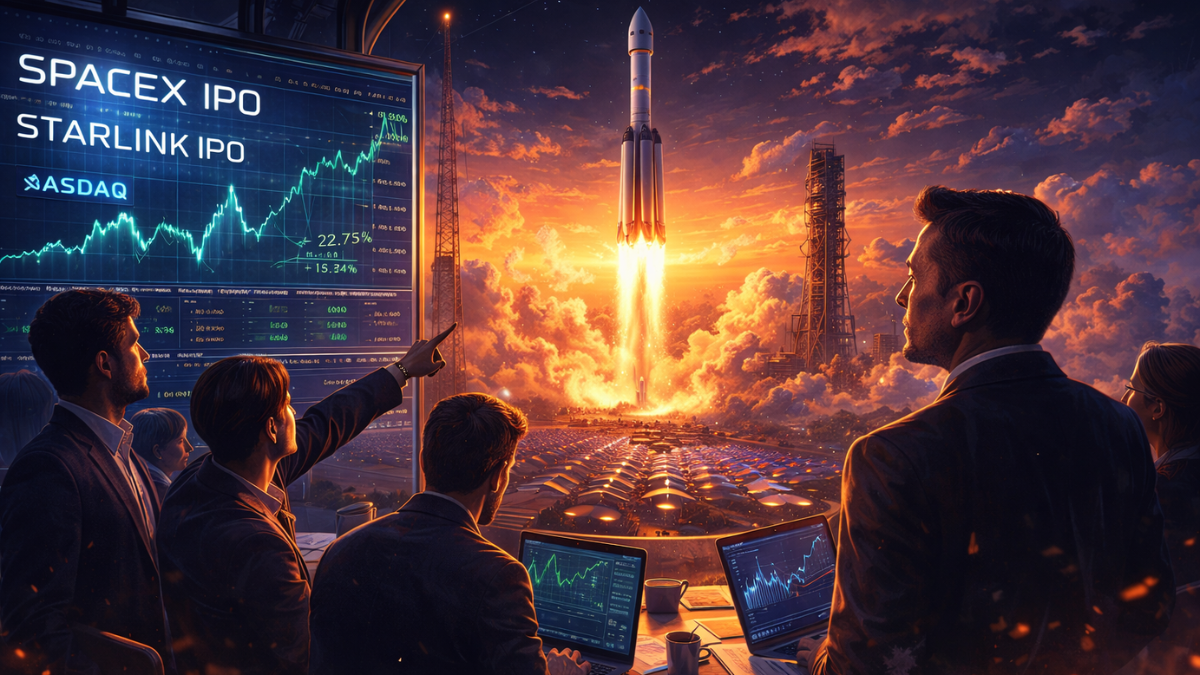
Wall Street hasn’t felt this jittery since the dot-com boom. By April 2026, the phrase SpaceX IPO isn’t just a headline; it is an obsession for every fund manager from Midtown to Menlo Park. After a decade of “will-he-or-won’t-he” speculation that felt more like a soap opera than a financial forecast, Elon Musk appears ready to do the unthinkable: unbundle Starlink from the SpaceX mother ship and take it public.
For years, SpaceX operated as a fortress of private exploration—a black box of innovation where failures were spectacular fireballs and successes were historic leaps for mankind. But as we move through the second quarter of 2026, the narrative has shifted from exploration to infrastructure. Starlink, which began as a “crazy” side project to fund Mars, has matured into a global utility with a stranglehold on orbital connectivity.
With analysts whispering about a valuation north of $250 billion, this isn’t just another stock market debut. It is a seismic pivot in the “Unicorn Blueprint.” This deep dive explores the strategic mechanics behind the unbundling, the cold mathematics of colonization, and why the 2026 market has created the perfect high-stakes moment for the largest public offering in history.
Why the SpaceX IPO Timing Hits the 2026 Inflection Point
In the high-stakes game of venture scaling, timing isn’t just a factor—it’s the only factor. Five years ago, a SpaceX IPO would have looked like a “hail mary” pass to stay solvent. Today, it is a victory lap. The U.S. market in 2026 is finally finding its footing after the “Great Correction” of the mid-2020s. Investors have officially soured on speculative software plays that burn cash to buy users.
Instead, the smart money is moving toward “Hard Tech”—physical infrastructure that is essential, defensible, and generates massive, predictable cash flow. Starlink is the poster child for this shift. By separating the internet service provider from the rocket manufacturer, Musk is giving the market a high-margin utility business while keeping the high-risk, “explosion-prone” R&D of deep space travel behind closed doors.
The Shift from “Growth” to “Utility”
In 2026, the Fed has finally stabilized interest rates after a four-year rollercoaster. This predictability makes the cost of capital for a massive satellite constellation finally trackable. For the first time, an institutional investor can look at Starlink’s churn rate and subscriber acquisition cost (SAC) without the “noise” of a rocket test flight clouding the balance sheet.
According to data from McKinsey & Company, the SpaceX IPO arrives just as we approach the threshold of the projected $1 trillion space economy by 2030.
[Read more on Johny Millionaire: It Takes to Build a $1B Company in America Today]
The Math of Mars: How Starlink Funds the Starship Vision
To truly grasp the motivations behind the SpaceX IPO, you have to accept one uncomfortable truth: for Elon Musk, money is merely a fuel source for a much larger engine. That engine is headed to Mars.
Think of Starlink as Musk’s personal printing press. Every suburban dish installed in the Midwest and every maritime terminal activated in the Atlantic is a micro-investment into the first city on the Red Planet. The Starship program is a capital-intensive beast. Maintaining a fleet of reusable mega-rockets and building Martian life-support systems requires tens of billions of dollars in annual liquidity—money that private venture rounds can no longer provide at scale.
Turning Orbits into Reliable Cash Flow
By 2026, Starlink has moved beyond “rural internet.” It has captured the lion’s share of the global aviation and maritime markets.
- The High-Margin Trap: Once a satellite is in orbit, the marginal cost of adding a new subscriber is nearly zero. This creates a “software-like” margin on a hardware-based business.
- The Starshield Monopoly: The “Starshield” variant, built specifically for government and military use, has secured multi-year contracts under the “2025 Artemis Connectivity Accord,” providing a floor of revenue that public markets find irresistible.
- Dividend Potential: Analysts expect a public Starlink to eventually offer dividends, a rarity in the Musk world, to attract “widow and orphan” funds seeking stable yields.
By taking Starlink public, Musk unlocks the equity value of this utility to provide the “Mars Fund” with a permanent war chest. It ensures that even if a recession hits Earth, the development of Starship never runs out of oxygen.
Financial Forensics: Explaining the $250B Valuation
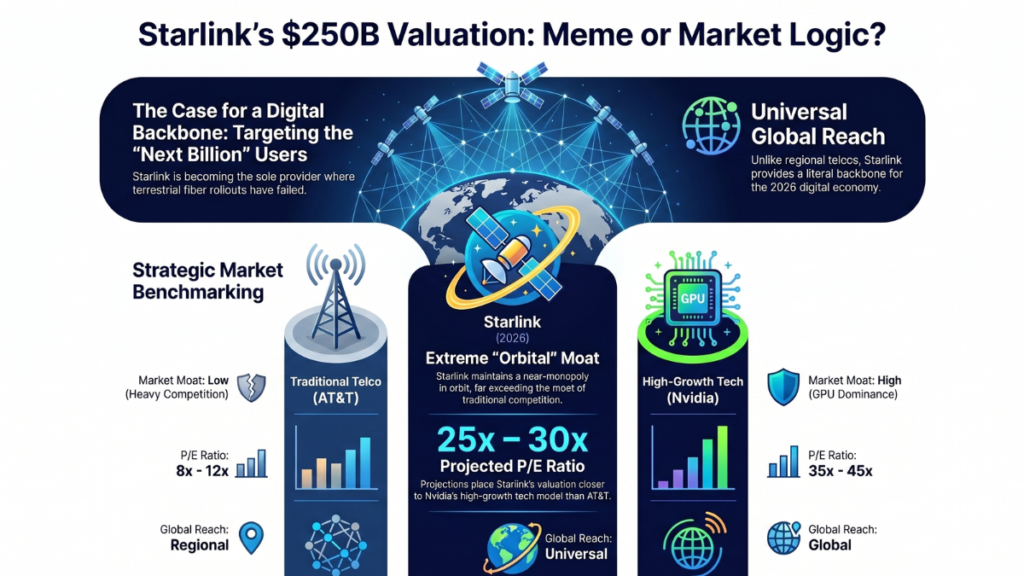
Critics often argue that $250 billion is a “meme valuation.” However, when you run the numbers against 2026 benchmarks, the logic holds up. To understand this, we have to look at the Projected P/E (Price-to-Earnings) ratios.
| Metric | Traditional Telco (AT&T) | High-Growth Tech (Nvidia) | Starlink (Projected 2026) |
| Market Moat | Low (Heavy Competition) | High (GPU Dominance) | Extreme (Orbital Monopoly) |
| P/E Ratio | 8x – 12x | 35x – 45x | 25x – 30x |
| Global Reach | Regional | Global | Universal |
Starlink isn’t being valued as a “phone company.” It’s being valued as the literal backbone of the 2026 digital economy. With the recent failure of terrestrial fiber rollouts in developing nations, Starlink has become the only provider for the “next billion” internet users.
Unbundling the Empire: The Strategic “Why”
In traditional business journalism, “unbundling” is often a polite word for a company in retreat. For SpaceX, it is an aggressive expansion strategy. When a conglomerate becomes too large, its most successful parts often get “lost” in the consolidated balance sheet—a phenomenon known as the “Conglomerate Discount.”
By spinning off Starlink, Musk achieves three critical objectives:
- Pure Play Valuation: Investors can buy into a satellite internet company without worrying about a rocket exploding on a distant launchpad. This allows for a higher valuation multiple.
- The Talent War: It allows SpaceX to offer liquid stock options in a public Starlink to its best engineers. In 2026, with Blue Origin and Amazon’s Project Kuiper poaching talent, having a “liquid” stock is a massive retention tool.
- Regulatory Shielding: Separating the utility (Starlink) from the manufacturer (SpaceX) may help navigate the increasingly complex FAA’s Commercial Space Transportation regulations that have tightened since the mid-2020s.
The Competitor Landscape: Starlink vs. Amazon’s Project Kuiper
It would be a mistake to assume Musk has the heavens to himself. Amazon’s Project Kuiper has finally reached “Initial Operating Capability” in early 2026. However, the “moat” Starlink has dug is wider than many realize.
While Jeff Bezos has the capital, Musk has the “Vertical Advantage.” Because SpaceX owns the rockets, Starlink’s launch costs are internal transfer prices—essentially at cost. Amazon, even with Blue Origin, must pay market rates for many of its launches. In 2026, Starlink’s “Direct-to-Cell” technology is already in its second generation, while Kuiper is still struggling with dish-based latency issues. This head start is worth at least $50 billion in market cap.
The “X” Ecosystem: Synergy Across Tesla, X, and X.ai
While the SpaceX IPO suggests a separation, the reality of the Musk empire is one of deep, invisible integration. We call this the “X” Ecosystem—a triangular data fly-wheel that makes Starlink more valuable than any other ISP.
- Tesla: Uses Starlink for real-time fleet connectivity. In 2026, Tesla’s “Robotaxi” network relies on Starlink’s low-latency satellites to navigate rural and “dead-zone” areas where 5G fails.
- X (formerly Twitter): Serves as the primary customer service and distribution arm. In 2026, X premium subscribers get “Starlink Mini” data packages as part of their subscription.
- X.ai (Grok): The massive data sets from Starlink’s global network—monitoring everything from weather patterns to maritime traffic—provide the raw training data that makes Grok the most “geospatially aware” AI on the market.
If you own Starlink stock, you aren’t just betting on internet; you are betting on the connectivity layer of a unified, AI-driven future.
Controversial Opinion: Does Unbundling Weaken the Mission?
While Wall Street loves the spin-off, some space purists argue that unbundling Starlink is a strategic error. Historically, the “profitable” side of SpaceX (Starlink) acted as a shield for the “exploratory” side (Starship). By making Starlink a public company, Musk subjects it to the whims of quarterly earnings reports.
If Starlink has a bad quarter, will public shareholders be okay with billions of dollars in “inter-company service agreements” flowing back to a private SpaceX? The potential for shareholder lawsuits in 2027 and 2028 is high. Musk is essentially betting that he can maintain “Super-Voting” control to keep his Martian dreams alive.
The Retail Investor Perspective: How to Prepare for the Launch
For the average investor, the SpaceX IPO feels like a “once-in-a-generation” opportunity. But how do you actually participate without getting crushed by the “Musk Premium”?
- Watch the S-1 Filing: Pay close attention to the “Risk Factors” section. Look for how much control Musk retains and the specific terms of the SpaceX-Starlink service contracts.
- The “Post-Hype” Dip: History shows that Musk-related assets often see a massive surge on day one, followed by a “reality check” correction 90 days later once the initial excitement wears off.
- Brokerage Access: In 2026, several fintech platforms have already started “Pre-IPO” pools for retail investors. Use these with caution, as the fees often eat into the potential gains.
Key Takeaways for the Strategic Investor
- Liquidity Over Growth: The IPO is a tactical move to fund Mars, not a sign that Starlink has hit its ceiling.
- Hard Tech is the New SaaS: Orbital infrastructure is the highest-moat business model of the 2020s.
- Founder Risk is Real: You are investing in Elon Musk’s brain as much as you are in satellite hardware.
- Ecosystem Play: The value of Starlink is multiplied by its data-sharing with Tesla and X.ai.
FAQ: The SpaceX IPO & Starlink Spin-off
1. Can I buy SpaceX stock right now?
As of April 2026, SpaceX remains private. You can only gain exposure through secondary markets like EquityZen or Forge Global, but these require “Accredited Investor” status and often carry high minimums.
2. What will the ticker symbol be for Starlink?
The leading rumors suggest $SLNK for the internet arm, while $SPX is being reserved for the parent company if it ever decides to follow suit.
3. Will the IPO funds go directly to the Mars mission?
Indirectly, yes. While the capital raised goes to the Starlink balance sheet, it allows Starlink to pay SpaceX for launch services at a rate that funds the ongoing development of the Starship fleet.
4. Is Starlink’s “Direct-to-Cell” technology ready?
Yes. In early 2026, Starlink successfully completed its rollout with major U.S. carriers, effectively ending “dead zones” for any smartphone with a clear view of the sky.
Conclusion: The Final Frontier of Finance
The SpaceX IPO is the formal graduation of the “New Space” economy. It marks the moment space stopped being a playground for billionaires and started being a cornerstone of a modern investment portfolio. By unbundling Starlink, Musk is attempting the ultimate balancing act: keeping the public markets happy with consistent profits while using those profits to buy a ticket to another planet.
The 2026 market will remember this year as the moment the sky was no longer a limit, but a line item. Whether you believe in the Mars mission or not, Starlink’s dominance of the orbital “high ground” is an economic reality that can no longer be ignored.
Are you ready to own a piece of the stars, or is the “Musk Premium” a risk too far for your portfolio? The countdown has officially begun. Subscribe to the Johny Millionaire Newsletter for real-time IPO alerts and deep-dive analysis.


[…] Read more on Johny Millionaire: The SpaceX IPO Fever: Why Musk is Finally Preparing to Unbundle His Starlink Empire […]
[…] Read More: Why Musk is Finally Preparing to Unbundle His Starlink Empire […]
[…] Read More: The SpaceX IPO Fever: Why Musk is Finally Preparing to Unbundle His Starlink Empire […]