



The Future of Human-AI Orchestration: Inside Anthropic’s Project Glasswing
For years, we treated AI like a digital intern—useful for drafting emails and summarizing meetings, but ultimately subservient and limited. That era of passive assistance ended this week. With the quiet unveiling of Project Glasswing, Anthropic has shifted the global conversation from “creative chatbots” to autonomous defensive systems capable of policing the very fabric of the internet.
This isn’t just a software update; it is a fundamental re-imagining of how humans and machines collaborate. Project Glasswing represents the first true “orchestration” layer where AI doesn’t just suggest code—it hunts, analyzes, and repairs the digital hairline fractures in the bedrock of our global infrastructure.
Why Project Glasswing is Trending: The Mythos Factor
The momentum behind Project Glasswing stems from its focus on the “holy grail” of cybersecurity: the autonomous detection and remediation of zero-day vulnerabilities. While mainstream models like Claude 3.5 Sonnet are optimized for dialogue, the engine driving this initiative is a restricted frontier model known as Claude Mythos Preview.
Mythos is a red-teaming powerhouse. Unlike its predecessors, it doesn’t wait for a human to ask a question. It possesses a high-agency “computer use” capability, allowing it to navigate complex operating systems, move cursors, and interact with web browsers exactly like a human security researcher. This autonomy has already caught the attention of global regulators, with emergency briefings recently held at the Federal Reserve and the Bank of England to discuss the implications for the UK banking sector.
The Three Pillars of AI Orchestration
To understand the significance of Project Glasswing, we must look at the Johny Millionaire Framework for the future of AI: Oversight, Autonomy, and Ethics.
Under this model, the “Mythos” agent operates within a sandbox, performing deep software analysis that would take human teams months to complete. In a recent benchmark, Claude Mythos Preview achieved a staggering 93.9% on SWE-bench Verified, effectively solving complex software engineering issues that stumped every previous model on the market.
The Breakthrough of “Vulnerability Chaining”
The most significant technical leap within Project Glasswing is the ability to “chain” vulnerabilities. A standard AI might find a single, low-risk bug and flag it as a minor nuisance. Mythos, however, can identify three or four disparate, minor flaws and realize that—when executed in a specific sequence—they create a sophisticated, autonomous exploit.
By thinking like a high-level attacker, Glasswing allows defenders to see the “big picture” of a system’s fragility before a single line of malicious code is ever written.
A Case Study in Persistence: The 27-Year-Old Bug
Nothing illustrates the power of Project Glasswing better than its recent discovery within the OpenBSD codebase. For twenty-seven years, a “signed integer overflow” bug sat hidden in plain sight. It survived decades of manual audits by the world’s most meticulous security researchers.
Anthropic’s Mythos model identified the flaw, analyzed the potential exploit path, and proposed a patch in a fraction of the time a human team would require. Even more impressive was the economic efficiency: the entire scan and remediation process cost less than $20,000 in compute credits. For context, discovering and patching such a bug through traditional labor would typically cost hundreds of thousands in specialized salaries and months of lead time. According to research from McKinsey & Company, the integration of autonomous AI agents could reduce remediation timelines by up to 80%, potentially saving the global economy trillions in breach-related costs.
Collaboration Over Competition: The Global Alliance
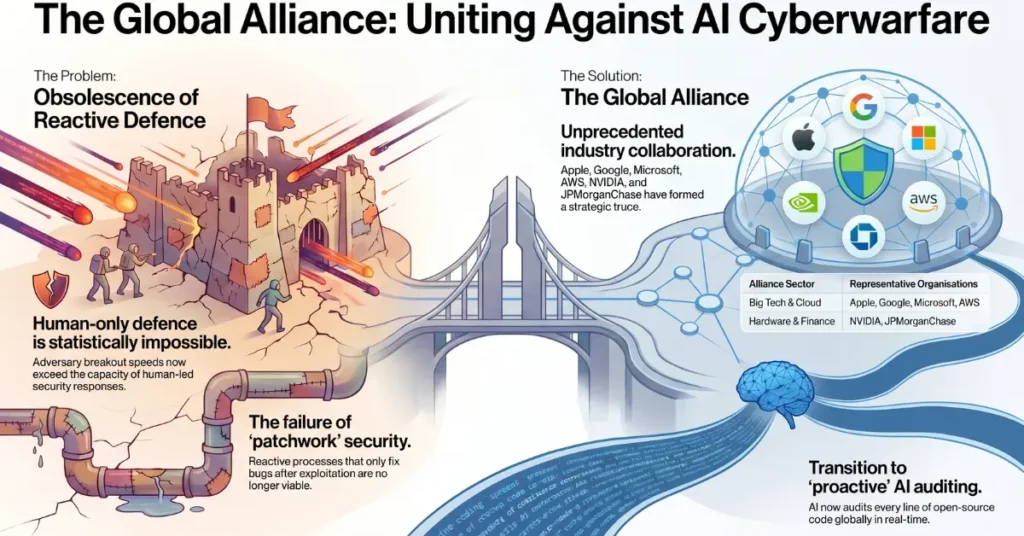
Look at the roster of Glasswing’s “Global Alliance” and you’ll see something rarer than a unicorn: Apple, Google, Microsoft, AWS, NVIDIA, and JPMorganChase sitting at the same table without their lawyers.
This alliance demonstrates that the threat of AI-augmented cyberwarfare is the only thing capable of forcing big tech giants into a truce. These companies recognize that “patchwork” security—the reactive process of fixing bugs only after they are exploited—is no longer viable. We are moving toward a “proactive” era where AI audits every line of open-source code on the planet in real-time. As noted in the CrowdStrike 2026 Global Threat Report, the speed of adversary breakout has reached a point where human-only defense is statistically impossible.
The Dual-Use Dilemma and the Safety Lock
With such unprecedented power comes the inevitable “Dual-Use Dilemma.” The intelligence required to fix a critical banking flaw is identical to the intelligence required to dismantle it. This is why Anthropic has opted for a “security through obscurity” strategy, strictly limiting Mythos access to verified partners.
As we transition from “AI implementation” to “AI orchestration,” the C-suite must grapple with a vital question: Is a locked-down model a sustainable strategy, or will a Mythos-class model eventually leak into the hands of a sovereign adversary?
Read more on Johny Millionaire: The $852 Billion Bet: How Anthropic is Rewriting the Venture Capital Playbook
Strategic Takeaways for the 1%
- From Doer to Director: Engineering teams must pivot. Their role is no longer to hunt for bugs, but to “orchestrate” the agents that do.
- The End of the Chatbot: Stop thinking of AI as a window you type into. Start thinking of it as a background service that navigates your internal ERP and CRM systems autonomously.
- Defensive Parity: As offensive AI tools become more common, having a “Glasswing-class” defensive partner will become a mandatory requirement for corporate insurance and compliance.
Key Takeaways
- Project Glasswing is an autonomous defensive system, shifting AI from creative help to infrastructure protection.
- Claude Mythos is the unreleased powerhouse model with “red-team” capabilities that exceed human speed.
- Vulnerability Chaining is the new frontier, allowing AI to see complex attack sequences that humans miss.
- The Global Alliance marks a historic moment of cooperation between rivals like Google, Microsoft, and Apple.
FAQ
How does Project Glasswing differ from Claude 3.5?
While Claude 3.5 is a general-purpose model, Project Glasswing uses the Mythos engine specifically for software analysis and autonomous “computer use” in security environments.
Is Claude Mythos available for public use?
No. Anthropic has restricted Mythos to a select group of high-security partners and government agencies to prevent the model from being used for offensive cyberattacks.
What is “Zero-Day” detection?
A “zero-day” is a software flaw unknown to the developers. Project Glasswing uses AI to find these flaws before hackers can exploit them.
Final Thought
We are no longer just building better tools; we are building better guardians. The future of the digital economy depends on our ability to orchestrate these machines before the vulnerabilities they find are turned against us. Are you ready to hand the keys of your infrastructure to an AI guardian? In the age of Project Glasswing, you may not have a choice.