


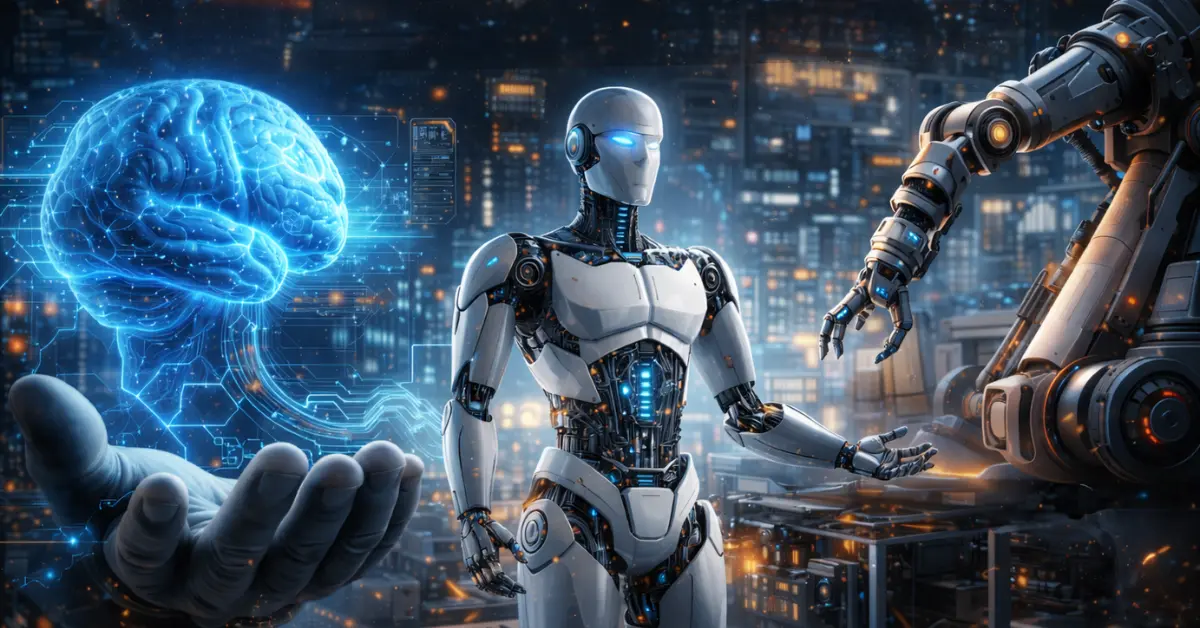
We’ve spent the better part of a decade staring at our MacBooks, watching artificial intelligence master the “digital ether.” We marveled as LLMs learned to write poetry and code, yet for the longest time, the American factory floor remained stuck in a repetitive 1980s loop. While our software was light-years ahead, the physical “body” of AI remained stubbornly primitive—limited to rigid, rule-based arms that failed the moment a single bolt was out of place.
That era officially ended this year. According to the International Federation of Robotics’ “Top 5 Trends for 2026,” we have reached a definitive tipping point: the shift from rule-based automation to Agentic AI. This is the moment the “brain” finally integrated with the “body.” In 2026, AI is no longer just chatting; it is executing in the physical world.
3-Minute Strategy Breakdown
- The Goal: Move from pre-programmed “if-then” logic to goal-oriented autonomy.
- The Metric: ROI is now measured by “dexterity-per-dollar,” not just speed.
- The Risk: Firms ignoring the IT/OT merge face structural obsolescence.
Agentic AI Explained: From “Chatting” to “Executing”
Think of Agentic AI not as a tool you use, but as a digital employee you delegate to. The radical shift here isn’t just speed—it’s judgment. Unlike traditional automation, which requires a human to script every micro-movement, Agentic AI operates with goal-oriented autonomy.
If you told a 2024-era robot to “move a box,” it followed a fixed geometric path. If the box was slightly tilted or an inch to the left, the robot simply crushed it or stopped entirely. Agentic AI, fueled by cognitive robotics, perceives the environment through high-fidelity computer vision and “reasons” through the task. If a box is obstructed, the robot identifies the obstacle, decides to clear it, and recalibrates its grip in real-time. This is the transition from passive processing to active agency.
The IT/OT Merge: Building Self-Evolving Systems
The true catalyst behind this convergence is the aggressive merging of Information Technology (IT) and Operational Technology (OT). Historically, these two worlds were silos—your data lived in the cloud, while your machines lived on the cold concrete of the floor.
In 2026, the factory of the future has finally unified these layers. Through high-speed, low-latency 6G private networks, real-time data exchange is turning assembly lines into self-evolving systems. When an Agentic AI on the floor encounters a new type of packaging, it doesn’t wait for a software update.
It learns the optimal handling technique on the fly and instantly uploads that “knowledge” to the cloud. Within seconds, every other robot in the global fleet possesses that same skill. This isn’t just automation; it is collective machine learning in a physical space.
Read more on Johny Millionaire: The $852 Billion Bet: How Anthropic is Rewriting the Venture Capital Playbook
2026: The “Deployment Year” for Humanoid Reliability
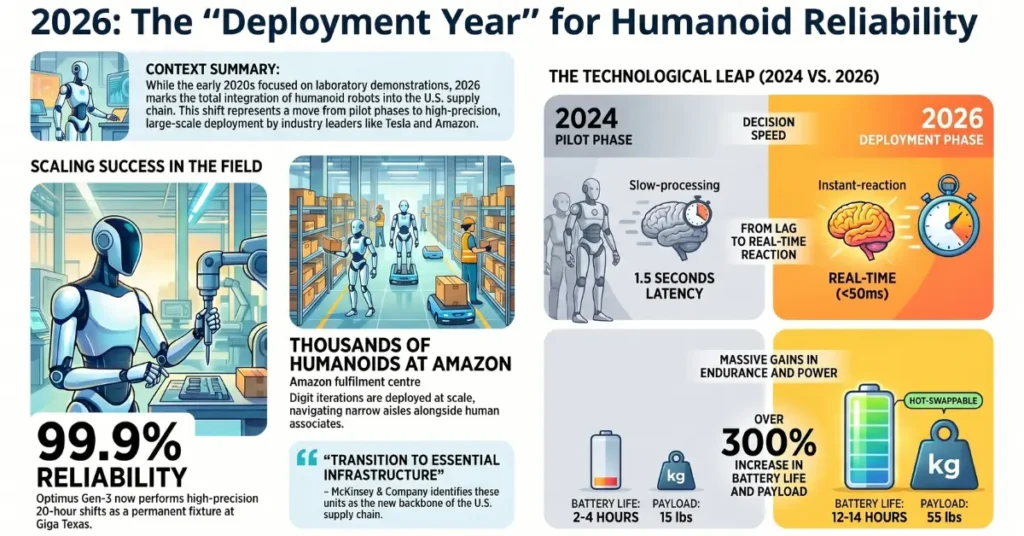
While the early 2020s were defined by impressive lab demos, 2026 is the year of the General Purpose Humanoid (GPH) at scale. Tech giants have moved past the pilot phase into total integration:
- Tesla’s Optimus Gen-3: Now a permanent fixture in Giga Texas. It has evolved from a shuffling prototype to a high-precision worker capable of 20-hour shifts with a 99.9% reliability rate.
- Amazon’s Sequoia Expansion: Thousands of “Digit” iterations now navigate narrow aisles, working alongside human associates.
| Feature | 2024 Pilot Phase | 2026 Deployment Phase |
| Battery Life | 2-4 Hours | 12-14 Hours (Hot-swappable) |
| Payload | 15 lbs | 55 lbs |
| Decision Speed | 1.5 seconds latency | Real-time (<50ms) |
According to a recent report from McKinsey & Company, these units have finally crossed the threshold of “essential infrastructure.” They are no longer experiments; they are the backbone of the U.S. supply chain.
Solving the Labor Gap: The ROI of Human-Level Dexterity
The American manufacturing sector has long struggled with a chronic labor shortage. Traditional robotics couldn’t fill the gap because most roles require “human-level dexterity”—the ability to pick up a fragile glass vial and a heavy steel wrench with the same hand.
Agentic AI has solved the “End-Effector” problem. By utilizing tactile sensing and generative design for robotic hands, machines can now perform delicate assembly tasks previously reserved for human fingers. The ROI is no longer a boardroom debate. With labor costs rising and the price of humanoid units dropping below $30,000, the payback period for an AI-integrated robot is now less than 18 months.
Read more on Johny Millionaire: The Biotech Boom: Why 2026 is the Year of the Healthcare Unicorn
The “Millionaire Physicality Scale”: A Strategy for Leaders
For the modern entrepreneur, the lesson of 2026 is clear: the competitive advantage has shifted from those who have the best code to those who can most effectively apply that code to the physical world.
As noted by Harvard Business Review, the “physicality” of AI is the next frontier of digital transformation. However, we are seeing an “Artisanal Resistance”—luxury sectors like high-end watchmaking and bespoke furniture that are rejecting humanoids to preserve “human-made” value. As a leader, you must decide where your brand sits on the Physicality Scale: total automation for scale, or human-centric for prestige.
Key Takeaways
- Autonomy > Automation: Don’t buy machines that need a script; invest in agents that can reason.
- Kill the Silos: If your IT and OT departments aren’t sharing a single data lake, you are losing money.
- Focus on Dexterity: The highest ROI in 2026 lies in automating the “messy” tasks, not the easy ones.
FAQs
1. How does Agentic AI differ from the AI in my phone?
Your phone’s AI (Generative) creates content. Agentic AI uses that same “intelligence” to interact with physical objects, making real-time decisions in a three-dimensional space.
2. Is this technology affordable for mid-sized businesses?
Yes. The “Robot-as-a-Service” (RaaS) model has matured, allowing firms to lease humanoid fleets for a monthly fee that is often lower than a standard entry-level salary.
3. What happens to the human workers?
We are seeing a massive shift toward “Supervisor” roles. Humans are no longer doing the lifting; they are managing the “agentic flows” and performing high-level maintenance.
Conclusion
The convergence of the AI “brain” and the robotic “body” represents a seismic shift in how wealth is created. We have moved from the era of digital assistance to the era of physical agency. In 2026, the winners won’t just be the ones with the smartest Agentic AI code, but the ones who had the courage to put that code to work on the factory floor.
The future isn’t just coming—it’s already walking, lifting, and building.


[…] Read more on Johny Millionaire: Agentic AI & The Robotics Convergence: Why 2026 is the Year the “Brain” Met the R… […]