


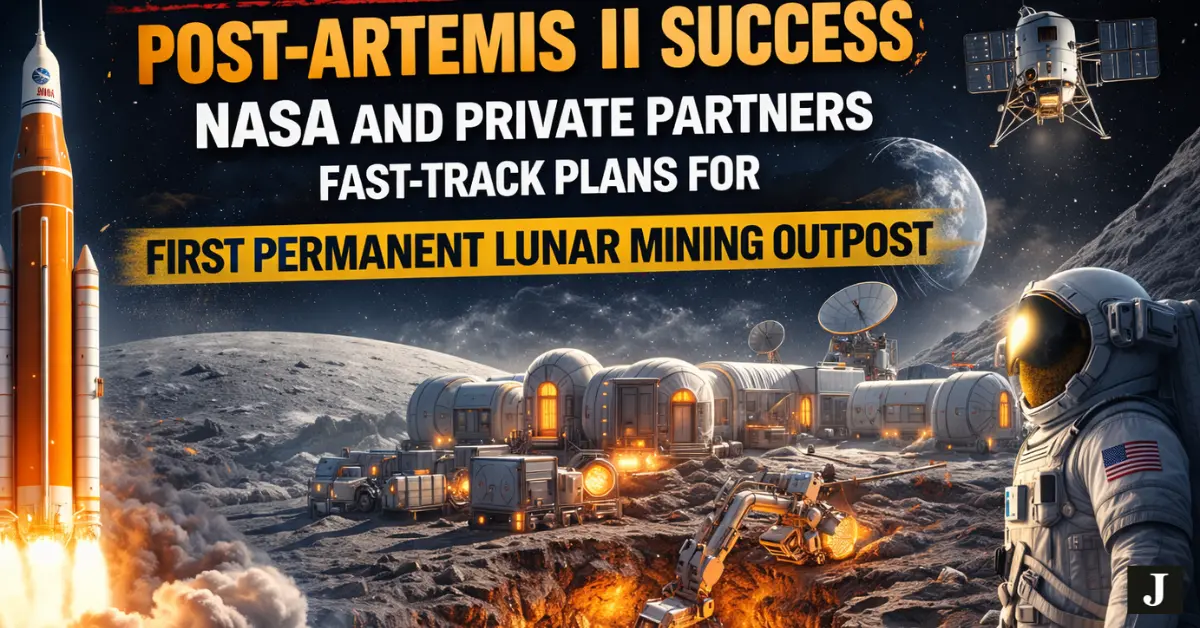
The successful splashdown of the Artemis II mission has done more than just prove human flight capability to the moon’s vicinity; it has fired the starting gun for a multi-billion dollar extraterrestrial economy. Emboldened by the mission’s flawless execution, NASA and its private partners are fast-tracking plans for the first permanent lunar mining outpost, shifting the lunar narrative from scientific exploration to industrial utilization.
The consortium, which includes aerospace titans and specialized startups, aims to establish a foothold at the lunar South Pole by 2028. The primary objective is the extraction of water ice and Regolith-hosted volatiles. These resources are critical for “in-situ resource utilization” (ISRU), a process that converts lunar ice into liquid hydrogen and oxygen to fuel deep-space missions. By eliminating the prohibitive cost of launching fuel from Earth’s gravity well, this permanent lunar mining outpost serves as the essential “gas station” for the future of Mars exploration.
For the private sector, the business case is maturing rapidly. Companies like Intuitive Machines and Blue Origin are no longer just contractors; they are stakeholders in a new asset class. The “Lunar Gold Rush” is driven by the demand for Rare Earth Elements (REEs) and Helium-3, a potential fuel for future fusion reactors. According to the latest strategic outlook from NASA, the integration of commercial robotics and autonomous drilling technologies is expected to reduce operational overhead by 40% compared to previous estimates.
However, the rapid acceleration of these plans raises complex legal and regulatory questions. The Outer Space Treaty remains the foundational framework, but the 2026 commercial reality is testing its limits. Investors are keeping a close watch on how the U.S. and its Artemis Accords signatories define property rights for extracted materials.
This pivot toward a permanent industrial presence signals that the moon is no longer a destination, but a domain. As private capital pours into lunar logistics, the transition from government-led sorties to a self-sustaining lunar economy appears not only possible but inevitable. The moon is officially open for business, and the first outpost will likely dictate the trade routes of the 21st century.
Read More: Defense Tech 2.0: The Rise of Autonomous Systems in the U.S.-Iran Conflict