


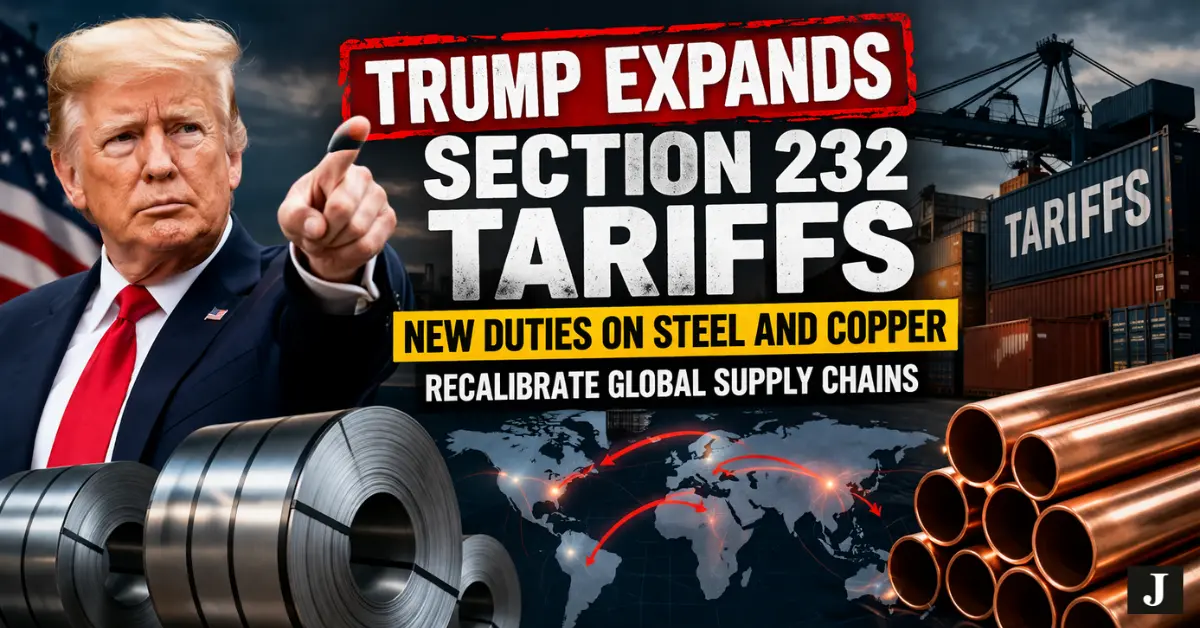
In a move that has sent tremors through global commodities markets, the White House announced a significant expansion of Section 232 tariffs today, targeting imported steel and, for the first time, industrial copper. Citing national security concerns and the need to bolster domestic smelting capacity, the administration’s executive order effectively recalibrates the cost-benefit analysis for thousands of American manufacturers.
The new trade barriers come at a volatile time for the industrial sector. While the 2018 steel duties primarily focused on raw metal, this 2026 expansion broadens the scope to include specific high-grade alloys and copper derivatives essential for the burgeoning electric vehicle (EV) and renewable energy industries. By invoking Section 232 of the Trade Expansion Act of 1962, the administration bypasses traditional legislative hurdles, asserting that a reliance on foreign copper—much of which is processed in China—threatens the integrity of the U.S. defense industrial base.
For investors, the immediate impact was visible in the divergence of equity markets. Domestic producers like Nucor and United States Steel saw shares climb in early trading, while heavy equipment giants and automotive manufacturers faced downward pressure due to anticipated input cost hikes. Analysts suggest that the inclusion of copper is a strategic pivot; as the “metal of electrification,” copper is vital for everything from data centers to the national power grid.
This policy shift necessitates a massive overhaul of global supply chains. Procurement officers are now scrambling to secure North American sourcing to avoid the new duties, which industry insiders suggest could reach as high as 25%. According to recent trade data from the U.S. Department of Commerce, the U.S. currently imports a substantial portion of its refined copper, making this a high-stakes gamble on domestic “near-shoring” capabilities.
Critics, including several trade advocacy groups, warn that these tariffs may act as a “stealth tax” on consumers, potentially fueling inflationary pressure just as the Fed attempts a soft landing. However, proponents argue that the long-term benefit of a self-sufficient industrial base outweighs short-term price volatility. As documented by the Peterson Institute for International Economics, trade protections of this scale often lead to a rapid, albeit expensive, reorganization of international trade routes.
As the dust settles, the message to the C-suite is clear: the era of friction-less global sourcing is over. Companies must now prioritize supply chain resilience and domestic partnerships over the razor-thin margins provided by offshore suppliers.
Read More: Why Quantum Advantage is No Longer a “Maybe” for 2026