


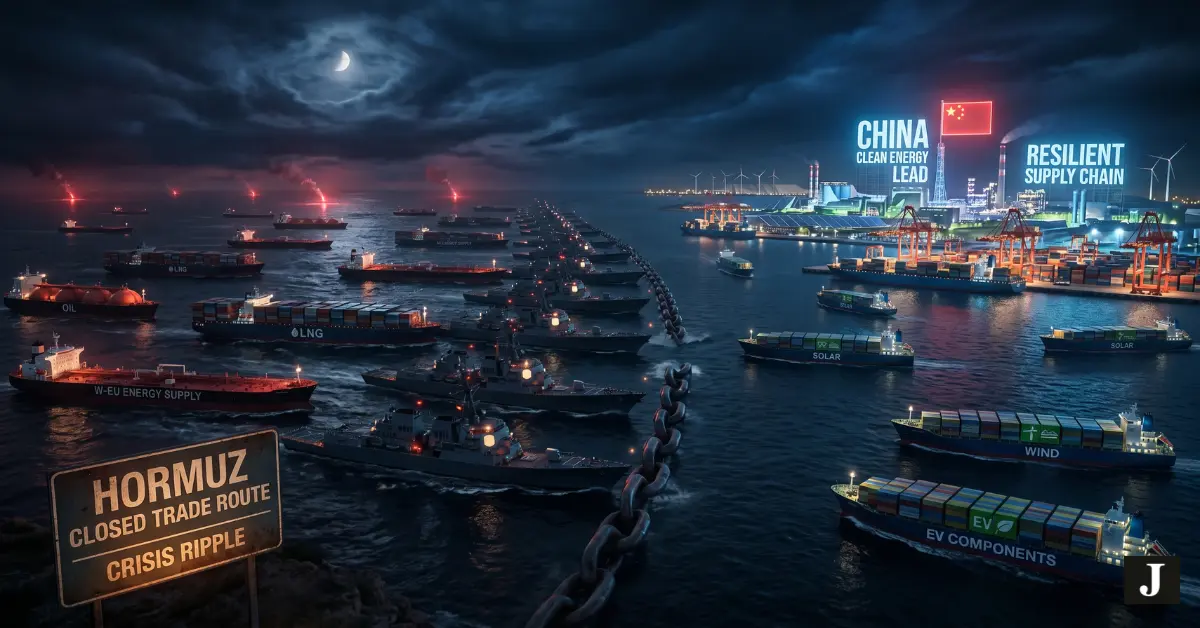
WASHINGTON — As geopolitical instability forces a sustained closure of key maritime corridors, the global economy is witnessing a profound structural shift. The Hormuz Crisis ripple is no longer just an energy pricing issue; it has become a catalyst for a global industrial realignment. While Western economies scramble to secure alternative fossil fuel supplies amidst the bottleneck, China is aggressively capitalizing on the chaos to solidify its dominance over the global clean energy supply chain.
The closure of the Strait of Hormuz has sent Brent Crude prices into a volatile spiral, but the secondary effect is perhaps more damaging to U.S. interests. With traditional oil and gas routes compromised, the “energy transition” has accelerated from a policy goal to a national security imperative. However, because China controls over 80% of the world’s solar supply chain and a vast majority of lithium-ion battery processing, the West’s race toward renewables is inadvertently funneling market share toward Beijing.
For U.S. investors and policymakers, this is a “Sputnik moment” for the 21st century. As shipping rates soar and traditional energy stocks face extreme volatility, China is leveraging its land-based “Belt and Road” infrastructure to bypass the maritime blockades that are currently strangling Western logistics. According to recent trade data from the International Renewable Energy Agency (IRENA), China’s export of wind turbines and EV components to Europe and Asia has spiked by 40% since the onset of the Hormuz Crisis.
This crisis highlights a critical vulnerability in the American “re-shoring” strategy. While the U.S. has made strides in domestic manufacturing via the Department of Energy’s clean energy initiatives, the pace of domestic capacity building cannot yet keep up with the vacuum left by disrupted global trade. The result is a widening gap where China provides the only ready-to-scale solutions for a world desperate to decouple from Middle Eastern oil.
The forward-looking insight for the C-suite is clear: the energy transition is now inseparable from geopolitical strategy. Companies that fail to diversify their component sourcing away from Chinese-controlled trade routes risk trading one form of energy dependence for another.In conclusion, The Hormuz Crisis ripple has exposed the fragility of a transition that relies on a single geopolitical rival. Unless the U.S. and its allies can rapidly establish “friend-shored” mineral processing and manufacturing, the closed trade routes of today will ensure China’s clean energy hegemony for decades to come.
Read More: How Robotics and LLMs are Converging to Automate U.S. Manufacturing