


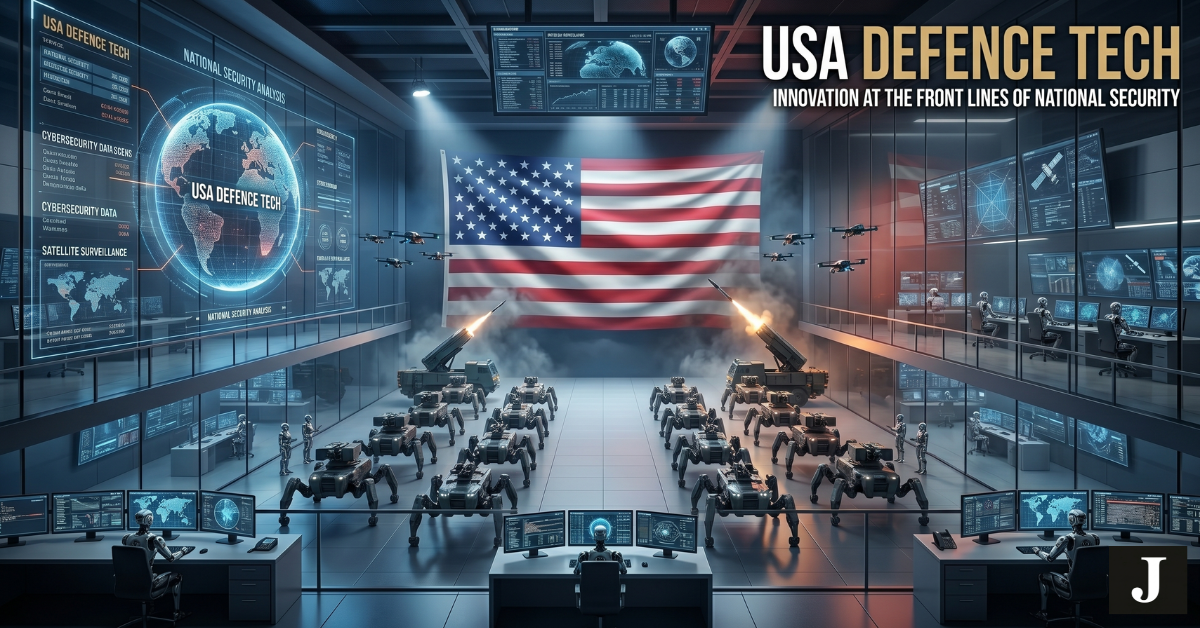
The rules of engagement haven’t just been updated; they’ve been completely overwritten. For decades, the “military-industrial complex” was a slow-moving parade of behemoths like Lockheed Martin and Boeing. It was an industry of sheer mass—multi-billion dollar jets, massive crewed carriers, and kinetic power that relied on human reflexes.
But as we cross the threshold of April 2026, a new chapter is being written in the volatile, salt-sprayed waters of the Middle East. As the U.S.-Iran conflict intensifies, the Persian Gulf has become the crucible for the Strategic Silicon Shield—a profound technological shift where data is more lethal than lead. We are no longer watching the hardware-heavy warfare of the 20th century. We are witnessing the rise of the Silicon Valley of Defense. This is Defense Tech 2.0, and it is defined not by the size of your hull, but by the speed of your silicon.
For the Sand Hill Road crowd, this isn’t just a growth sector; it’s a gold rush with a national security mandate. We’re witnessing the moment the “kill chain” became an “algorithmic chain,” and the financial rewards for those who own the code are virtually unprecedented. Rumors are currently circulating about a secret $2B “Dark Fund” being raised by a top-tier Menlo Park firm, specifically designed to snap up Series B startups specializing in Kinetic AI before they hit the public markets.
This isn’t just a strategic update; it is a total, AI-powered re-platforming of global power.
The Drone Swarm Moat: How Autonomous Tech Changed the Strait of Hormuz
The primary arena for this test of wills is the Strait of Hormuz, a 21-mile-wide jugular vein for the world’s energy supply. In the era of Defense Tech 2.0, controlling this chokepoint isn’t about parking a $13 billion aircraft carrier like the USS Gerald R. Ford in the center of the lane. In fact, a target that large has become an ironic liability—a massive, slow-moving concentration of risk in an age of asymmetric precision.
Controlling Chokepoints with Numbers
The new American defense strategy, validated by frantic operational data coming out of the Gulf, relies on massive, distributed, and intelligent autonomy. Consider the math: a single F-35 fighter costs nearly $100 million. For that same price, the U.S. military can now deploy a swarm of 10,000 AI-powered autonomous drones. These aren’t the consumer-grade quadcopters you see in parks; these are networked, Edge Computing powerhouses.
Startups like Anduril Industries have developed systems that function as a single, distributed consciousness. Using their proprietary Lattice AI platform, Anduril coordinates swarms across air, sea, and sub-surface. If a dozen drones are neutralized by Electronic Warfare (EW), the mesh network instantly heals and re-routes its intelligence. It is a “Drone Swarm Moat” that is virtually impossible to cross because it has no single point of failure.
The Power of “Distributed” Defense
Ask any tactical commander currently stationed in the Persian Gulf, and they’ll tell you the same thing: theory died the moment the first swarm was deployed. Today, sensor-to-shooter integration isn’t a PowerPoint slide; it’s a frantic, millisecond-by-millisecond dance between silicon and steel.
In February 2026, a coordinated harassment attempt by dozens of fast-attack craft was neutralized before a single human sailor even reached their station. The prepositioned maritime swarm detected the thermal signatures, identified the intent via behavioral algorithms, and choreographed a non-lethal electronic disabling of the vessels in under 400 milliseconds. The “asymmetric advantage” has officially shifted to whoever has the best software.
[Read more on Johny Millionaire: https://johnymillionaire.com/nyc-agentic-ai-startup-hub/]
The “SaaSification” of the Pentagon: A New Investment Thesis
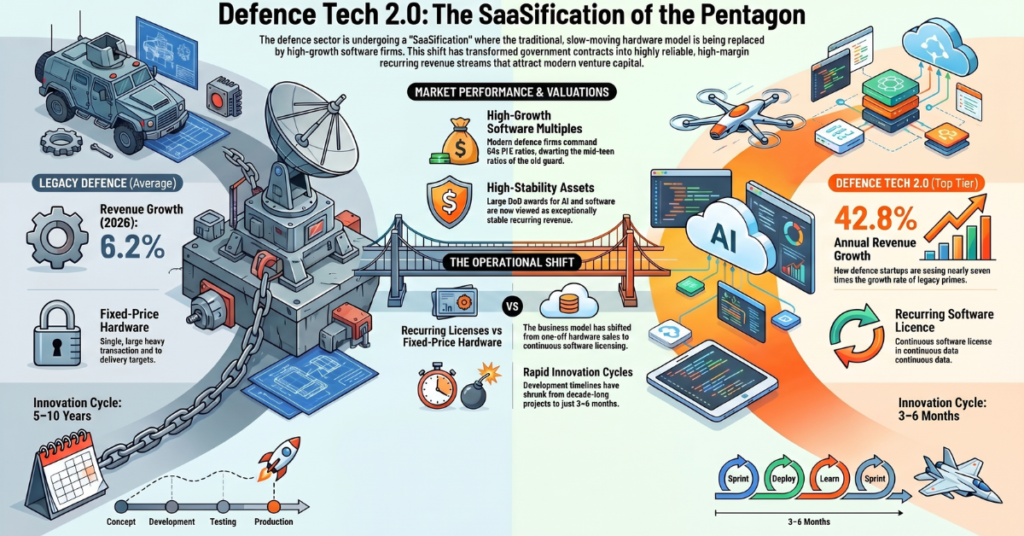
For decades, venture capital stayed away from the Pentagon. The sales cycles were legendary for their length, the “Valley of Death” swallowed startups whole, and the capital expenditures were too high. But the rise of Defense Tech 2.0 has flipped the script, introducing the SaaS model to the art of war.
Comparing the Old Guard vs. The New Silicon
In 2026, the market cap growth of “New Defense” is beginning to dwarf legacy primes. While Lockheed Martin and Northrop Grumman struggle with 5-8% annual revenue growth and P/E ratios in the mid-teens, startups like Palantir and Anduril are seeing 40% YoY growth with multiples that look more like high-growth software firms.
| Metric | Legacy Defense (Average) | Defense Tech 2.0 (Top Tier) |
| Revenue Growth (2026) | 6.2% | 42.8% |
| P/E Ratio (Trailing) | 16x | 64x |
| Contract Type | Fixed-price hardware | Recurring software license |
| Innovation Cycle | 5-10 Years | 3-6 Months |
This “SaaSification” means government contracts are now viewed as highly reliable, high-margin, “recurring revenue.” While a consumer app’s users might churn over a UI change, a $500M award from the DoD for an AI-intelligence layer is as stable as an asset gets.
The VC Surge of 2026
The data is staggering. In Q1 2026, a total of $14.2 billion was invested in Defense Tech venture rounds—a massive 40% increase over the same period in 2025. This isn’t just a trend; it’s a fundamental reallocation of global capital. VCs are betting that the “brains” of these autonomous systems will capture the lion’s share of the $1 trillion global defense market.
Geopolitical Contagion: From the Persian Gulf to the Suez Canal
The U.S.-Iran conflict is the laboratory, but the product is being exported globally. The “Suez Canal & Red Sea Contingency” is the latest example of how Defense Tech 2.0 is being used to secure global trade.
As shipping insurance premiums skyrocketed due to regional instability, a coalition of trade partners began deploying “Autonomous Escort Corridors.” These are essentially AI-governed lanes where drones provide 24/7 protection for commercial tankers. The tech proven in the Strait of Hormuz is now the standard for protecting the 12% of global trade that passes through the Red Sea. For investors, this means the TAM (Total Addressable Market) isn’t just the DoD; it’s every shipping conglomerate and trade bloc on the planet.
[Read more on Johny Millionaire: https://johnymillionaire.com/ai-data-center-real-estate-boom-2026/]
Ethical AI in Warfare: The Algorithmic Chain
As the military success of these systems becomes undeniable, it is forcing an urgent debate over the “Kill Chain.” In 2026, the speed of combat has outpaced human biology. When a swarm of incoming hypersonic missiles is detected, a human brain literally cannot process the information fast enough to respond. The only effective defense is a Kinetic AI system.
The Struggle for Responsible Deployment
This creates a high-stakes strategic imperative. If your adversary uses a “human-out-of-the-loop” model that decides in milliseconds, and you stay with a “human-in-the-loop” model that takes seconds, you are effectively choosing to lose.
Lawmakers in 2026 are struggling to create a framework for “Meaningful Human Oversight.” The policy challenge is documenting how an AI made a target identification. This is why companies that offer “Explainable AI”—algorithms that can show why they chose to fire—are seeing a massive valuation premium. A major study by McKinsey & Company recently highlighted that the “Auditability” of an AI weapon is now a more important feature than its range or speed.
The “Autonomous Attrition” Paradox: A Contrarian View
While the “Drone Swarm” narrative is dominant, the Johny Millionaire perspective requires looking at the hidden costs. There is a rising concern over “Autonomous Attrition.”
While a drone is “cheap” at $10,000, losing 5,000 of them in a single week of high-intensity conflict adds up. Moreover, the logistics of maintaining, charging, and transporting a swarm of 10,000 units creates a different kind of “tail” than a single carrier. The next phase of Defense Tech 2.0 won’t just be about making drones; it will be about the automated factories and AI logistics that can replace them at scale. The real winners may not be the drone makers, but the automated manufacturing platforms that power them.
The IPO Watchlist: 2026’s Most Resilient Sector
The IPO market for 2026 has been a “flight to quality.” Investors are ignoring speculative crypto and overpriced SaaS for assets that can withstand geopolitical turmoil.
The 2026 Defense Watchlist
- Anduril Industries: Rumored Q2 2026 IPO. Their Lattice platform is the “Windows” of autonomous warfare. Current valuation whispers suggest a $50B+ debut.
- HawkEye 360: Specializing in space-based RF analytics. They are the ones who “see” through Electronic Warfare.
- Shield AI: The leader in “AI Pilots.” Their Hivemind software allows jets to fly and fight autonomously in GPS-denied environments.
- Epirus: Focused on Directed Energy. Their systems are the “Anti-Drone” cure, using high-power microwaves to fry swarms.
This is a fundamental shift. Investors are looking for companies with stable revenues, powerful IP moats, and a market mandated by national survival.
KEY TAKEAWAYS
- The Moat is Data, Not Steel: In Defense Tech 2.0, the winner is whoever has the best sensor fusion and decision-making algorithms. The hardware is increasingly a commodity.
- Defense is the New SaaS: Government contracts are providing the most stable, high-margin recurring revenue in the 2026 market.
- The “Strategic Silicon Shield”: National security is being re-platformed. The future belongs to distributed, intelligent, and autonomous systems that can out-think the enemy.
- Manufacturing is the Secret Alpha: As drone attrition rises, the companies that can automate the production of these systems will capture the second wave of value.
FAQs
Q: What exactly is Defense Tech 2.0?
A: It is the shift from hardware-centric defense (tanks, ships) to software-centric defense (AI, mesh networks, autonomous swarms). It emphasizes speed of data over sheer kinetic mass.
Q: Is “Kinetic AI” legal under international law?
A: It is the subject of intense debate. Current U.S. policy requires a “human-in-the-loop,” but the speed of 2026 combat is pushing systems toward “human-on-the-loop,” where AI acts and humans can intervene, but aren’t the primary bottleneck.
Q: Why is this sector considered “resilient” for investors?
A: Because its primary customer—the government—has an infinite mandate to spend on survival. Unlike consumer tech, defense spending is rarely “optional” during times of conflict, making it a powerful hedge against recession.
Q: What is the “Strategic Silicon Shield”?
A: It is a Johny Millionaire concept describing the layer of autonomous and electronic defense systems that protect trade and territory without the need for massive, localized human presence.
Q: How does Electronic Warfare (EW) affect autonomous systems?
A: EW is the primary counter-measure. It attempts to “jam” the signals of drones. This is why Edge Computing—where the drone thinks for itself without needing a constant signal from home—is the most critical technology in 2026.
CONCLUSION
The U.S.-Iran conflict is a tragedy, but it is also a technological milestone. We are watching the sunset of the 20th-century military-industrial complex and the sunrise of an era where code is the ultimate deterrent. Defense Tech 2.0 has arrived, and it has already proven its tactical advantage in the most volatile corridors of global trade.
For the strategic investor, the shift offers a rare alignment of geopolitical necessity and financial stability. The Silicon Valley of Defense has been validated. Modern warfare is no longer a contest of sheer force; it is an algorithmic arms race. In this new era, the strongest moat isn’t made of concrete. It is made of intelligent, distributed, and adaptive data. The future is autonomous, and for those positioned correctly, the rewards will be as enduring as the peace these systems are designed to keep.
The code has been called to the front lines. Are you invested in the outcome?


[…] Read More: Defense Tech 2.0: The Rise of Autonomous Systems in the U.S.-Iran Conflict […]